WebMCP and AI SEO: Will Agent-Ready Websites Rank Better?
Short answer: not automatically.
WebMCP can make a website easier for AI agents to understand and act on, but it should not be treated as a shortcut to higher Google rankings. The better way to think about it is this: agent-ready websites may become more useful in AI-assisted discovery, comparison, shopping, onboarding, and support flows. If that usefulness creates clearer content, stronger structure, better task completion, and more trustworthy experiences, it can support the same quality signals that already matter in search and AI answer systems.
That distinction matters. Teams that add an agent interface only to chase a ranking bump will probably create another brittle SEO tactic. Teams that use WebMCP to make their site easier for both humans and AI agents to use may build a durable advantage.
This guide explains where WebMCP fits in the AI SEO stack, what it could change, what it probably will not change, and how marketing and product teams should prepare without overpromising the impact.
What WebMCP Means for Website Teams
Model Context Protocol, or MCP, is an open protocol for connecting language model applications to external data sources and tools. The official MCP specification says it gives applications a standardized way to share context, expose tools, and build composable workflows with AI systems. MCP servers can expose resources, prompts, and tools, while clients and hosts decide how those capabilities are presented and controlled.
WebMCP applies that same idea to the public website surface. Instead of expecting an AI agent to infer every possible action from messy HTML, JavaScript, forms, buttons, navigation, and modal states, a website can expose a clearer action layer. A research paper introducing webMCP describes it as a client-side standard for embedding structured interaction metadata into web pages so agents can map page elements to user actions more efficiently.
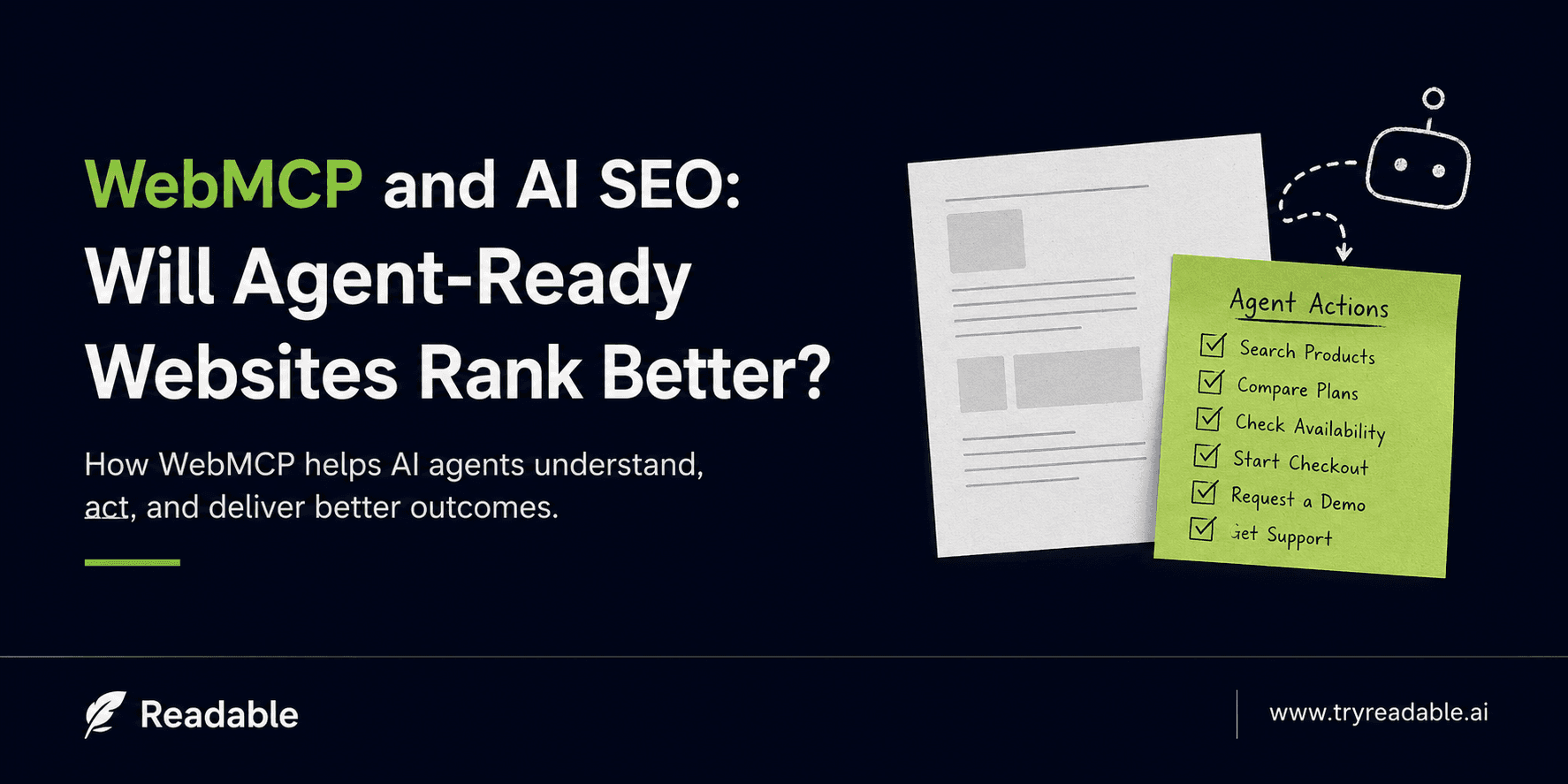
For a website team, that means the agent can move from guessing to reading an explicit capability map. It may be able to understand actions such as:
- Search products or content.
- Compare plans.
- Check availability.
- Start a checkout.
- Request a demo.
- Create a support ticket.
- Download a report.
- Fetch a policy or spec.
That is not the same thing as a sitemap, schema markup, or an API. It is closer to an agent-facing action contract for the live website experience.
If you want the broader foundation before this SEO angle, start with our pillar guide to WebMCP implementation and our primer on how LLMs discover Model Context Protocol.
The Ranking Question: Direct Signal or Indirect Advantage?
The question most teams ask first is simple: will adding WebMCP make us rank better?
Based on current public guidance, there is no reason to assume WebMCP is a direct Google ranking factor. Google Search Central continues to emphasize helpful, reliable, people-first content, page experience, crawlability, and clear technical SEO. Google also says AI Overviews and AI Mode can use query fan-out, issuing multiple related searches across subtopics and sources to build AI-powered responses with supporting links.
That points to a practical conclusion. WebMCP is unlikely to work like a magic ranking tag. It is more likely to help in indirect ways when it improves the site signals and usefulness that AI systems already need.
The useful question is not “Does WebMCP boost rankings?” The useful question is “Does WebMCP help an AI system understand what our site does, when to use us, and how to complete a task with confidence?”
If the answer is yes, WebMCP can support AI SEO by strengthening your site’s actionability layer.
How WebMCP Could Help AI Visibility
AI search is not only about pages being indexed. It is also about whether AI systems can confidently describe, compare, recommend, and use a business in context.
For many websites, the gap is not just missing content. The gap is that the site does not expose its real capabilities in a machine-readable way. A human can eventually figure out where the pricing page is, how the configurator works, what the return policy says, and which form starts the right workflow. An AI agent may have to infer all of that from incomplete markup and changing UI states.
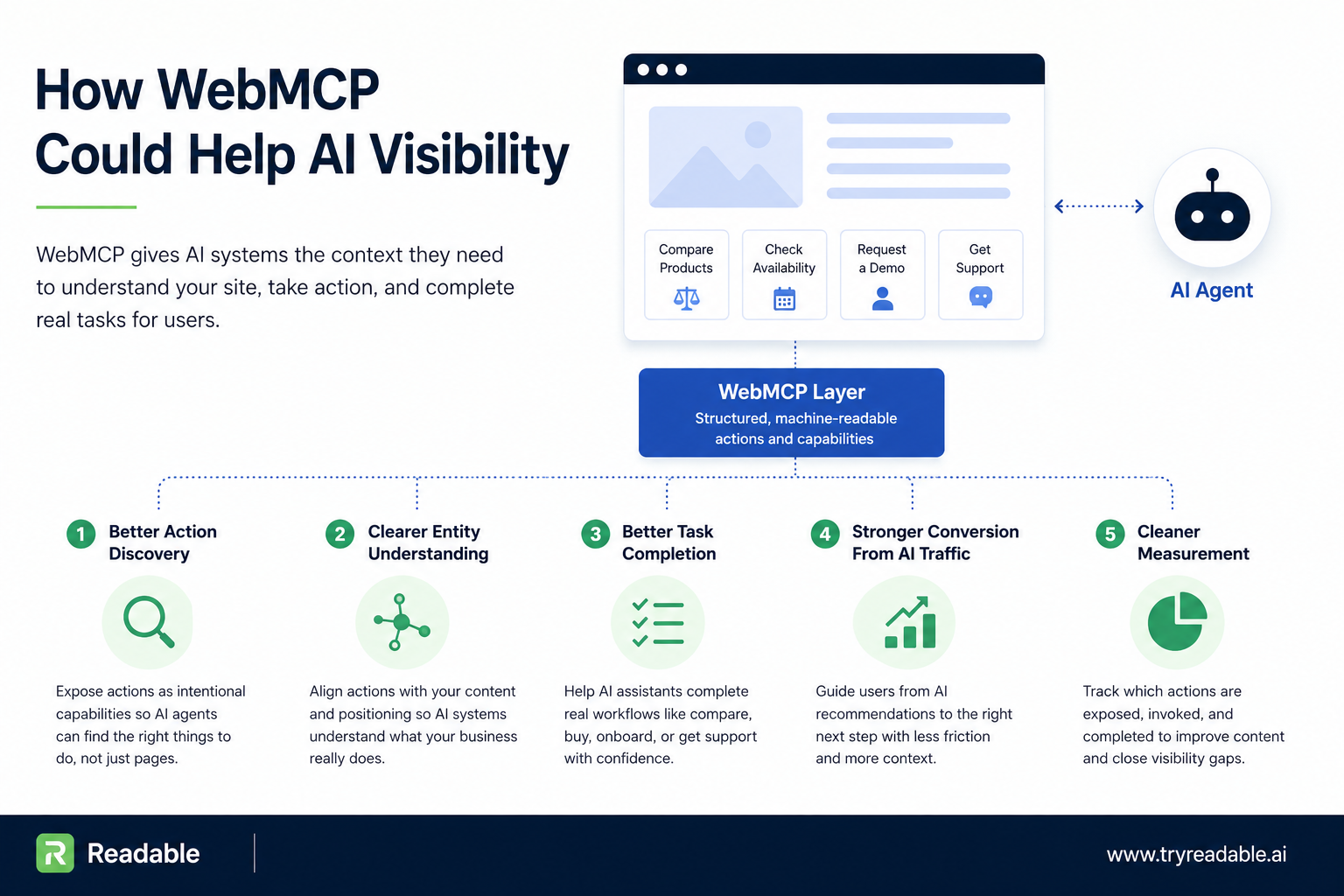
WebMCP could help in five practical areas.
1. Better Action Discovery
Search engines and AI answer systems can already discover web pages through links, sitemaps, structured data, and content. But an agent trying to act on behalf of a user needs more than a page list. It needs to know what actions are available.
A WebMCP layer can describe actions as intentional capabilities rather than loose UI elements. “Book a demo” becomes an action with expected inputs and outcomes. “Compare products” becomes an action that accepts a use case, category, or plan. “Find return policy” becomes a retrieval action tied to the correct policy source.
That can matter for AI visibility because many future recommendations may not end with a click to a landing page. They may end with an agent selecting a vendor, checking a constraint, and beginning the next step.
2. Clearer Entity Understanding
Classic SEO asks whether a page can be crawled and understood. AI SEO asks whether the brand, product, category, audience, proof, and actions are clear enough to be used in an answer.
WebMCP can reinforce entity understanding when the actions match the content graph. For example, if a SaaS website says it helps ecommerce teams recover abandoned carts, the agent-facing actions should support that same positioning: fetch integrations, compare pricing, check Shopify compatibility, request implementation help, or generate a migration checklist.
That consistency helps AI systems avoid treating the website as a generic vendor page. It gives them a stronger map of what the business can actually do.
This is the same direction we cover in what an AI-native website is: the site needs to become understandable as a set of claims, evidence, answers, and next actions.
3. Better Task Completion
AI search will increasingly reward usefulness beyond the first answer. If a user asks an AI assistant to find, compare, and take the next step, websites that help the assistant complete the task may win more qualified handoffs.
That does not mean every page needs dozens of agent actions. It means high-intent workflows should become easier to complete:
- A comparison page should expose comparison criteria and next-step actions.
- A pricing page should expose plan constraints and contact routes.
- A product page should expose availability, compatibility, and purchase actions.
- A support page should expose troubleshooting, ticket creation, and escalation actions.
This is where WebMCP may matter more than traditional ranking language suggests. A page can rank and still be hard for an agent to use. An agent-ready page can become the source that an AI assistant prefers when it needs to complete a real workflow.
4. Stronger Conversion From AI Traffic
Some WebMCP value may show up after discovery, not before it.
If AI assistants send fewer but more qualified visitors, the winning site may be the one that gives the assistant and the user a clean next step. A WebMCP action layer can reduce friction when the user is already in a task state. Instead of landing on a broad marketing page, the agent can initiate the correct workflow with context attached.
For example, a B2B buyer might ask an assistant to shortlist tools that integrate with HubSpot, support SOC 2, and offer implementation help. A normal website can answer those points if the content is strong. An agent-ready website can also expose a “request implementation review” action with the right fields and permission boundaries.
That does not guarantee more traffic. It can increase the value of the traffic and citations you do receive.
5. Cleaner Measurement
AI SEO is difficult to measure because AI referrals, direct visits, crawlers, and agent actions can blur together. A WebMCP layer gives teams a more explicit event surface: which actions were exposed, which actions were invoked, which required consent, which completed, and which failed.
That can help marketing, product, and analytics teams separate passive visibility from active usefulness. It also creates feedback loops for improving content. If agents repeatedly ask for an unavailable proof point, missing integration, or unsupported comparison, the content team has a clear gap to fix.
What WebMCP Will Not Do
A clear action layer does not rescue a weak website.
WebMCP will not make thin content authoritative. It will not make an unclear product easy to recommend. It will not override crawl blocks, poor page quality, or missing trust signals. It will not tell Google that your page deserves to rank if the page does not help users.
Google’s guidance remains plain: helpful content is made for people, demonstrates expertise, helps visitors achieve their goals, and avoids search-first shortcuts. Google also says SEO is useful when it helps search engines discover and understand people-first content.
That framing applies cleanly to WebMCP. Use it to clarify a genuinely useful site. Do not use it to decorate an unhelpful one.
The Relationship Between WebMCP, Schema, and llms.txt
WebMCP is one layer in a broader AI-readable website stack. It should not replace the parts you already need.
Schema markup helps search engines and other systems understand structured facts about pages, products, organizations, articles, reviews, events, and other entities.
Sitemaps help search engines discover indexable URLs.
Robots directives and snippet controls help define what can be crawled, indexed, and shown in search features.
The llms.txt proposal gives LLMs a curated markdown entry point for understanding a website at inference time. The proposal explicitly says it is designed to coexist with current web standards, with a different purpose from sitemap.xml or robots.txt.
WebMCP is different again. It is about actions and procedures. It says, “Here is what an agent can do with this website, under these constraints.”
That means the stack should look more like this:
- Schema explains entities and facts.
- Sitemap and internal links explain discoverable pages.
- llms.txt explains curated AI-readable context.
- Knowledge base content explains durable buyer questions.
- WebMCP explains safe agent actions.
For a deeper comparison, read WebMCP vs llms.txt once that support article is live, and our existing post on whether llms.txt files are useful.
The Security Caveat for AI SEO Teams
Agent readiness creates risk because actions are more powerful than content.
The MCP specification is explicit about this. Tools represent arbitrary code execution paths and should be treated with caution. Hosts should obtain explicit user consent before invoking tools. Tool annotations and descriptions should be treated as untrusted unless they come from trusted servers. The tools specification also says there should be a human in the loop with the ability to deny tool invocations.
That matters for WebMCP because the website is no longer just publishing content for reading. It may be exposing actions that affect accounts, carts, forms, payments, records, or private data.
Security researchers have also started studying WebMCP-specific risks. A 2026 paper on WebMCP tool surface poisoning describes mid-session tool injection, where attackers may manipulate agent-visible tools during an active session, especially through third-party scripts. The paper recommends mitigations such as binding tool identity to origin, enforcing data boundaries, maintaining lifecycle consistency, and logging tool registration and invocation.
For AI SEO teams, the lesson is direct: do not let growth goals push unsafe agent actions into production. A website that leaks data, lets tools change meaning mid-session, or hides destructive actions behind vague names will lose trust even if it gets short-term attention.
A Practical Readiness Model
If you want WebMCP to support AI visibility, work in this order.
Step 1: Fix the Human Page First
Before exposing an action, make the human page clear. The page should answer:
- Who is this for?
- What problem does it solve?
- What evidence supports the claim?
- What are the limits or tradeoffs?
- What should the visitor do next?
If a human cannot understand the page, an agent-facing action layer will only encode confusion.
Step 2: Map Actions to Search Intent
Do not expose every button. Start with the actions that match high-intent AI search journeys:
- Compare this product against alternatives.
- Check whether this product fits my use case.
- Find pricing or plan constraints.
- Retrieve proof, security, or compliance information.
- Start a quote, demo, checkout, or support workflow.
This creates alignment between AI discovery and product conversion.
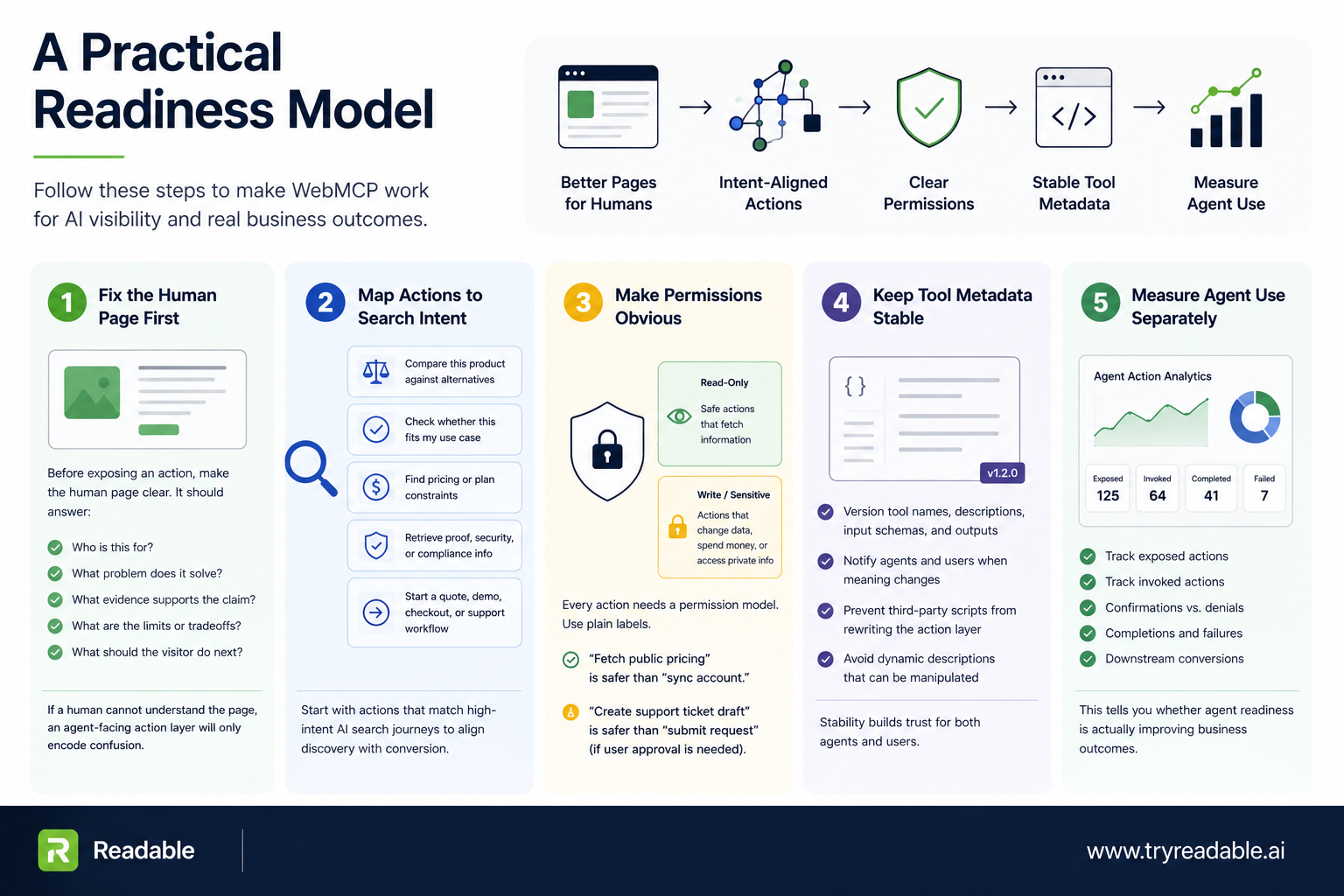
Step 3: Make Permissions Obvious
Every action needs a permission model. Read-only actions should be separated from actions that mutate data, submit forms, spend money, or access private information.
Use plain labels. “Fetch public pricing” is safer than “sync account.” “Create support ticket draft” is safer than “submit request” if the user still needs to approve it.
Step 4: Keep Tool Metadata Stable
If an action changes meaning, agents and users need to know. Tool names, descriptions, input schemas, and outputs should be versioned and monitored. Avoid letting third-party scripts rewrite the action layer. Avoid dynamic action descriptions that can be manipulated by user-generated content or ad scripts.
Step 5: Measure Agent Use Separately
Do not mix agent actions into generic pageview analytics. Track exposed actions, invoked actions, confirmations, denials, completions, failures, and downstream conversions. This is the measurement layer that tells you whether agent readiness is actually improving business outcomes.
So, Will Agent-Ready Websites Rank Better?
Some will, but not because WebMCP is a ranking trick.
Agent-ready websites are more likely to win when they also have strong content, clear entities, crawlable pages, trustworthy proof, fast experiences, and useful workflows. WebMCP can make those workflows easier for AI agents to discover and use. It can also create cleaner measurement and better conversion from AI-assisted journeys.
The ranking effect, if it appears, will probably be indirect:
- Better crawlable and AI-readable content supports discovery.
- Better structured facts support understanding.
- Better task completion supports user satisfaction.
- Better measurement helps teams fix the gaps that block AI recommendations.
- Safer action design builds trust with users and agent platforms.
That is still worth doing. It is just not a shortcut.
What To Do Next
If you are preparing for WebMCP, do not start with protocol work. Start with your highest-value AI journeys:
- Which buyer questions should AI systems answer with confidence?
- Which website actions should an assistant be allowed to take?
- Which actions require user consent?
- Which pages need better evidence before any agent should recommend them?
- Which analytics events would prove agent readiness is working?
Then build the layers in order: content clarity, structured data, llms.txt, knowledge base coverage, and finally safe WebMCP actions.
That is the durable AI SEO path. Do not ask whether WebMCP can make weak pages rank. Ask whether it can help useful pages become easier for AI systems to understand, trust, and act on.
Sources
- Model Context Protocol specification
- Model Context Protocol tools specification
- webMCP: Efficient AI-Native Client-Side Interaction for Agent-Ready Web Design
- WebMCP Tool Surface Poisoning: Runtime Manipulation Attacks on LLM Agents
- Google Search Central: AI features and your website
- Google Search Central: Creating helpful, reliable, people-first content
- The llms.txt proposal
Looking to improve AI SEO for your website?
Talk to us to discuss possibilities using WebMCP and other AI SEO tools.