MCP and x402 solve different parts of the same agentic internet problem.
MCP helps AI agents call tools and retrieve external context. x402 helps clients pay for HTTP resources when access requires payment.
Together, they point toward a new market structure: paid MCP servers.
In that world, an AI agent can discover a tool, understand what it does, see that a premium call requires payment, pay for the call, and continue the workflow with the returned result.
That is a big shift. It turns APIs and tools from developer-integrated services into agent-discoverable commerce surfaces.
MCP in one paragraph
The Model Context Protocol, or MCP, is a standard for connecting AI systems to external tools, services, and data sources.
Instead of hard-coding every integration inside every AI app, MCP gives agents a structured way to discover available tools, understand their schemas, and call them during a task.
Readable has already covered how LLMs discover MCP configurations. The short version: MCP makes external capability easier for agents to understand and use.
x402 in one paragraph
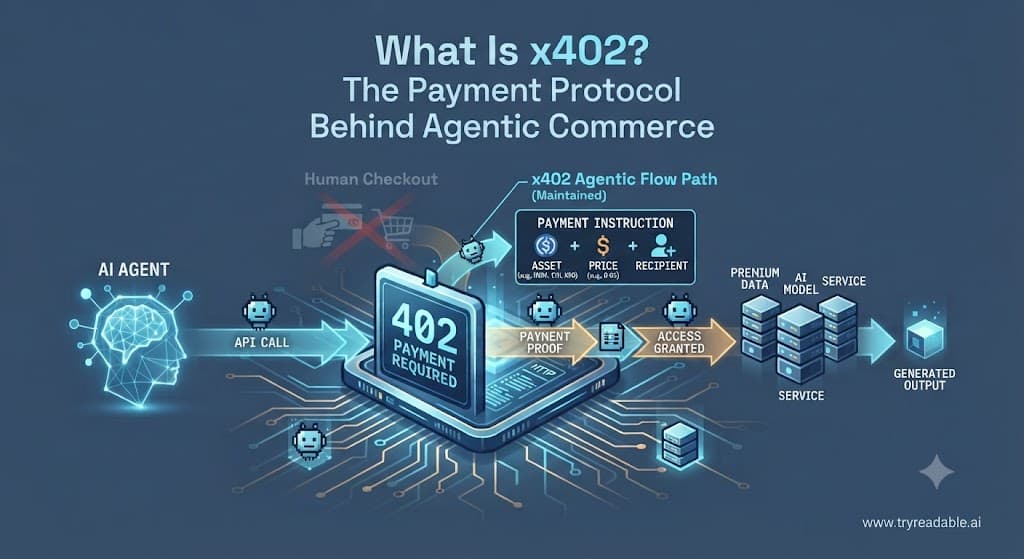
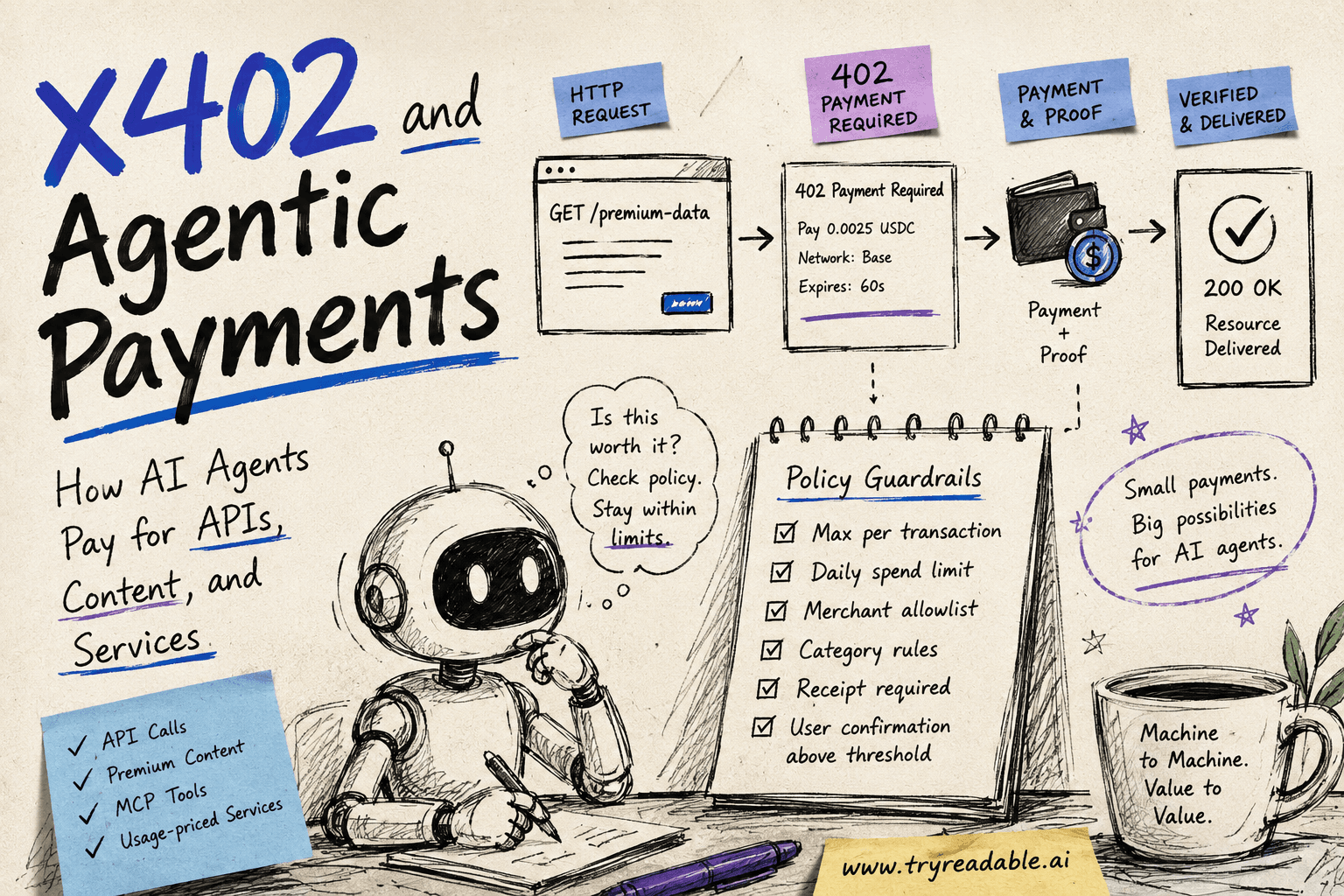
x402 is an HTTP-native payment protocol built around the 402 Payment Required status code.
A server can respond to a request by saying payment is required, include structured payment requirements, and then return the resource when the client retries with valid payment proof.
The official x402 docs include a guide for using x402 with MCP servers, which is one of the clearest signs that the protocol is being designed for agent-driven tool access.
Source references:
- x402 official docs
- x402 guide for MCP servers
- x402 Bazaar discovery layer
- Model Context Protocol website
Why paid MCP servers matter
Most APIs were built for developers. A company signs up, gets credentials, reads docs, integrates, handles billing, and ships a product.
AI agents create a different path.
An agent may need to call a tool once, compare several providers, retrieve a narrow result, or buy a one-time capability on behalf of a user. That does not always fit subscription-first API pricing.
Paid MCP servers could enable a more flexible model:
- Free tool discovery.
- Free metadata and capability descriptions.
- Paid premium tool calls.
- Paid data retrieval.
- Paid verification or transformation.
- Paid workflow execution.
MCP makes the tool callable. x402 makes the paid call possible.
What a paid MCP flow could look like
Imagine an AI agent helping a founder evaluate expansion into a new market.
The agent needs current market data. It discovers a market-intelligence MCP server with several tools:
- Search public market summaries.
- Retrieve category benchmarks.
- Generate a competitive landscape.
- Buy a premium data extract.
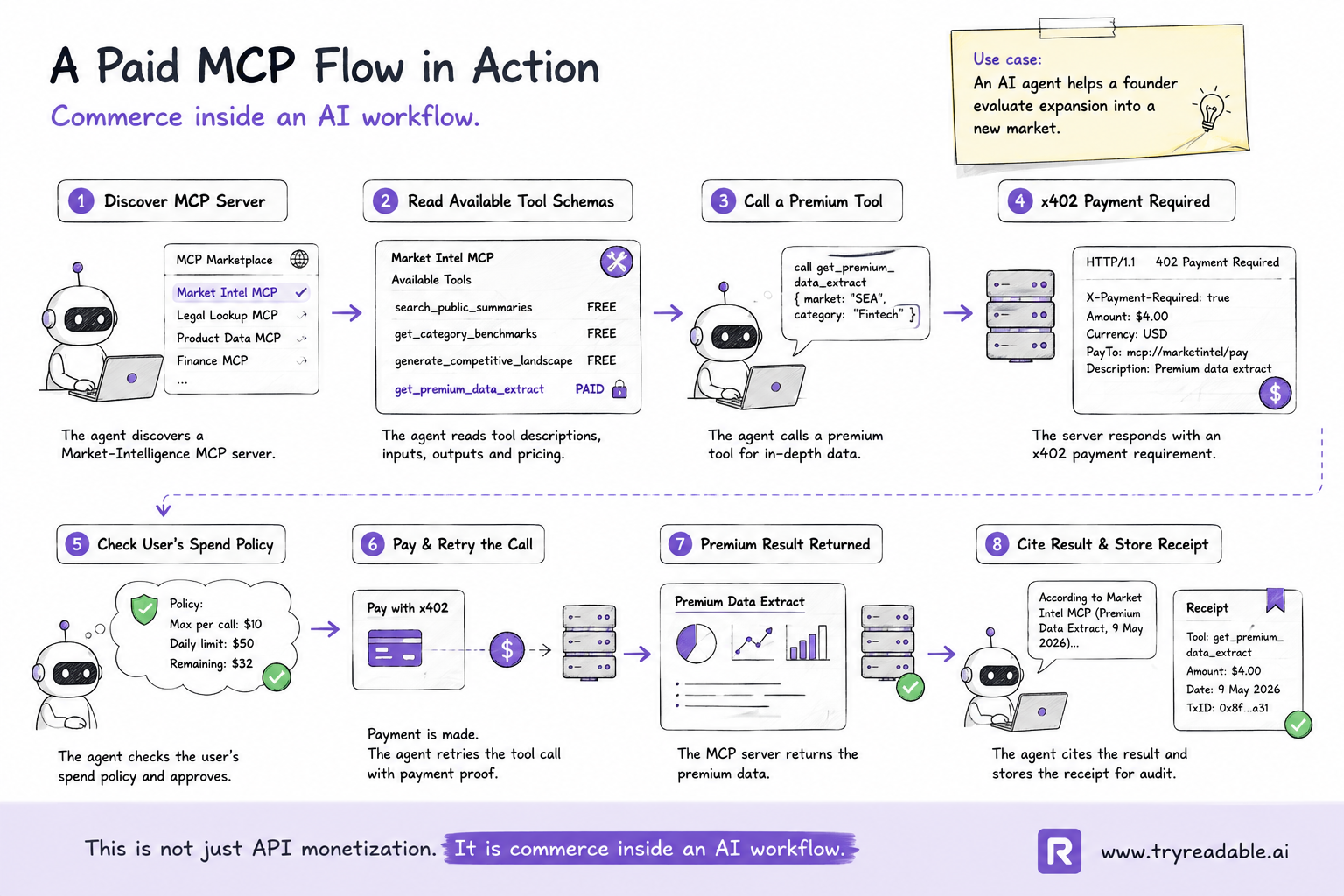
The basic search tool may be free. The premium data extract may require payment.
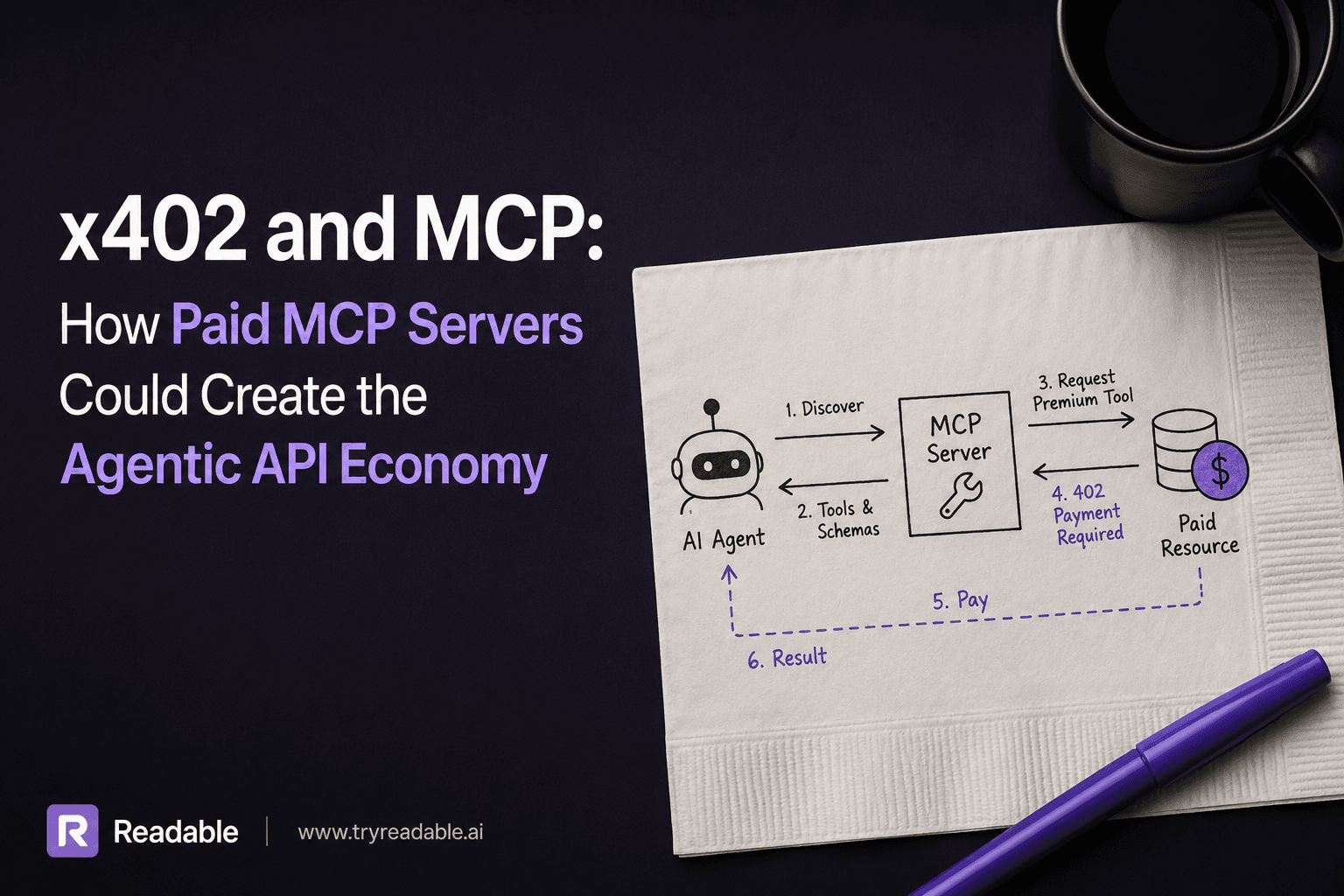
A paid flow could work like this:
- The agent discovers the MCP server.
- The agent reads the available tool schemas.
- The agent calls a premium tool.
- The server returns an x402 payment requirement.
- The agent checks the user's spend policy.
- The agent pays and retries the tool call.
- The MCP server returns the premium result.
- The agent cites the result and stores the receipt.
This is not just API monetization. It is commerce inside an AI workflow.
Why x402 is useful for MCP monetization
MCP servers need a payment model that matches agent behavior.
A subscription-only model can work when the agent operator already has an enterprise relationship with the provider. But many future agent workflows will involve resources the user has not preconfigured.
x402 fits because it can express price and payment requirements at request time.
That creates several advantages.
Agents can evaluate cost dynamically
If a tool call costs money, the agent can compare the cost against the expected value of the answer. This is much cleaner than hiding price behind account creation.
Providers can monetize narrow value
Not every API needs a full subscription. A provider can charge for one high-value lookup, one validation, one benchmark, or one generated artifact.
Tool calls can carry payment proof
The server can verify that the specific request was paid before returning the premium result.
Receipts can become workflow evidence
For business users, the receipt is part of the audit trail. An agent should be able to explain what it bought, why, and which result was returned.
What kinds of MCP servers could be paid
The strongest early candidates are tools with high marginal value and clear outputs.
Market and competitive intelligence
Agents may pay for current benchmarks, category trends, vendor data, pricing intelligence, or buyer intent signals.
Compliance and legal lookups
Agents may need to check a regulation, retrieve a policy interpretation, validate a document, or access jurisdiction-specific guidance.
Product and inventory data
Retail, travel, real estate, and B2B procurement agents may pay for high-confidence product availability, quote generation, or reservation holds.
AI visibility and brand intelligence
Agents and teams may pay for structured analysis of how AI systems describe a company, category, or competitor.
This is close to Readable's world: the valuable resource is not just raw content. It is interpreted visibility and decision context.
Specialist transformations
A paid MCP tool could transform a file, enrich a record, verify a claim, summarize a dataset, or produce a formatted output.
Discovery becomes the new SEO
Paid MCP servers only work if agents can find them.
That is where discovery layers matter. The x402 docs include Bazaar as a discovery layer for x402-compatible endpoints and tools. Whether Bazaar or another registry becomes the dominant path, the strategic point is clear: agents need structured ways to discover payable capabilities.
This changes SEO.
Traditional SEO asks: can people find our pages?
Agentic discovery asks:
- Can agents find our tools?
- Can agents understand what each tool does?
- Can agents compare our tool with alternatives?
- Can agents see pricing and constraints?
- Can agents trust our output?
- Can agents pay and verify access?
That means product marketing, developer relations, and AI visibility teams will start overlapping.
Content strategy for paid MCP servers
If you want agents to choose your MCP server, your content needs to explain the capability in human and machine terms.
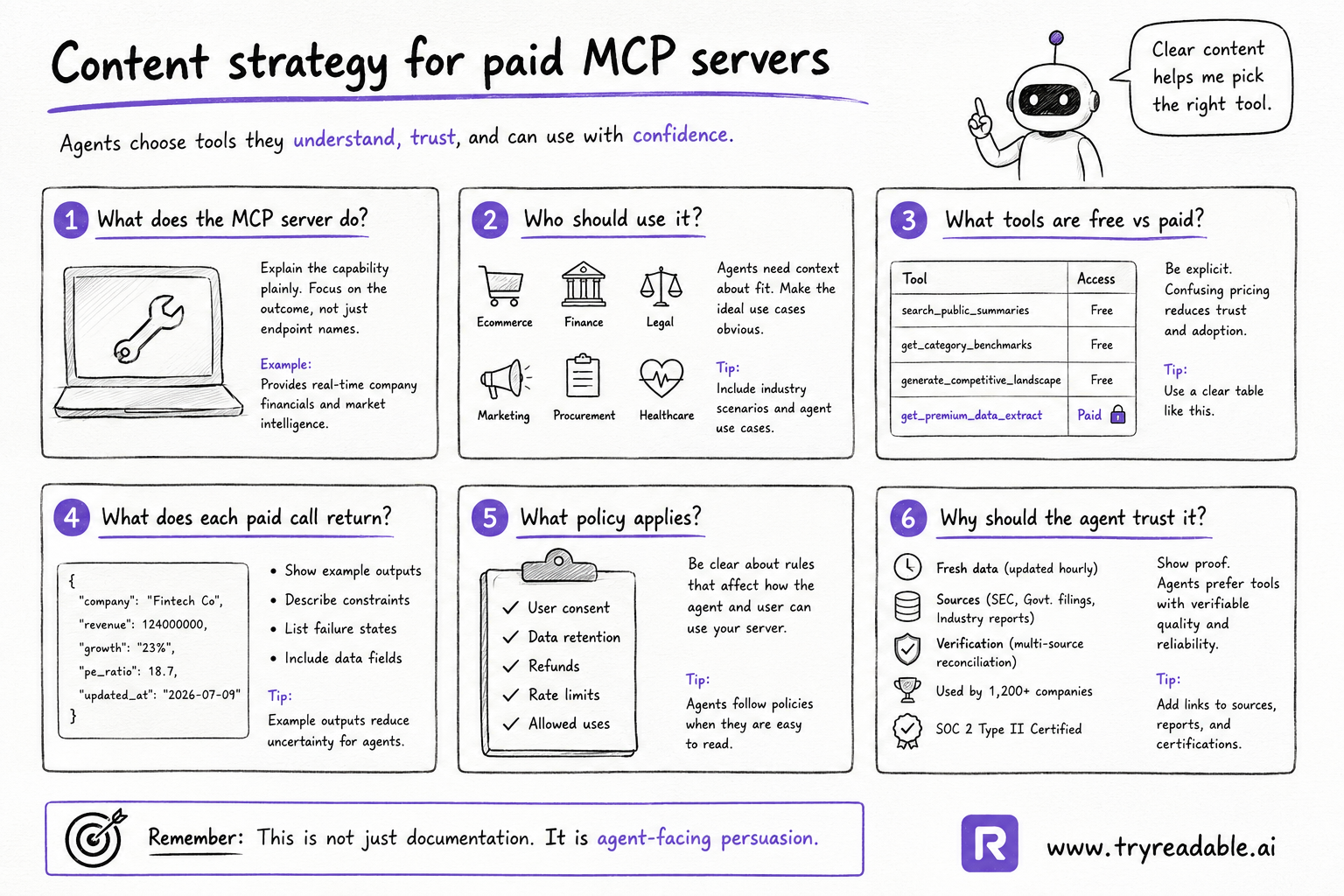
Create pages that answer:
What does the MCP server do?
Explain the capability plainly. Avoid only listing endpoint names.
Who should use it?
Agents need context about fit. Is this for ecommerce, finance, legal, marketing, procurement, healthcare, or developers?
What tools are free versus paid?
Be explicit. Confusing pricing will reduce trust.
What does each paid call return?
Show example outputs, constraints, and failure states.
What policy applies?
Clarify user consent, data retention, refunds, rate limits, and allowed uses.
Why should the agent trust it?
Include proof: freshness, sources, verification method, customer evidence, certifications, or benchmark methodology.
This is not just documentation. It is agent-facing persuasion.
Technical readiness checklist
Before charging for MCP calls through x402, teams should prepare:
- Stable MCP server metadata.
- Clear tool schemas.
- Free discovery or metadata calls.
- Paid tool boundaries.
- x402 payment requirement handling.
- Payment verification.
- Receipts and request IDs.
- Error states for unpaid, paid-but-failed, expired, and policy-denied requests.
- Logging for agent client, tool, amount, status, and result.
- Documentation that explains when an agent should use the paid call.
Business readiness checklist
The commercial questions are just as important:
- Which tool calls are valuable enough to charge for?
- Is usage-based pricing easier than subscription pricing?
- Which buyer owns the spend?
- What spend limits should be expected?
- How will refunds or failed calls be handled?
- What proof will buyers need for reimbursement or audit?
- How will you measure agent-sourced revenue?
- How will agents discover the tool in the first place?
If these are unanswered, x402 implementation will be premature.
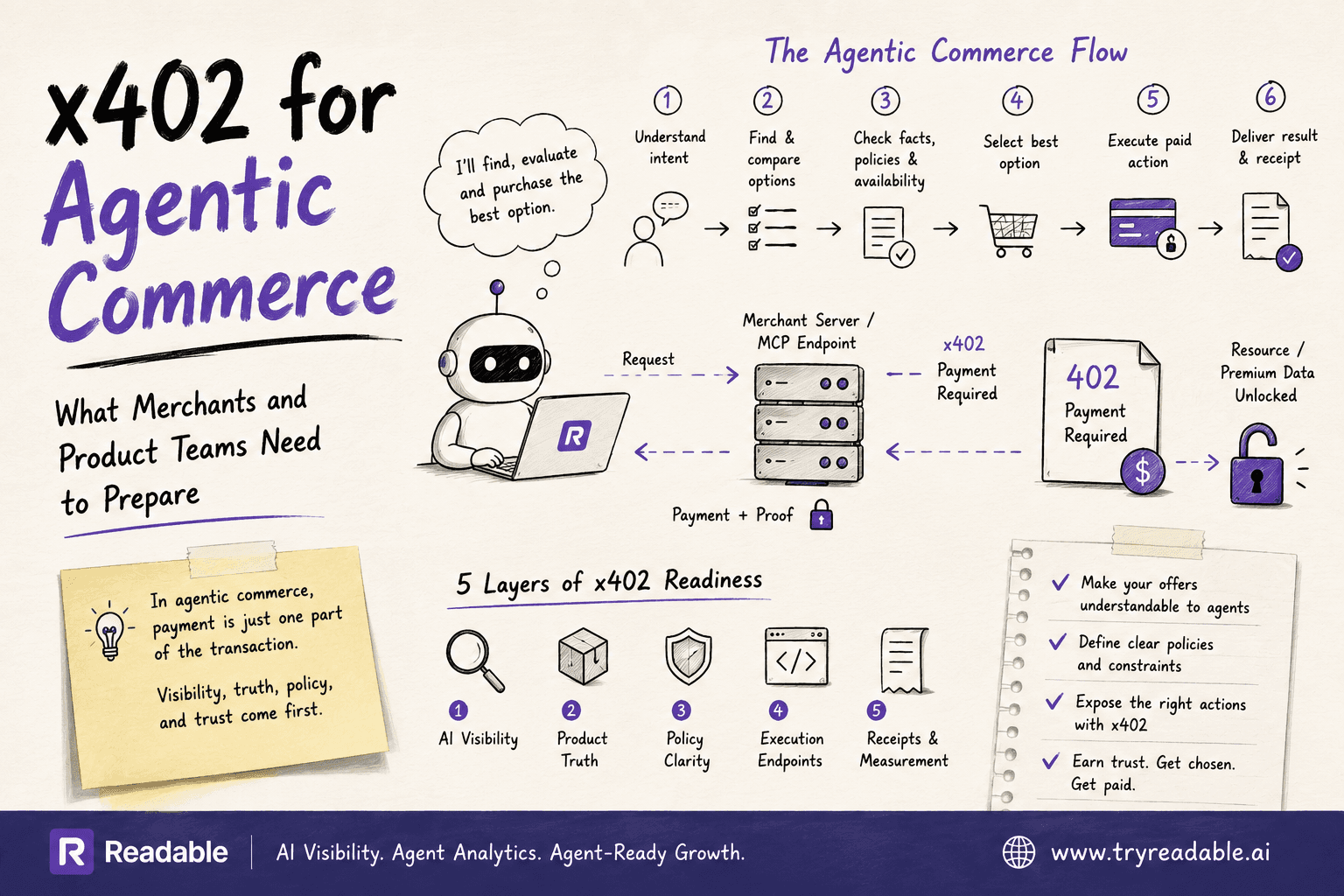
MCP plus x402 and Readable's larger thesis
Readable's broader thesis is that AI visibility, content, and execution are converging.
First, AI systems need to understand your brand.
Then agents need to retrieve reliable information about your business.
Then agents need tools that let them act.
Finally, some actions will require payment.
MCP and x402 sit in the final two layers: action and payment. But those layers depend on the earlier ones.
A paid MCP server that is invisible to AI systems is like a store with no road leading to it. A visible tool with unclear pricing will be skipped. A payable endpoint with weak receipts will create trust problems.
The companies that win will build the whole path.
FAQ
What is a paid MCP server?
A paid MCP server is an MCP server where some tool calls or resources require payment before access. Free tools may describe capabilities, while premium tools return paid data, actions, or results.
How does x402 work with MCP?
An MCP server can require payment for certain HTTP-backed tool calls. With x402, the server can return a 402 payment requirement, verify payment proof, and then return the paid result after the client retries.
Why would an AI agent pay for an MCP tool?
An agent may pay when a tool provides high-value information or execution that helps complete the user's goal, such as a benchmark, data extract, verification result, quote, or premium analysis.
Is MCP enough without x402?
MCP can make tools callable, but it does not by itself define how every paid tool call should be billed and verified. x402 can provide a payment mechanism for HTTP resources and tool calls.
How should companies prepare paid MCP content?
They should publish clear pages explaining what the server does, when agents should use it, what calls cost, what each call returns, what policies apply, and why the output can be trusted.
The bottom line
MCP makes tools available to agents. x402 can make premium tool calls payable.
That combination could create the agentic API economy: a web of discoverable, callable, paid capabilities that AI agents use inside real workflows.
But the commercial winner will not be the team with the cleverest payment hook. It will be the team whose tool is discoverable, understandable, trusted, priced clearly, and measured end to end.
Make your agent-facing content and tools discoverable
Readable helps teams see whether AI systems can find, explain, and recommend their brand before agents reach a paid tool or MCP server.