x402 is a payment protocol for a web where software, APIs, and AI agents can pay for digital resources directly over HTTP.
That sounds technical. The business implication is much bigger.
Most online payments were designed around a human moving through checkout: account creation, cart review, card entry, fraud checks, and confirmation screens. Agentic commerce works differently. An AI agent may need to retrieve a price, unlock a data source, call an API, compare offers, or complete a narrow task without a person clicking through a checkout page.
That creates a new requirement: payment must become part of the machine-readable request flow.
x402 is one answer to that problem. It revives the long-unused HTTP 402 Payment Required status code and turns it into a practical pattern for internet-native payments.
What x402 means in simple terms
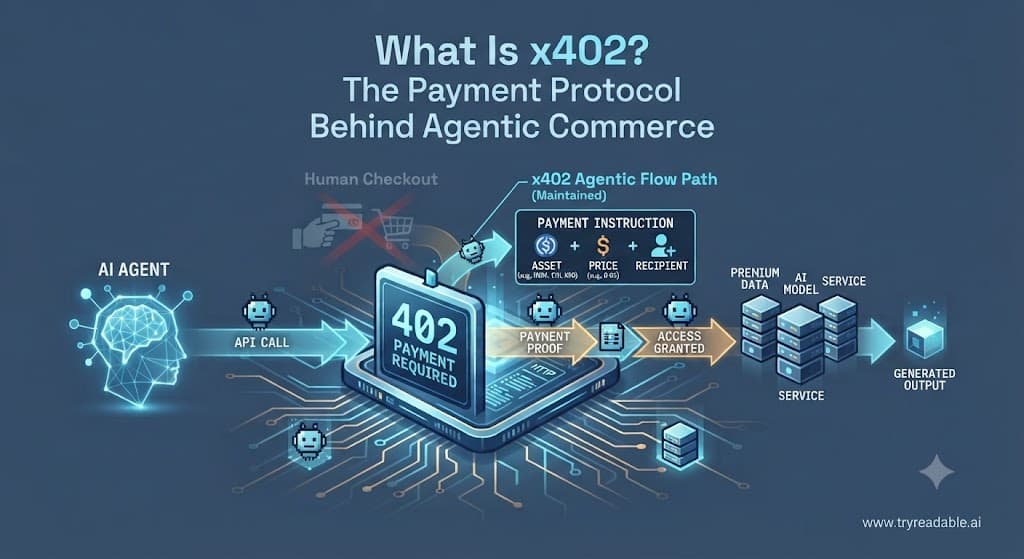
x402 lets a server say: this resource requires payment, here is what it costs, here is how to pay, and here is how to retry the request after payment.
Instead of redirecting a user to a checkout page, the server returns payment instructions in the HTTP response. The client, which may be a human-operated app or an AI agent, completes the payment and retries the original request with payment proof.
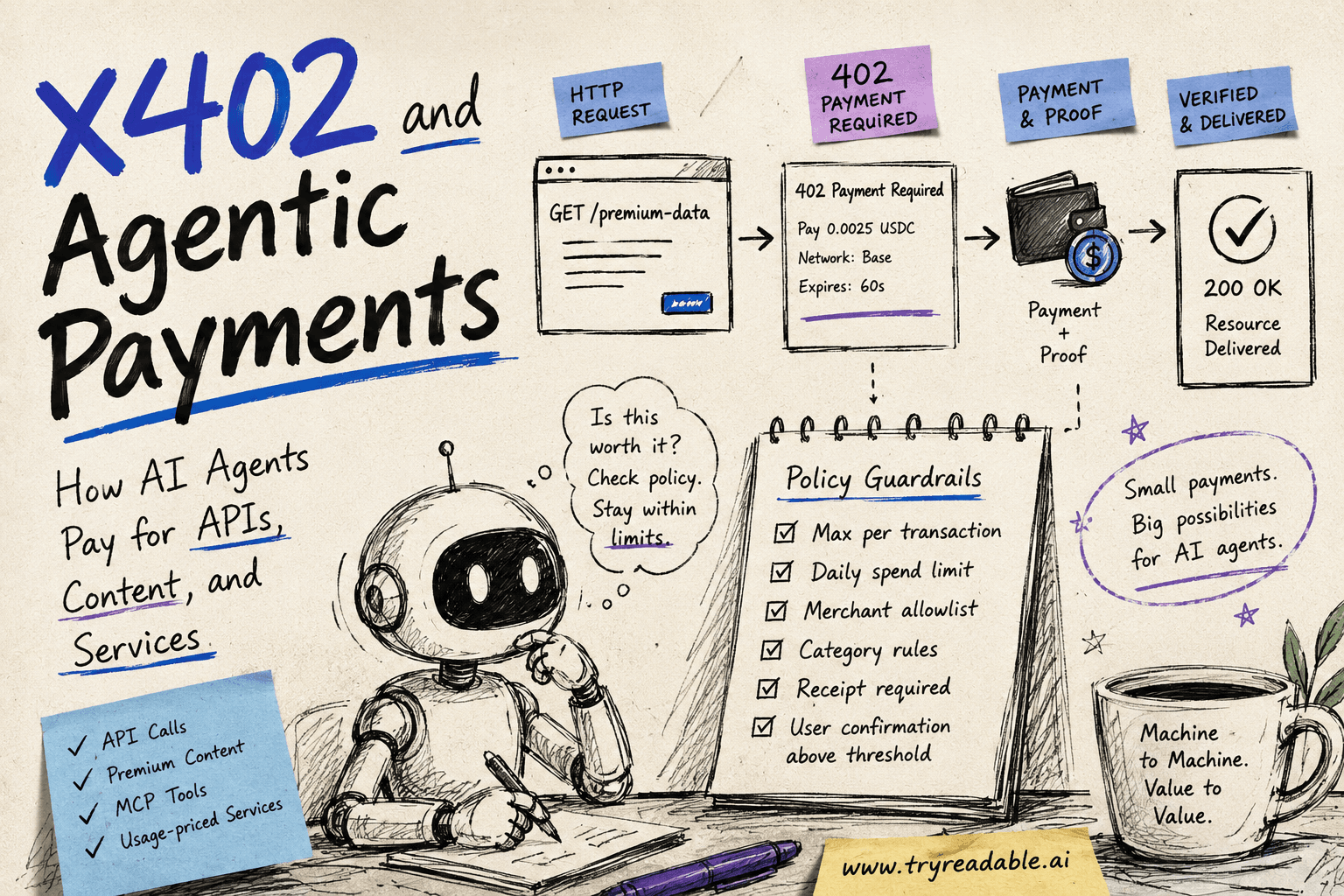
A simplified x402 flow looks like this:
- A client requests a protected resource.
- The server responds with HTTP 402 Payment Required.
- The response includes payment requirements.
- The client completes payment through a supported payment scheme.
- The client retries the original request with proof of payment.
- The server verifies the payment and returns the resource.
The official x402 documentation describes the protocol as a way to make payments over HTTP without requiring accounts, sessions, subscriptions, or custom billing flows for every resource. Coinbase's x402 documentation frames it around APIs, AI agents, paywalls, microservices, and usage-based billing.
Useful source references:
Why HTTP 402 matters now
HTTP has always had status codes for common web interactions. 404 means a resource was not found. 401 means authentication is required. 429 means too many requests.
402 Payment Required existed for decades, but it never became a mainstream web primitive because most payments happened through human checkout flows.
AI agents change the timing.
An agent does not want to leave an API request, open a checkout page, fill a cart, and then return to the original task. It needs a structured answer:
- What does this resource cost?
- What payment methods are accepted?
- What proof is needed?
- What happens after payment?
- Can the transaction be verified automatically?
x402 gives software a direct way to negotiate that payment requirement inside the request flow.
Why x402 is relevant to agentic commerce
Agentic commerce is commerce where AI agents help discover, evaluate, and execute buying decisions. Some agents will recommend products. Others will schedule services, purchase API calls, book travel, renew subscriptions, or buy digital goods.
For that world to work, payment cannot be a separate human-only ceremony.
x402 is relevant because it supports three ideas that agentic commerce needs:
1. Pay-per-action instead of checkout-first commerce
A human checkout flow is overbuilt for many agent tasks. If an agent needs one API call, one data lookup, one document, one pricing check, or one generated asset, a full subscription or checkout funnel adds friction.
x402 allows a narrower model: pay for the specific resource being requested.
That is especially important for AI agents because they may evaluate many resources before choosing one. Small paid checks can become part of the decision process.
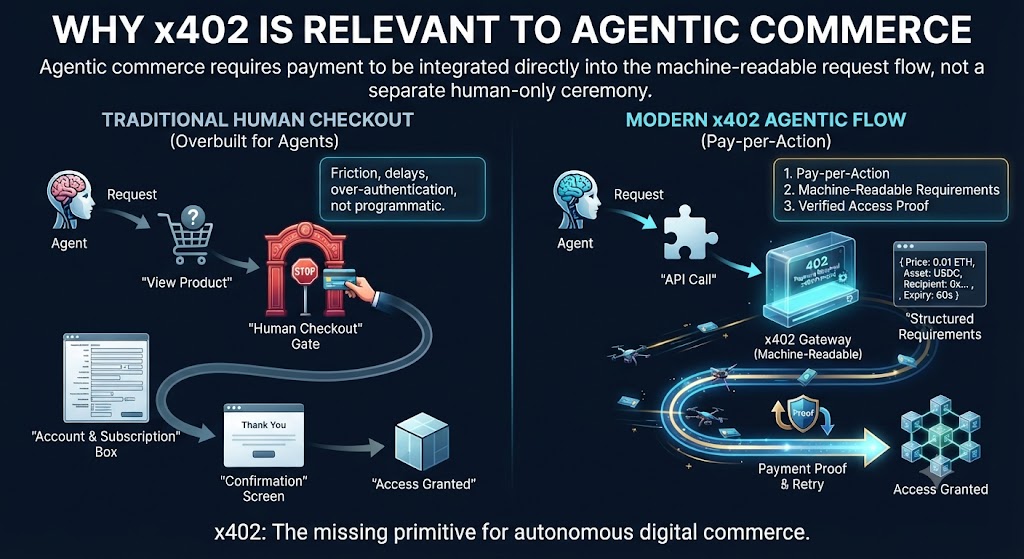
2. Machine-readable payment requirements
Agents need structured instructions. A payment page is not enough. The agent must know the price, asset, network or scheme, recipient, expiry, and verification expectations.
The more explicit those requirements are, the easier it becomes for agents to decide whether a paid resource is worth using.
3. Verified access after payment
The agentic economy needs proof. If an agent pays for a resource, both sides need a reliable answer to a basic question: has payment been made for this exact request?
x402 creates a repeatable request pattern around payment and access instead of leaving each API, merchant, or publisher to invent its own mechanism.
What x402 is not
x402 is often discussed in crypto-native circles, but teams should avoid reducing it to a crypto payment story.
x402 is not a consumer checkout replacement for every business. It is not a full fraud stack. It is not a universal policy layer for all agent permissions. It is not the same thing as an agent identity protocol.
It is best understood as a payment requirement and settlement pattern for HTTP resources.
That makes it powerful, but it also means x402 sits beside other infrastructure:
- Identity and authorization systems decide who or what is allowed to act.
- Consent frameworks define what the user authorized.
- Commerce APIs expose product, pricing, policy, and fulfillment data.
- Agent discovery layers help agents find payable resources.
- Analytics systems measure whether agent traffic converts.
In other words: x402 can help an agent pay, but it does not automatically make your business agent-ready.
Common x402 use cases
The strongest near-term use cases are not broad ecommerce checkout replacements. They are narrower machine-to-machine purchases.
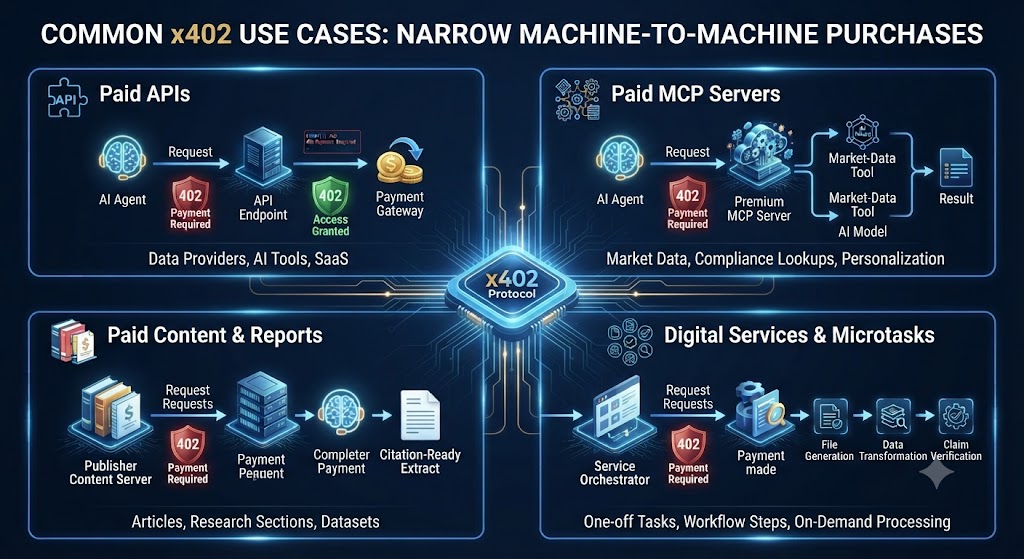
Paid APIs
A developer, app, or AI agent requests an API endpoint. Instead of requiring a subscription account, the endpoint can return a 402 payment requirement and grant access after payment.
This is useful for data providers, AI tools, research services, enrichment APIs, and specialized SaaS endpoints.
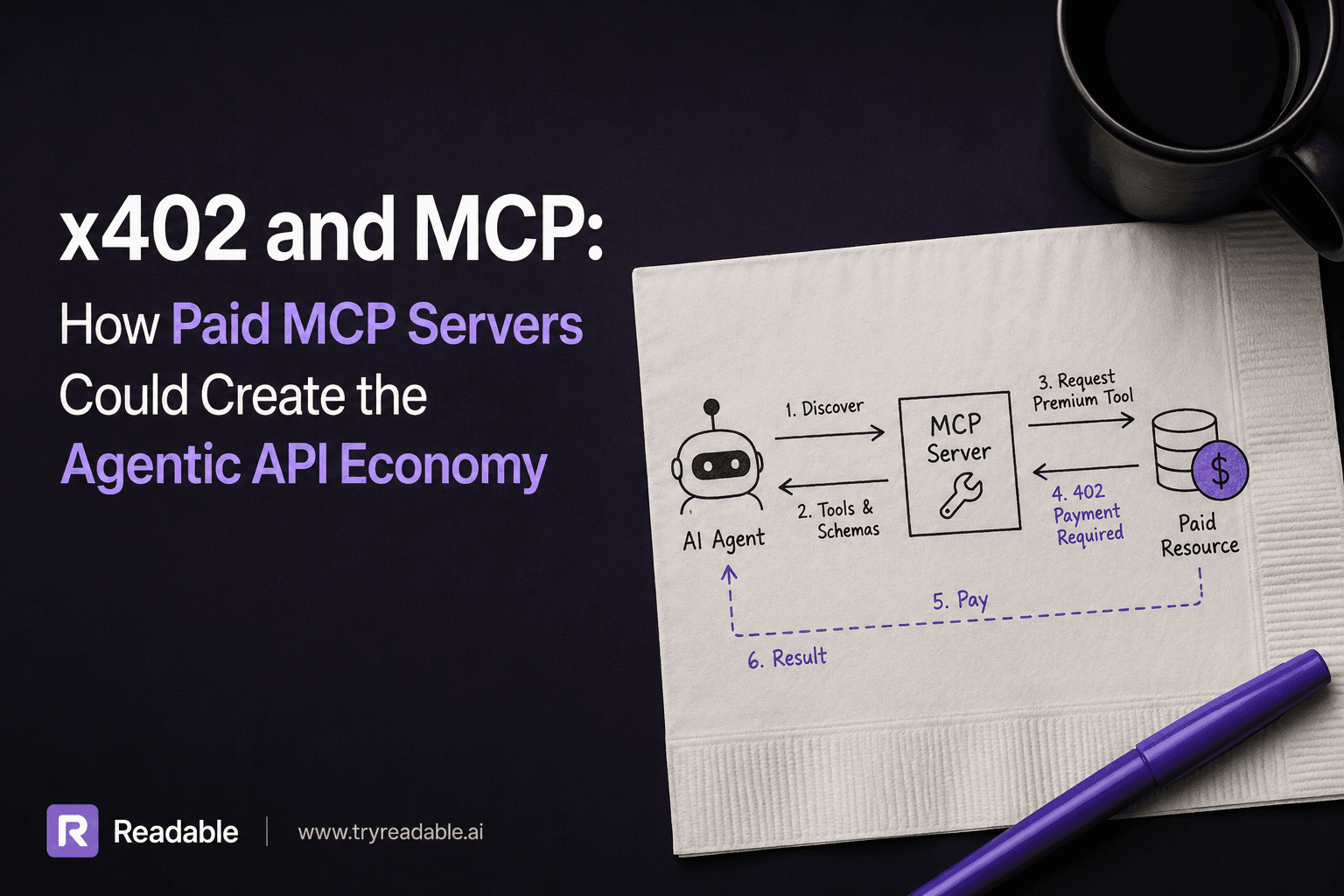
Paid MCP servers
MCP makes tools and data callable by AI agents. x402 can make those calls billable.
For example, an MCP server might expose a premium market-data tool, compliance lookup, product database, or personalization service. The agent can discover the tool, see that a call requires payment, complete the payment, and receive the result.
Readable has written about how LLMs discover MCP endpoints. x402 adds the payment layer to that discovery and execution story.
Paid content and reports
Publishers and research companies could use x402 to let agents buy one article, one report section, one dataset, or one citation-ready extract without forcing the user into a subscription flow.
This matters because AI agents may retrieve information on behalf of a user who does not want a full account relationship with every publisher.
Digital services and microtasks
Some agentic transactions will be service-like: generate a file, transform data, verify a claim, reserve inventory, run a search, or execute a workflow step.
x402 fits these tasks because the value is tied to a specific request.
Why marketers and growth teams should care
At first glance, x402 looks like developer infrastructure. But agentic payments affect marketing and growth because they change how buyers reach a transaction.
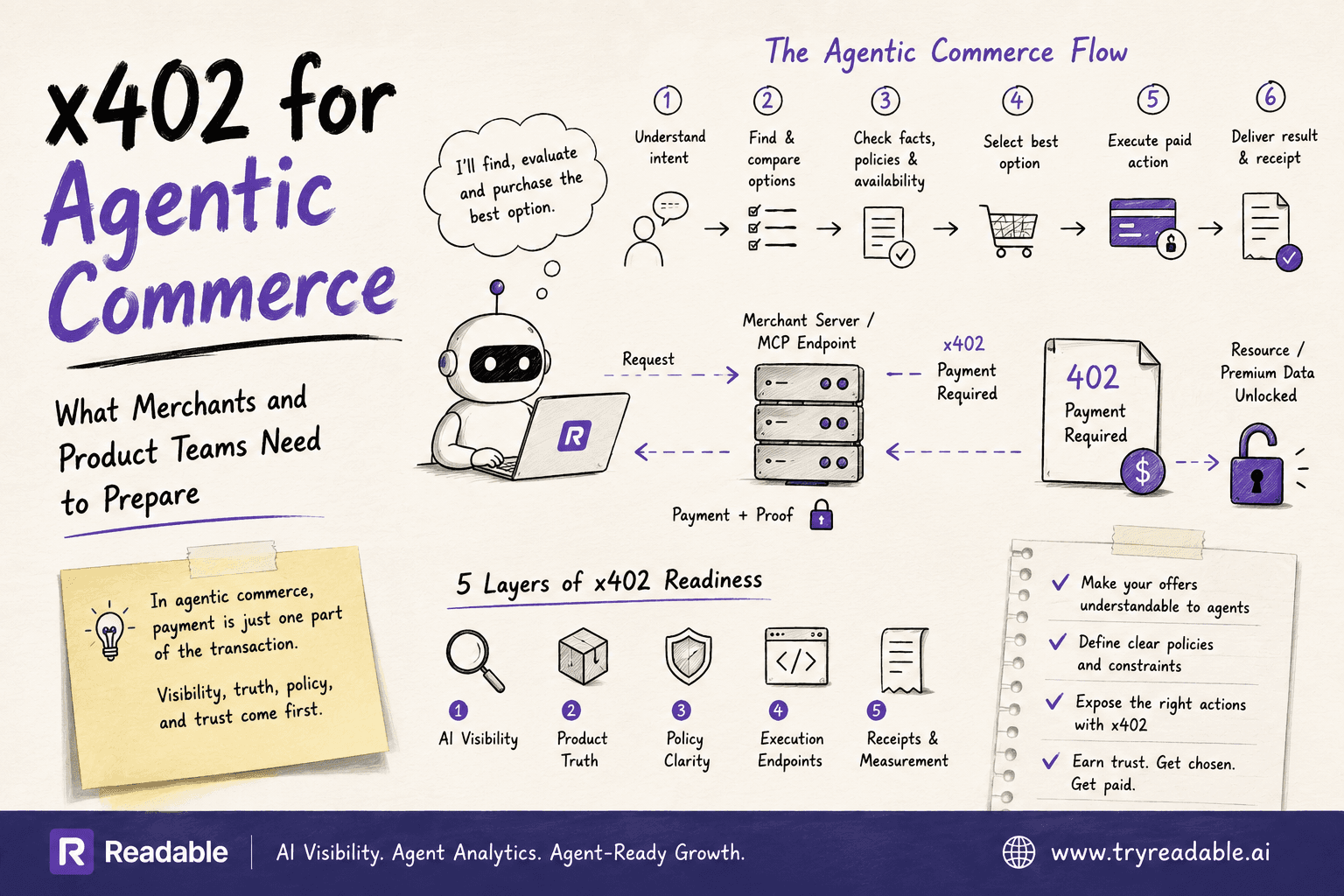
In traditional ecommerce, a user often visits a page, reads copy, compares options, and clicks through a checkout flow. In agentic commerce, the agent may evaluate structured facts, policy constraints, endpoint reliability, and payment compatibility before a human ever sees your site.
That means your growth surface expands beyond pages.
Your business may need:
- Clear product truth for AI systems.
- Structured pricing and availability data.
- Agent-readable policies.
- Payable endpoints for narrow tasks.
- Reliable receipts and confirmation states.
- Analytics for agent-driven visits and transactions.
If those surfaces are missing, agents may skip you even if your human website looks excellent.
x402 and AI visibility
The biggest strategic mistake is treating x402 as only a payment rail.
Payment happens late in the agent workflow. Before payment, the agent must discover your business, understand what you offer, compare you against alternatives, trust your information, and decide that a paid action is useful.
That is where AI visibility enters the picture.
If your product facts are unclear in ChatGPT, Gemini, Perplexity, or agentic discovery surfaces, an x402 endpoint will not rescue the transaction. The agent may never reach the payable resource.
A practical readiness sequence looks like this:
- Make your brand and product facts visible in AI answers.
- Publish structured, citation-worthy content around buyer questions.
- Expose machine-readable product, pricing, and policy surfaces.
- Add callable tools or APIs where agents need execution.
- Use x402 for paid access where a narrow request has clear value.
- Measure agent visits, failed requests, paid actions, and downstream revenue.
Readable's position is simple: agentic commerce starts before payment. It starts with whether AI systems can understand and recommend you.
x402 readiness checklist
Use this checklist before treating x402 as a go-to-market motion:
- Can an AI system clearly explain what your product does?
- Are your pricing, plans, limits, and policies machine-readable?
- Do you have endpoints or tools an agent would actually need to call?
- Is the paid resource valuable as a single request, not only as a subscription?
- Can the agent verify that payment unlocked the right resource?
- Do you provide receipts, status, and failure reasons in structured form?
- Can your analytics separate human visitors, AI agents, and AI-referred users?
- Do you have internal ownership across product, payments, security, and growth?
If the answer is mostly no, the first step is not x402 implementation. The first step is agent-readiness.
FAQ
What is x402?
x402 is an HTTP-native payment protocol that uses the 402 Payment Required status code to let clients pay for protected resources and retry the original request with payment proof.
Why is x402 important for AI agents?
AI agents need to access APIs, tools, content, and services programmatically. x402 lets a server express payment requirements in a machine-readable way instead of forcing the agent through a human checkout flow.
Is x402 only for crypto payments?
No. x402 is a protocol pattern for HTTP payments. Some current implementations use crypto payment schemes, but the strategic idea is broader: payment becomes part of the machine-readable request flow.
Is x402 the same as agentic commerce?
No. Agentic commerce is the broader shift toward AI agents discovering, evaluating, and executing commerce. x402 is one possible payment primitive inside that broader system.
Should every merchant implement x402 now?
Not necessarily. The strongest early use cases are paid APIs, paid MCP tools, digital resources, and narrow machine-to-machine services. Merchants should first make their product data, policies, and agent-facing content clear enough for AI systems to trust.
The bottom line
x402 matters because it turns payment into something software can understand inside an HTTP workflow.
That is a foundational shift for agentic commerce. But payment is only one layer. The companies that win will not be the ones that merely add a payment endpoint. They will be the ones agents can discover, understand, trust, pay, and measure.
For most teams, the first move is not to ask: should we support x402?
The better question is: when an AI agent is ready to buy, can it understand why it should choose us?
Find the AI search gaps before agents make the choice
Readable shows where your brand, product facts, and agent-ready content are missing from AI answers so you can fix the pages that matter first.