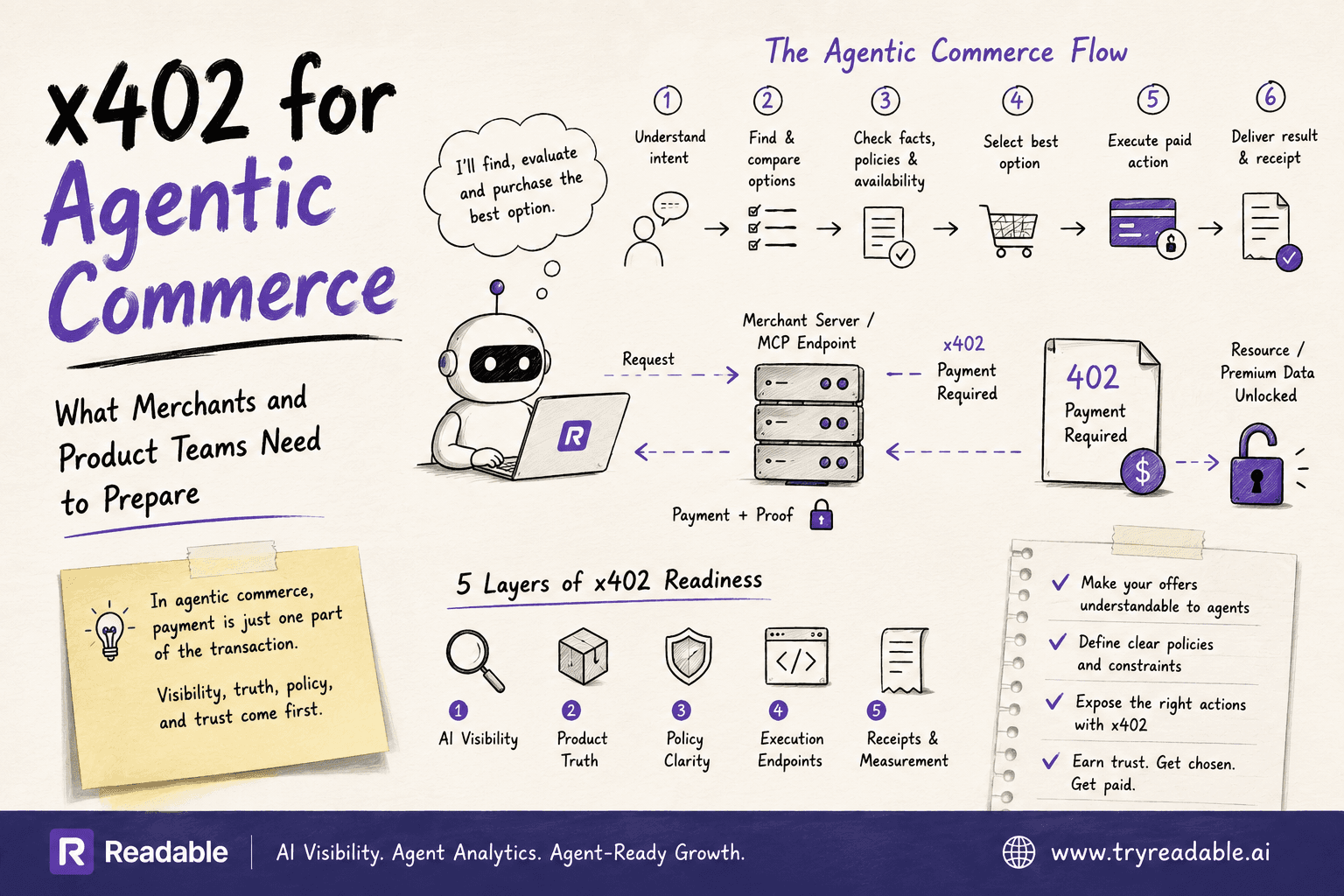
Agentic payments are payments initiated or assisted by AI agents acting on behalf of a user, business, or software workflow.
That definition sounds simple. The implementation is not.
A normal payment flow assumes a human is present. The user sees a checkout page, confirms the cart, enters credentials, approves authentication, and receives a receipt. An AI agent has a different job. It may need to evaluate a paid API, unlock a data source, call a premium tool, retrieve a document, or complete a small paid action as part of a larger workflow.
For that to work, payments need to become machine-readable.
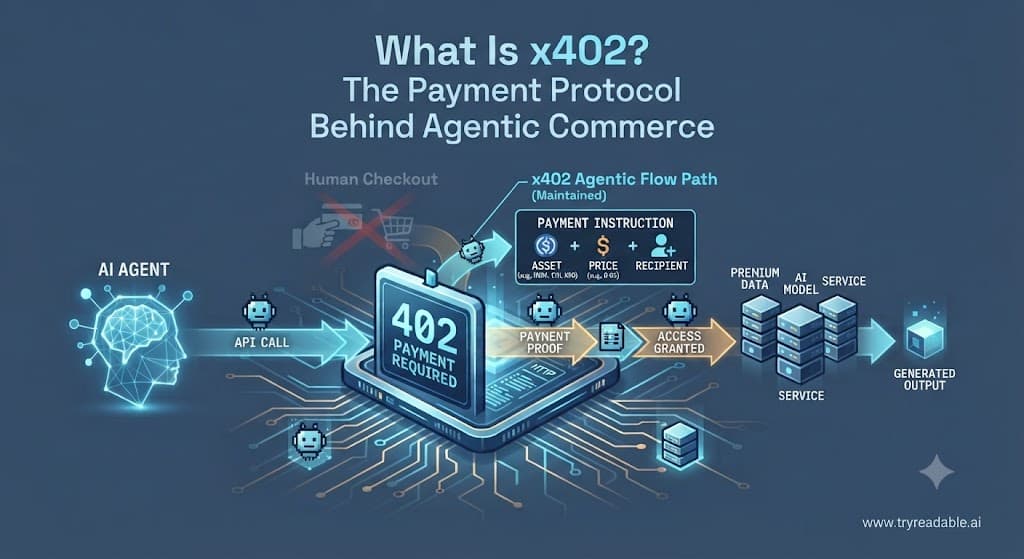
x402 is one of the most important protocols in this shift because it brings payment requirements into the HTTP request itself.
What makes agentic payments different
Traditional payments are designed around human intent at a visible moment of checkout. Agentic payments are designed around delegated intent across a workflow.
That creates several differences.
The buyer may be software
The user may have given broad instructions, but the immediate actor is an agent. The agent decides whether a paid resource is useful, whether it fits the user's constraints, and whether the payment should be attempted.
The payment may be small
Many agentic payments are likely to be resource-level purchases: one API call, one dataset, one analysis, one generated asset, one lookup, or one reserved action.
A full checkout flow is too heavy for that.
The transaction needs context
An agentic payment is not just an amount. It needs context:
- What was requested?
- Who authorized the agent to act?
- What constraint was applied?
- What resource was unlocked?
- What proof confirms the transaction?
- What should happen if the paid request fails?
The merchant needs evidence
Merchants and platforms need logs, receipts, verification, and policy enforcement. A paid agent request without structured evidence creates operational risk.
How x402 supports agentic payments
x402 makes payment a direct part of the HTTP request-response cycle.
The official x402 docs describe a pattern where a protected resource can respond with HTTP 402 Payment Required. The response contains payment instructions. The client pays through a supported scheme, then retries the request with payment proof.
For AI agents, this is valuable because the payment requirement is structured. The agent does not need to parse a checkout page or guess which button to click.
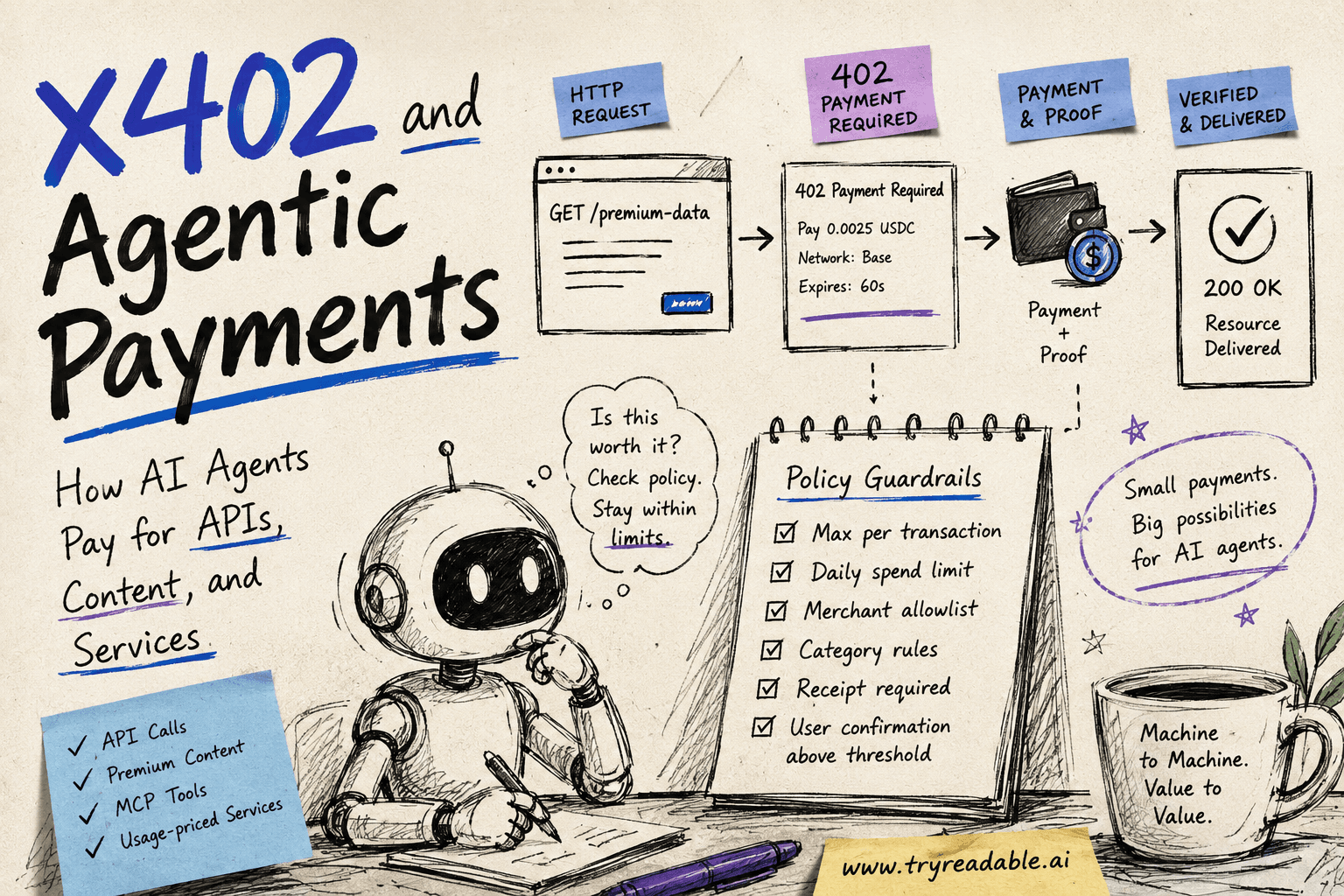
A simple agentic payment flow might look like this:
- The agent requests a premium endpoint.
- The endpoint returns a 402 response with payment requirements.
- The agent evaluates whether the price fits the user's policy.
- The agent obtains or uses payment capability.
- The agent retries the request with payment proof.
- The server verifies payment and returns the result.
- The agent stores the receipt and continues the task.
Source references:
Where x402 fits best today
The highest-value x402 use cases are not necessarily full retail purchases. They are paid digital resources where the agent can understand value before payment.
Paid API calls
An AI agent may need an API call for weather data, financial data, enrichment, identity verification, research, SEO intelligence, or product availability.
Instead of requiring every agent operator to create an account and preload credits, the API can respond with a payment requirement for the specific request.
Premium content retrieval
An agent preparing a decision brief may need access to a report, benchmark, article, or expert dataset. x402 can support payment for one resource instead of forcing a subscription.
This is especially relevant for research publishers and data companies.
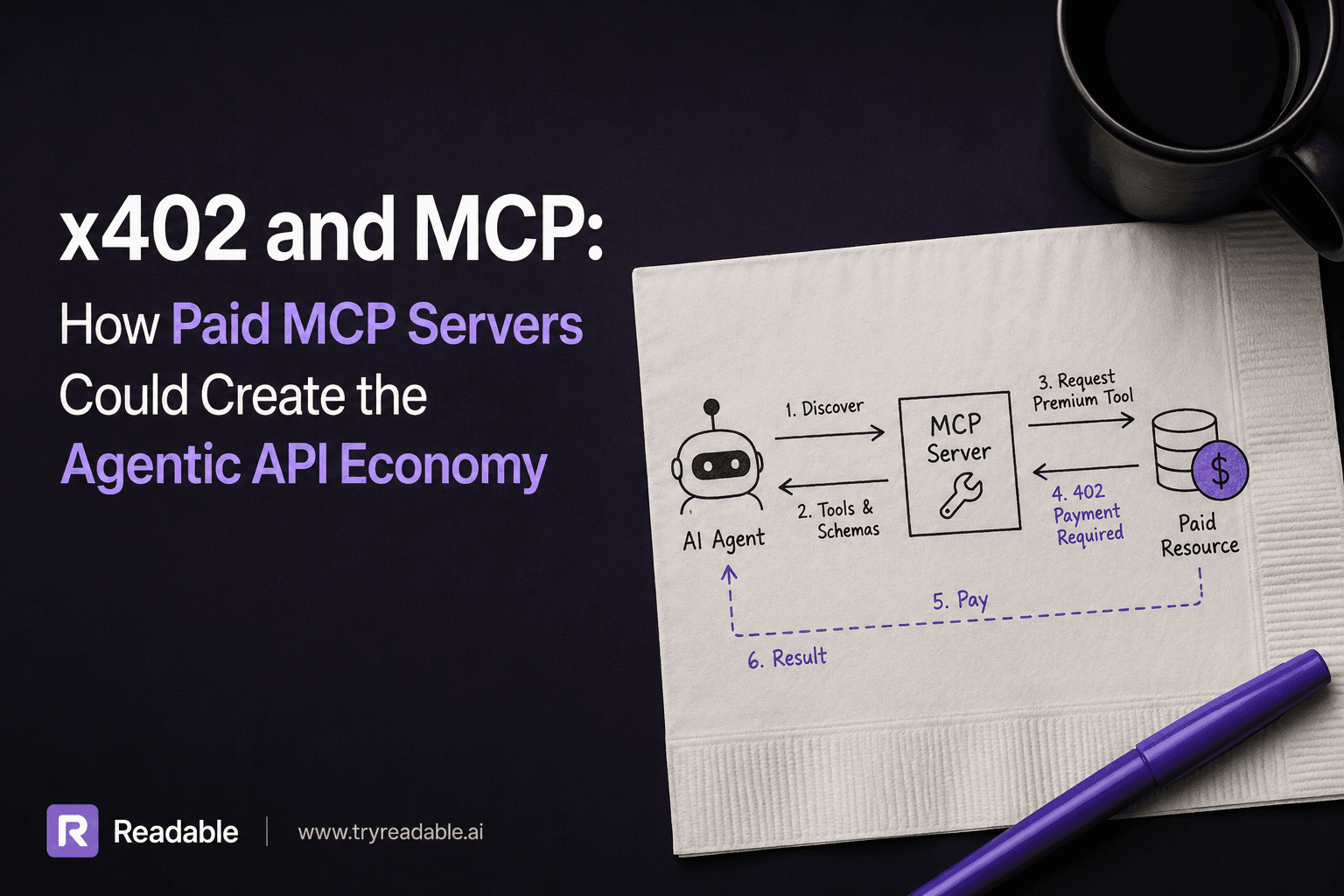
Paid MCP tools
MCP lets agents call external tools. x402 can let those tool calls become paid actions.
For example, an agent might call a market-research MCP server. The free tool can describe available reports. A premium tool call can return the full benchmark after payment.
Usage-priced AI services
Some AI services are too expensive to expose freely. x402 can help charge per transformation, per generation, per validation, or per workflow step.
B2B procurement and verification
In B2B workflows, agents may need to validate vendors, request compliance artifacts, check a product fit score, or retrieve machine-readable terms. Not all of those actions require a full sales cycle. Some can be priced as narrow paid services.
Why agentic payments need policy
The hardest part of agentic payments is not the payment message. It is authorization.
A payment-capable agent should not be able to spend freely. It needs policy boundaries.
Common controls include:
- Maximum amount per transaction.
- Maximum spend per day or workflow.
- Merchant allowlists or blocklists.
- Category constraints.
- Required user confirmation above a threshold.
- Receipt requirements.
- Refund and dispute handling.
- Data-sharing restrictions.
This is why x402 should be understood as one layer in the agentic payments stack, not the whole stack.
x402 can express and verify the paid resource request. Identity, user consent, spend controls, and risk decisions still need to be handled by surrounding systems.
x402 versus checkout
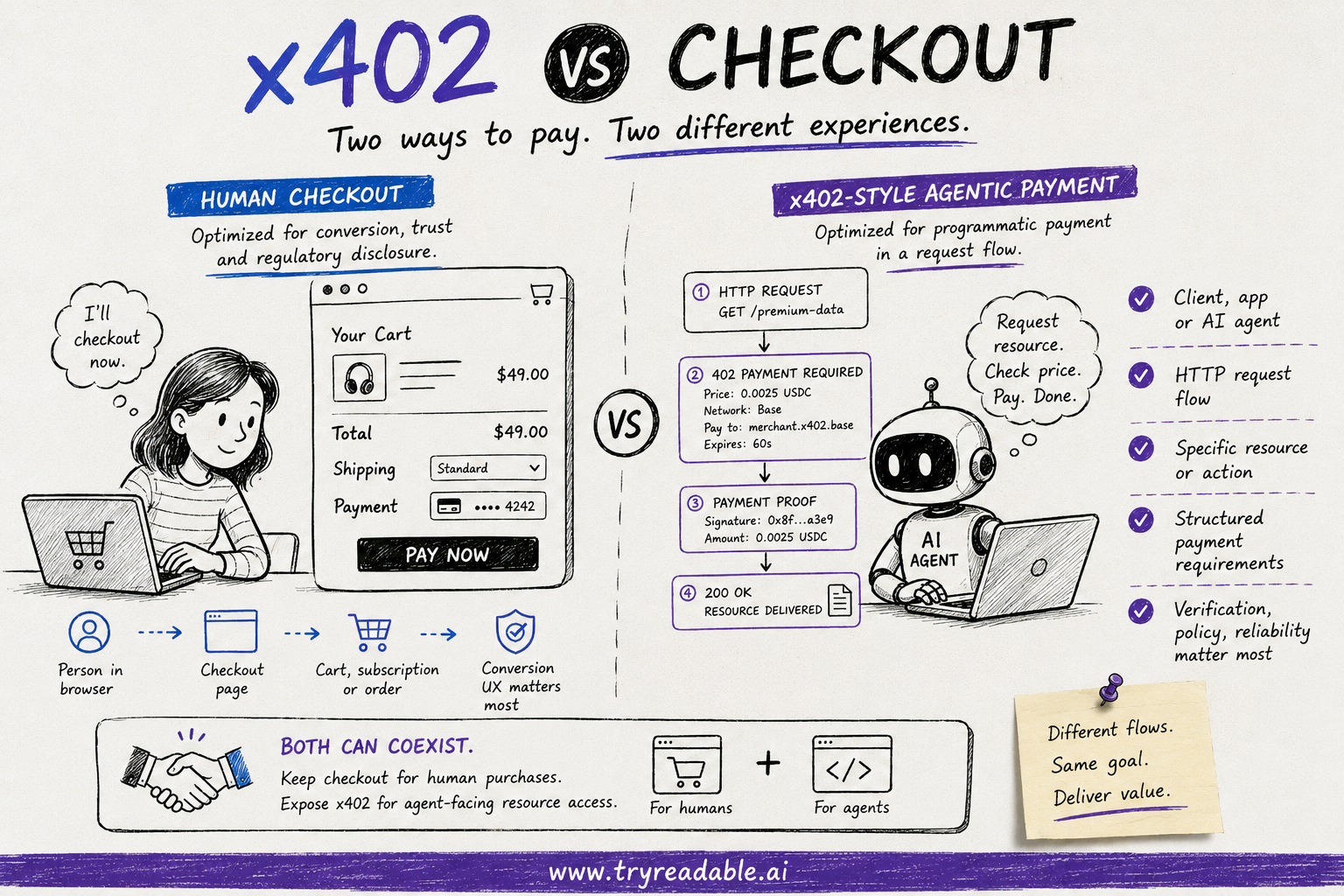
Human checkout is optimized for conversion, trust, and regulatory disclosure in a visual interface. x402 is optimized for programmatic payment in a request flow.
| Question | Human checkout | x402-style agentic payment |
|---|---|---|
| Who is acting? | A person in a browser | A client, app, or AI agent |
| Where does payment happen? | Checkout page | HTTP request flow |
| What is being bought? | Cart, subscription, or order | Often a specific resource or action |
| How is value described? | UI and copy | Structured payment requirements |
| What matters most? | Conversion UX | Verification, policy, reliability |
Both models can coexist. A merchant may keep checkout for human purchases and expose x402 for agent-facing resource access.
What merchants should prepare before agentic payments
Many teams will be tempted to start with payment rails. That is understandable, but incomplete.
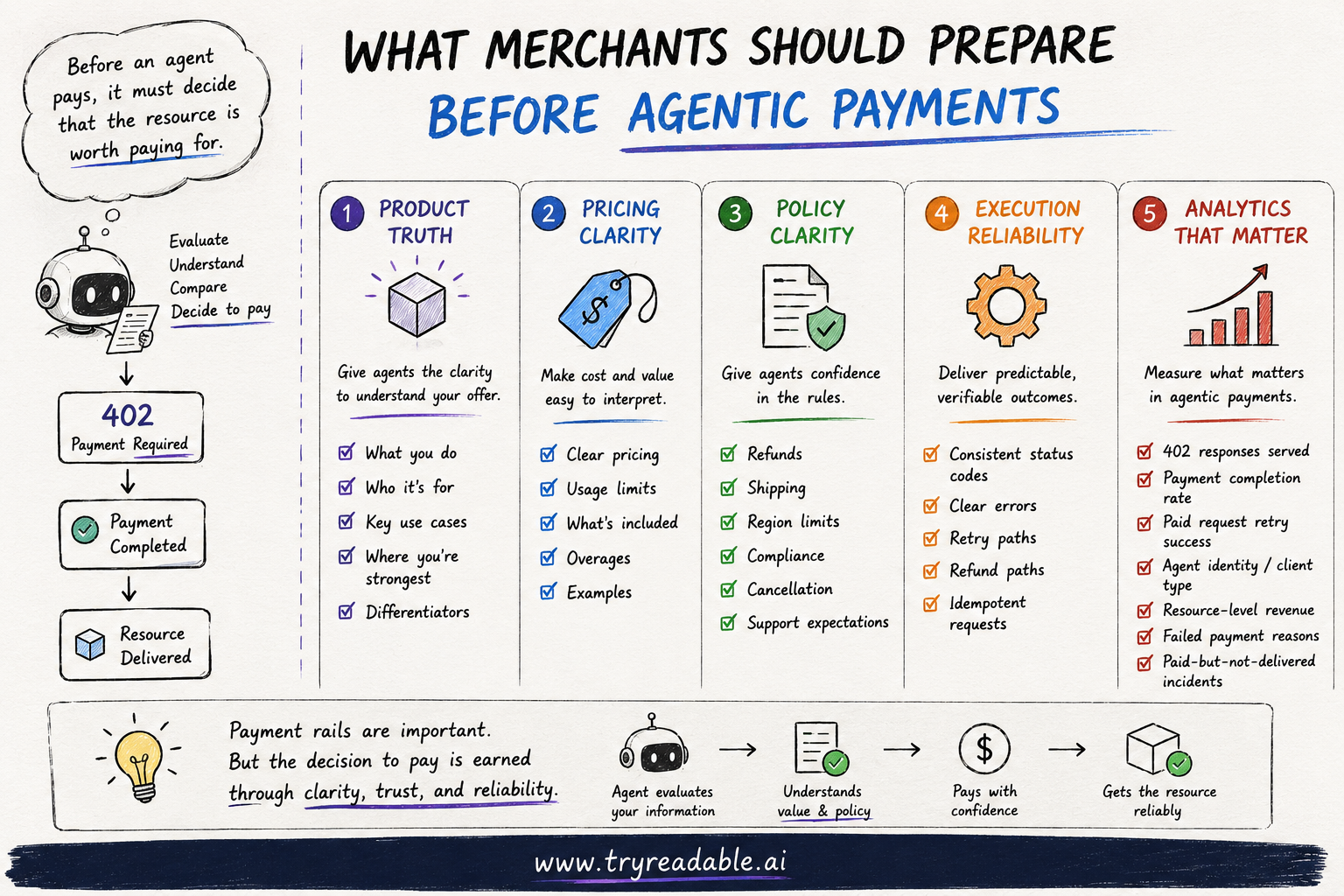
Before an agent pays, it must decide that the resource is worth paying for.
That decision depends on your agent-facing information layer.
Product truth
Agents need clear descriptions of what your product or service does, who it is for, and where it is strongest.
If AI systems cannot explain your offer correctly, payment readiness will not help.
Pricing clarity
Agents need to understand cost, usage limits, overages, and what is included. Ambiguous pricing weakens agent confidence.
Policy clarity
Refunds, shipping, region limits, compliance boundaries, cancellation rules, and support expectations should be structured and easy to interpret.
Execution reliability
A paid agent request must return predictable status. If a paid action fails, the agent needs a clear error, retry path, or refund path.
Analytics
Teams need to measure more than sessions and pageviews. Agentic payments require metrics like:
- 402 responses served.
- Payment completion rate.
- Paid request retry success.
- Agent identity or client type.
- Resource-level revenue.
- Failed payment reasons.
- Paid-but-not-delivered incidents.
Readable's guide to AI agent analytics is a useful companion here.
Why x402 changes the content strategy
Agentic payments create a new SEO and AEO challenge.
If your paid resource is invisible to AI systems, it will not be selected. If your content does not explain why the resource is useful, an agent may choose a cheaper or clearer alternative.
This means teams need content that answers:
- What does this endpoint, tool, report, or service do?
- When should an agent use it?
- What does it cost?
- What proof does it return?
- What alternatives exist?
- What policy limits should be respected?
The best agentic-payment content will not read like a generic product page. It will read like a buyer guide for both humans and machines.
A practical agentic payments roadmap
For teams exploring x402, a pragmatic sequence looks like this:
- Identify narrow resources an agent would pay for.
- Define the value of each resource in plain language.
- Publish explainers and FAQs that make the resource discoverable.
- Create structured metadata around price, limits, and policy.
- Add a callable endpoint or MCP tool.
- Add x402 payment requirements where paid access makes sense.
- Instrument the full flow from discovery to paid request.
- Review failures weekly and improve content, policy, and endpoint reliability.
This sequencing matters. If you start with payment but skip discovery, the agent has nothing to choose. If you start with an endpoint but skip policy, you create risk. If you start with content but skip execution, you cannot capture the transaction.
FAQ
What are agentic payments?
Agentic payments are payments initiated or assisted by AI agents inside a delegated workflow. The user may define the goal and constraints, while the agent evaluates and executes specific paid actions.
How does x402 help AI agents pay?
x402 lets a server return payment requirements through HTTP 402. The agent can read those requirements, complete payment through a supported scheme, and retry the original request with payment proof.
Is x402 better than checkout?
It depends on the use case. Human checkout is still useful for many consumer purchases. x402 is better suited to programmatic access, paid APIs, paid tools, and digital resources that agents can buy as part of a workflow.
What is the biggest risk with agentic payments?
The biggest risk is unmanaged delegation. Teams need spend limits, consent boundaries, merchant controls, clear receipts, and reliable failure handling.
How should marketers prepare for x402?
Marketers should make product facts, pricing, policies, and use cases clear enough for AI systems to retrieve and compare. Agentic payment readiness starts with agentic visibility.
The bottom line
x402 gives agentic payments a practical HTTP-native pattern. It can help agents pay for APIs, content, MCP tools, and digital services without dragging every transaction through a human checkout funnel.
But the winners will not be the companies that merely accept an agent payment.
The winners will be the companies agents can discover, understand, trust, pay, and measure.
Make your agentic payment surface easier to find
Readable helps teams understand where AI systems already mention them, where they are missing, and what content to build before agent-driven payments matter.