x402 is usually explained as a developer protocol. Merchants should read it as a signal about where commerce is going.
Agentic commerce will not be limited to people browsing product pages and clicking checkout buttons. AI agents will increasingly discover options, compare constraints, verify facts, and execute narrow actions on behalf of users.
When that happens, payment becomes only one part of the transaction.
The agent must also understand your product, trust your data, evaluate your policies, and confirm that the paid action completed correctly.
x402 can help with the payment step. It does not solve the rest automatically.
Why x402 matters for agentic commerce
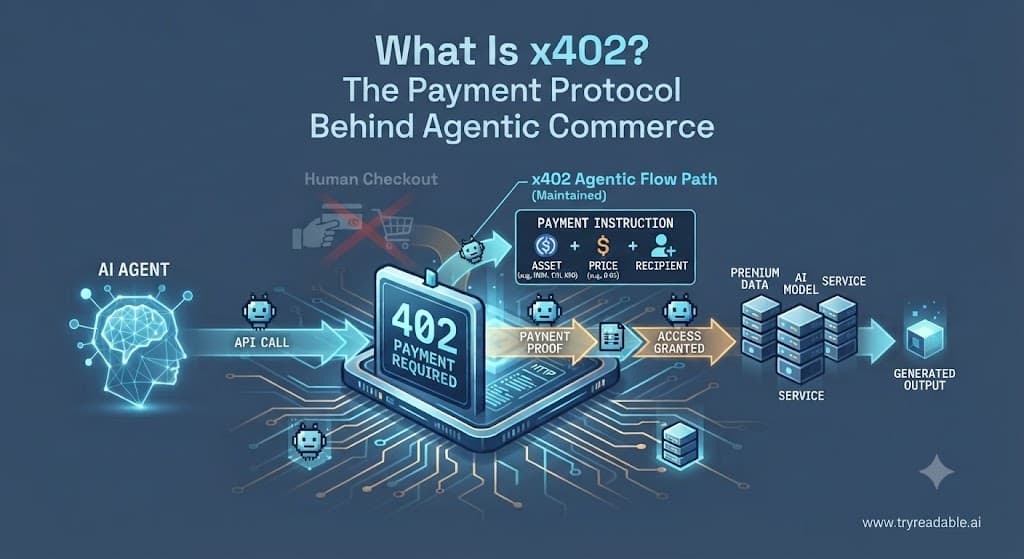
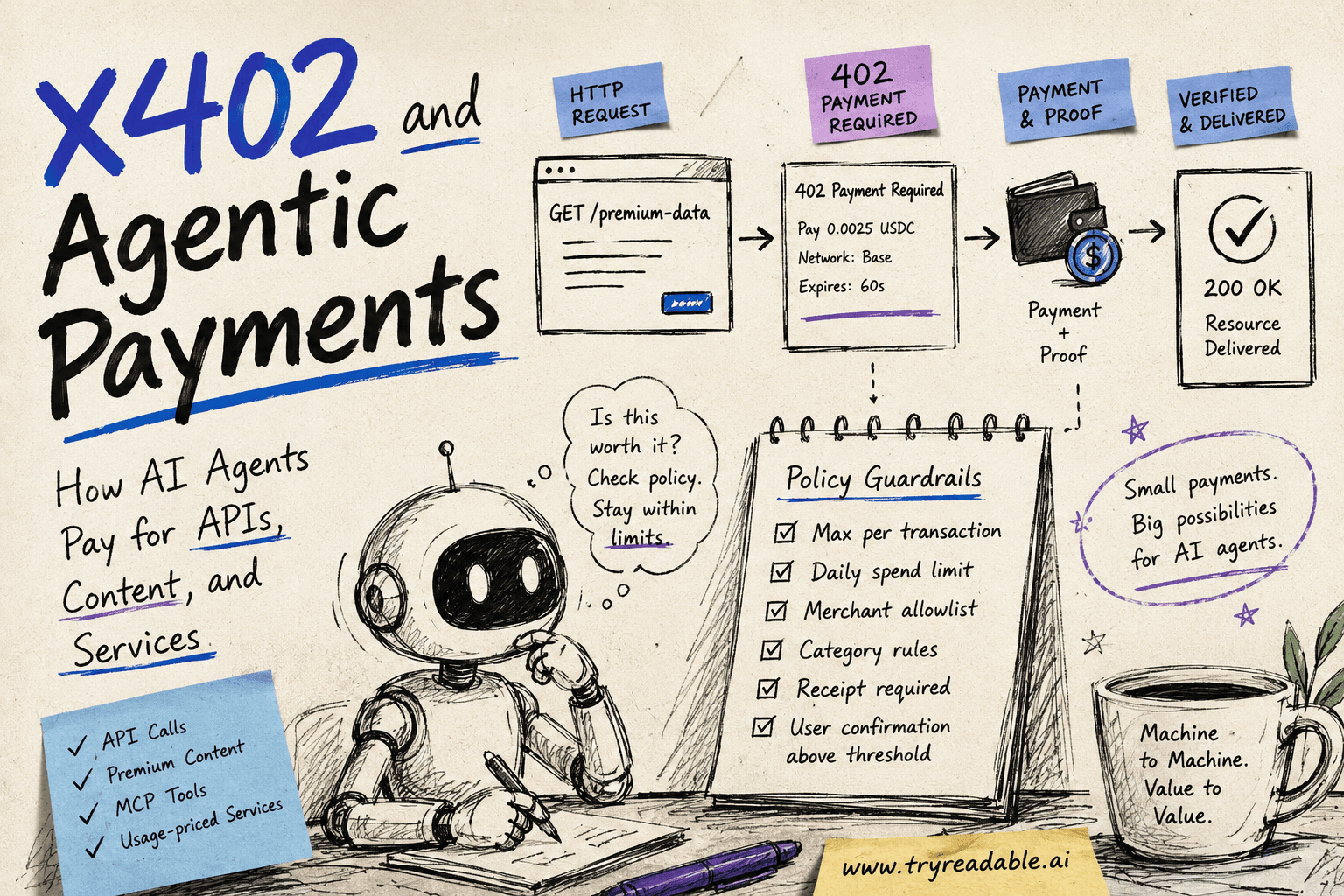
x402 uses the HTTP 402 Payment Required status code to let a server tell a client that a requested resource requires payment. The client can complete payment and retry the request with proof.
For commerce teams, that creates a new pattern: some paid actions can happen through a machine-readable HTTP flow instead of a human checkout page.
That matters because AI agents do not shop the same way humans do.
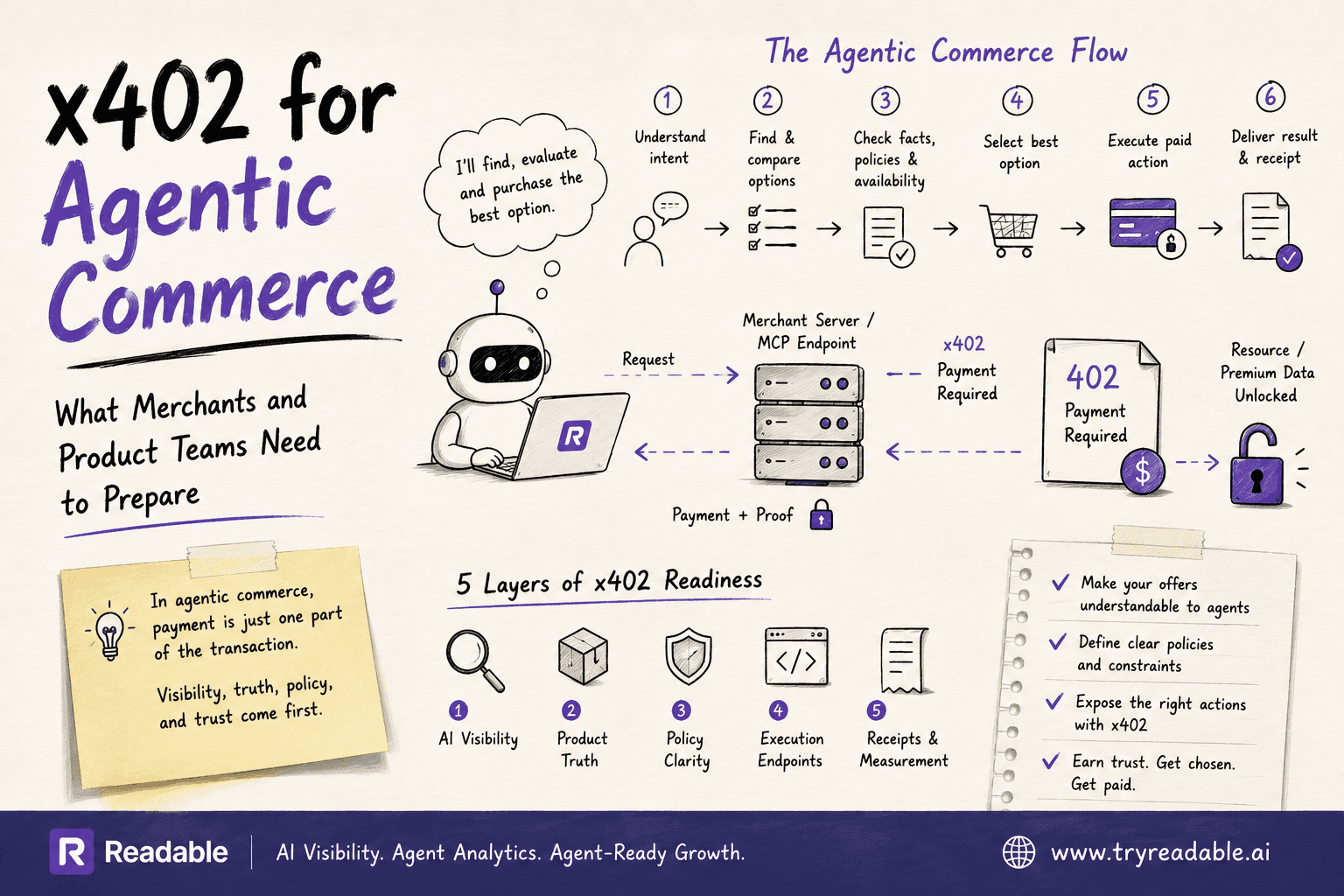
A human might browse a site, read reviews, add products to cart, compare shipping options, and then buy. An agent may do this instead:
- Convert user intent into constraints.
- Retrieve candidate options from trusted sources.
- Compare price, quality, availability, policy, and delivery.
- Select a resource or merchant.
- Execute a narrow paid action.
- Return the result and receipt to the user.
In that world, your commerce interface is no longer only your website. It is also your data, APIs, policies, payment requirements, and transaction evidence.
The merchant mistake: treating x402 as checkout
x402 is not simply a new checkout button.
It is better understood as a payment primitive for agent-facing resources. A merchant might use x402 for:
- Paid product-data access.
- Premium availability checks.
- Digital downloads.
- Expert reports.
- API-based quoting.
- Reservation holds.
- Verification services.
- Paid support or workflow actions.
That does not mean a fashion brand or marketplace should immediately replace checkout with x402. It means product teams should identify which parts of their buying journey need programmatic execution.
A human order may still require traditional checkout. A narrow agent task may not.
The five layers of x402 readiness
Merchants preparing for x402 should think in layers.
1. AI visibility
Before an agent pays, it must decide that your brand belongs in the answer set.
If AI systems do not know what you sell, who you serve, where you are strong, or why buyers choose you, your x402 endpoint may never be reached.
This is why AI visibility and agentic payments are connected. Visibility is upstream of transaction.
Start by checking whether ChatGPT, Gemini, Perplexity, and Google AI experiences accurately describe your brand for buyer-intent questions.
Readable's guide to how ChatGPT finds and chooses websites is a useful starting point.
2. Product truth
Agents need facts, not vibes.
Your product data should make core buying criteria explicit:
- Product names and variants.
- Category and use case.
- Price and pricing model.
- Availability.
- Delivery or fulfillment constraints.
- Compatibility.
- Refund and cancellation rules.
- Evidence, reviews, certifications, and guarantees.
If this information is trapped in images, vague copy, scripts, or inconsistent pages, agents may misread it or skip it.
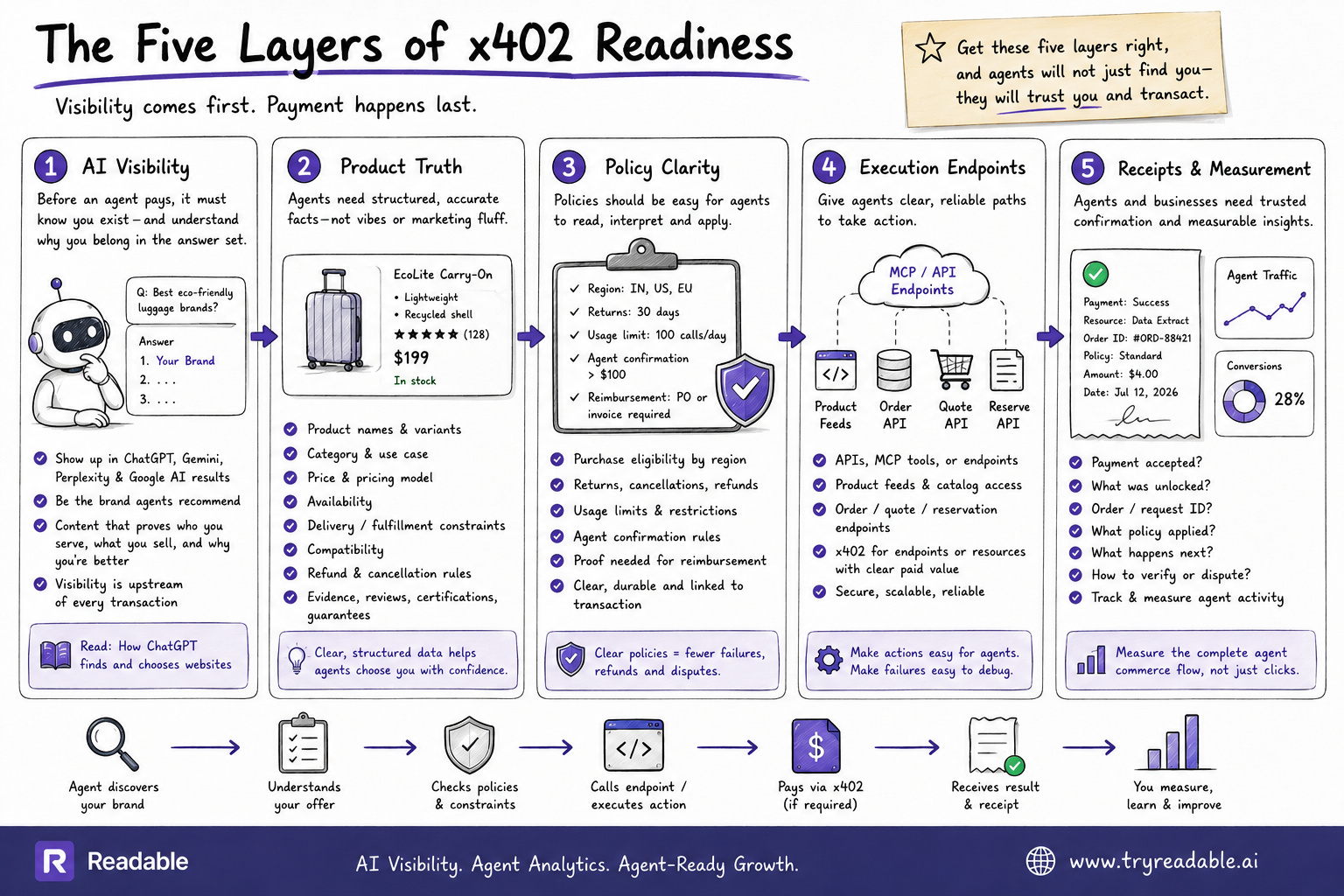
3. Policy clarity
Agentic commerce creates policy questions that are easy for humans to understand but hard for agents to infer.
For example:
- Can the product be purchased in this region?
- What happens if the user cancels?
- Is the item returnable?
- Are there usage limits?
- Does the agent need user confirmation above a spend threshold?
- What proof is required for business reimbursement?
Policies should be structured, durable, and linked to the transaction.
4. Execution endpoints
A merchant needs agent-callable paths for the actions agents should take.
That may mean APIs, MCP tools, product feeds, order endpoints, quote endpoints, or reservation endpoints.
x402 becomes relevant when a specific endpoint or resource has clear paid value.
5. Receipts and measurement
Agentic commerce needs confirmation states that software can trust.
The agent should be able to answer:
- Was payment accepted?
- What resource was unlocked?
- What order or request ID was created?
- What policy applied?
- What should happen next?
- How can the user verify or dispute it?
Your analytics team should also be able to measure the flow.
Traditional analytics often miss AI agent activity. See what your analytics misses when AI agents visit your website for the broader measurement problem.
Where x402 fits in the agentic commerce stack
A practical agentic commerce stack has several parts:
| Layer | Business question | Example |
|---|---|---|
| Discovery | Can agents find us? | AI search visibility, topic authority, agent directories |
| Understanding | Can agents interpret our offer? | Product facts, comparison content, schema, policies |
| Evaluation | Can agents compare us? | Pricing, fit criteria, proof, reviews, constraints |
| Execution | Can agents act? | APIs, MCP tools, order or quote endpoints |
| Payment | Can agents pay safely? | x402, tokenized payments, checkout APIs |
| Evidence | Can both sides verify? | Receipts, logs, status, reconciliation |
| Measurement | Can we improve it? | Agent analytics, paid request success, conversion attribution |
x402 sits mainly in the payment layer. Its value depends on the layers around it.
x402 and MCP in merchant workflows
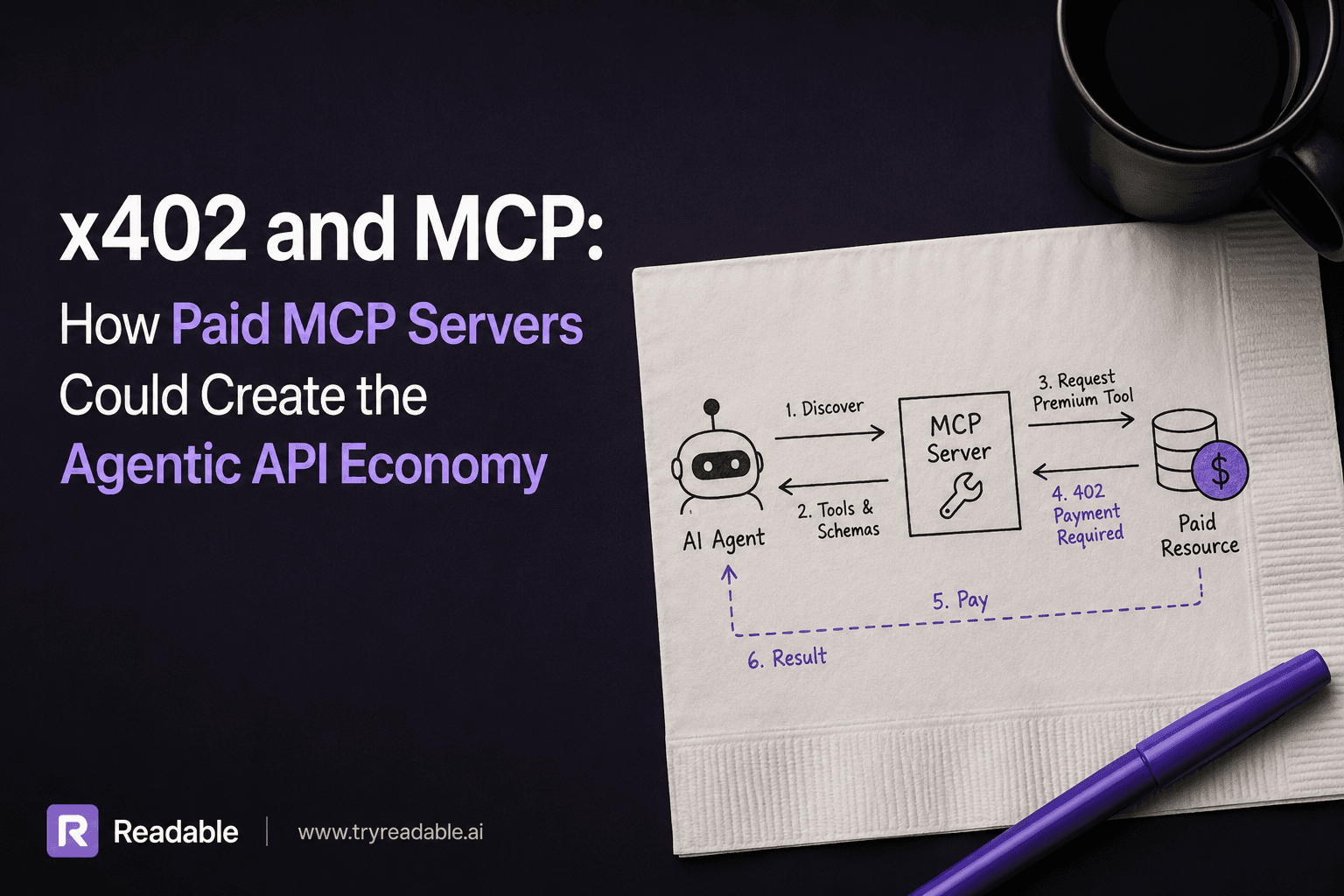
MCP is relevant because it gives agents a standard way to call tools and access data. x402 is relevant because some of those calls may require payment.
For a merchant, the combination might look like this:
- A product catalog MCP server exposes product search and availability.
- Free calls return basic product facts.
- Paid calls unlock premium personalization, inventory holds, custom bundles, or detailed recommendations.
- x402 handles payment requirements for those paid calls.
- Receipts and statuses feed analytics.
This is not science fiction for every merchant tomorrow. But it is a plausible direction for high-value agentic workflows.
What to create before implementing x402
If your goal is to win agentic commerce demand, build the content and data layer before the payment layer.
Recommended assets:
Buyer-question pages
Create pages that answer the questions agents are likely to ask when evaluating your category:
- Best product for a specific use case.
- Product versus competitor.
- Pricing and value comparison.
- Integration and compatibility questions.
- Policy and trust questions.
Machine-readable policy pages
Publish structured pages for returns, refunds, shipping, SLAs, regions, compliance, and usage limits.
Product truth pages
Give agents a stable source of truth for each product or service. Avoid contradictory claims across landing pages, docs, marketplaces, and support pages.
Endpoint documentation
If you expose APIs, tools, or MCP servers, explain what each endpoint does, what it costs, what it returns, and when an agent should use it.
Measurement documentation
Define what your organization counts as an agent-driven conversion, agent-assisted transaction, paid tool call, or AI-referred customer.
How to decide whether x402 is worth piloting
x402 is most attractive when a paid resource has these qualities:
- The value is easy to understand before payment.
- The request can be fulfilled programmatically.
- The price is small enough for delegated workflows.
- The action does not require complex human negotiation.
- The result can be verified immediately.
- The failure path can be handled clearly.
Examples that fit:
- One premium API response.
- One market-data lookup.
- One report download.
- One reservation hold.
- One generated file.
- One verification result.
Examples that may not fit yet:
- Complex custom enterprise purchases.
- High-risk regulated transactions.
- Purchases requiring detailed human consultation.
- Orders where fulfillment terms are ambiguous.
A 30-day readiness plan
Week 1: audit AI visibility
Identify the buyer questions where AI systems should recommend you. Check whether your brand appears, how it is described, and which competitors are mentioned instead.
Week 2: clean product and policy truth
Fix unclear claims, missing pricing context, weak product pages, and fragmented policy content.
Week 3: map agent actions
List the specific actions an agent might take: search inventory, request a quote, check policy, unlock a report, reserve an item, call a tool, or pay for data.
Week 4: select one paid resource pilot
Pick one narrow resource with clear value. Define the payment requirement, receipt, failure path, analytics events, and success metric.
Only then should x402 implementation become the next step.
FAQ
What is x402 for merchants?
For merchants, x402 is a way to expose paid digital resources or actions through an HTTP-native payment flow that software and AI agents can understand.
Does x402 replace ecommerce checkout?
No. x402 is better suited to narrow programmatic payments such as paid API calls, digital resources, and agent-facing tools. Human checkout will remain useful for many purchases.
How does x402 relate to agentic commerce?
Agentic commerce requires AI agents to discover, evaluate, and sometimes transact with businesses. x402 can support the payment part of that workflow when a paid resource is requested over HTTP.
What should product teams do before x402?
Product teams should clean product data, pricing, policies, execution paths, receipts, and analytics. Payment should not arrive before the agent can understand the offer.
Why does AI visibility matter for x402?
Agents cannot pay for a resource they never discover or trust. AI visibility determines whether your brand and resources enter the agent's consideration set before the payment step.
The bottom line
x402 may become an important payment primitive for agentic commerce, but it is not the whole strategy.
The merchant opportunity is larger: become understandable, callable, payable, and measurable by AI agents.
If your product truth is weak, x402 will not fix it. If your agent-facing content is missing, x402 will not create demand. If your policies are ambiguous, x402 will not create trust.
But if those foundations are strong, x402 can help turn agentic discovery into agentic transactions.
Turn AI visibility into agent-ready growth
Readable helps you find the buyer questions, product gaps, and missing proof points that stop AI systems from recommending your brand.