AI visibility platforms promise to show when a brand appears in ChatGPT, Gemini, Google AI results and other AI-generated answers. The harder question is whether a buyer can verify what each platform actually does before paying for it.
We explored five platforms using Puma as the common brand: Peec AI, OtterlyAI, Semrush, Profound and Scrunch AI.
The experience revealed a fragmented market. Peec generated a 96-prompt brand analysis. Otterly produced a Puma report from one prompt and exposed several useful research tools. Semrush showed substantial domain-level AI Search estimates but restricted its deeper AI Visibility workflow. Profound required a demo, while Scrunch required payment details before a live brand evaluation.
This is why we have not forced the products into a numerical ranking. Their figures came from different questions, markets and methods. Instead, this guide compares what a prospective buyer could actually see, what the evidence reveals and what still needs to be verified.
The screenshots were captured during the evaluation on 21–22 November 2026. Readable publishes this guide and is not included in the score comparison.
The short version
| Platform | What we could evaluate | Access observed | The clearest use case |
|---|---|---|---|
| Peec AI | A first-run Puma project with 96 prompts, visibility, share of voice and competitors | Seven-day trial followed by a paid plan | Structured brand and competitor monitoring |
| OtterlyAI | Puma prompt tracking, citations, content checks, crawlability and query fan-out | Seven-day trial visible in the product | Prompt monitoring plus practical research and site checks |
| Semrush | Worldwide AI Search estimates for puma.com alongside SEO data | Full AI Visibility workflow was trial-gated | Existing Semrush users connecting AI discovery with SEO |
| Profound | Enterprise positioning, pricing approach and demo route | Demo required; custom enterprise pricing | Enterprise buyers prepared for a sales-led evaluation |
| Scrunch AI | Trial terms and entry pricing | Card required for a seven-day trial | Buyers willing to begin with a card-gated product trial |
There is no defensible overall winner from the evidence available. Peec exposed the most substantial Puma project during onboarding. Otterly exposed the widest collection of accessible diagnostic tools, but its Puma result came from only one prompt. Semrush supplied useful high-level estimates while its deeper toolkit remained restricted. Profound and Scrunch could not be assessed using live Puma results.
Why the visibility scores cannot be compared directly
An AI visibility percentage only makes sense in the context of the questions being tracked.
A brand may appear in every answer to a branded question such as “best Puma running shoes” and receive 100% coverage. The same brand may appear far less frequently across broader questions such as “best running shoes for flat feet” or “lightweight shoes for a first marathon.” Both results can be correct, but they measure different things.
Market selection also changes the output. The Peec and Otterly Puma projects available to us were configured for the United States. Semrush displayed worldwide domain estimates. Putting those figures in one league table would create certainty that the data does not support.
We therefore evaluated more useful buying questions:
- How quickly can a buyer reach real brand data?
- Can the buyer inspect the prompts behind the headline score?
- Does the platform reveal competitors and cited sources?
- Does it explain what the marketing team should do next?
- Can the results be exported and independently checked?
- How much commitment is required before the product can be evaluated?
Peec AI: the most complete first-run Puma project
Peec created the broadest Puma dataset in this exercise. Its onboarding flow built a brand profile, asked for a target market and organised the project around four topics: accessories and equipment, athletic apparel, footwear, and motorsport gear.
The resulting project contained 96 prompts, with 24 assigned to each topic. The visible questions covered branded and non-branded discovery as well as commercial, informational and transactional intent.
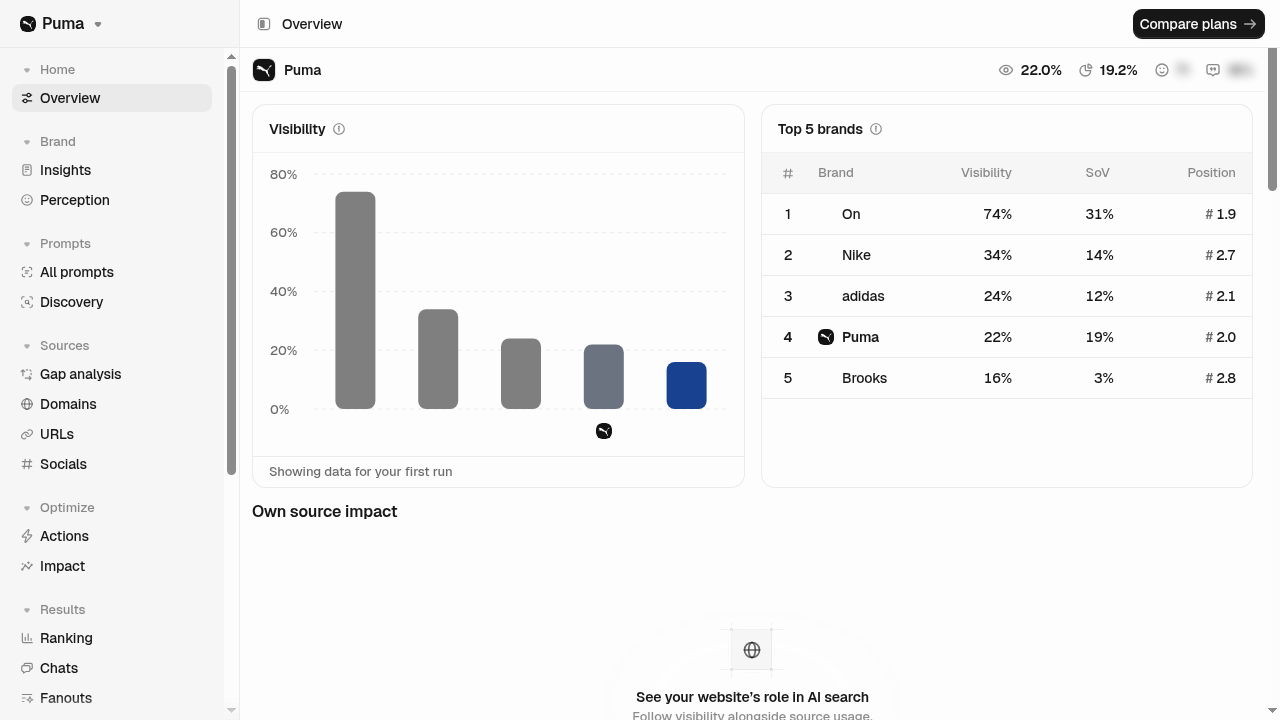
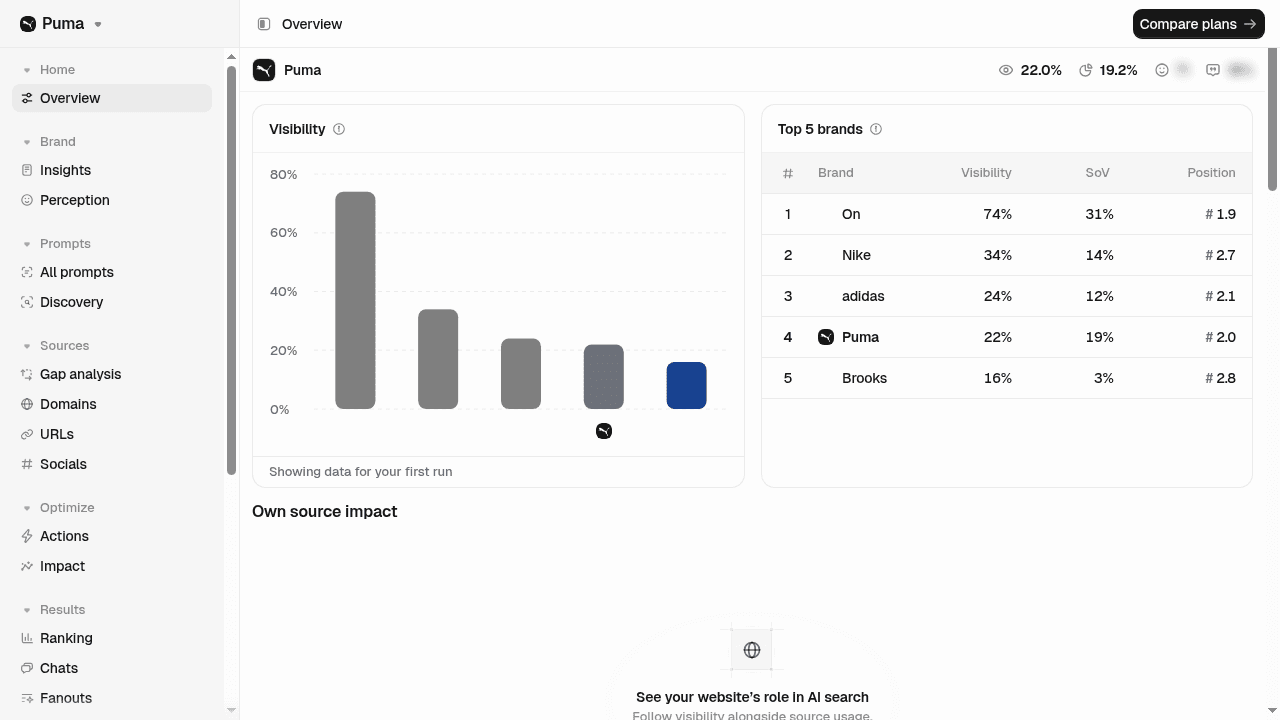
Peec’s first Puma run showed 22% visibility and placed Puma fourth among the five most visible brands.
What Peec showed for Puma
In Peec’s first United States run, Puma recorded:
- 22% visibility;
- 19.2% share of voice in the headline display; and
- an average position of approximately 2.0 in the top-brand table.
The five brands shown in the competitive overview were:
| Brand | Visibility | Share of voice | Position |
|---|---|---|---|
| On | 74% | 31% | 1.9 |
| Nike | 34% | 14% | 2.7 |
| Adidas | 24% | 12% | 2.1 |
| Puma | 22% | 19% | 2.0 |
| Brooks | 16% | 3% | 2.8 |
This was the richest competitive view we could access. It showed how Peec moves from brand setup to a multi-topic question set and competitor overview without requiring the marketer to build every prompt manually.
There was still an important limitation. The prompt-level performance figures were blurred in the trial view. The interface displayed columns for visibility, share of voice, position, win rate and sentiment, but those values could not be inspected. Before buying, we would ask to see how every metric connects to the underlying AI answers.
Peec pricing shown during the evaluation
Peec’s monthly pricing screen listed:
- Starter: $95 per month for 50 tracked prompts, one project and one country;
- Pro: $245 per month for 150 tracked prompts, two projects and three countries; and
- Advanced: $495 per month for 350 tracked prompts, five projects and three countries.
The 96-prompt Puma setup exceeded the Starter allowance and was directed towards the Pro plan. The screen offered a seven-day trial.
Our assessment: Peec made it easy to understand what a real monitoring project could look like. Automatic prompt generation and topic structure can help a marketing team reach a baseline quickly. The next evaluation step should be an unblurred review of the underlying answers, sources and calculation rules.
OtterlyAI: accessible diagnostics, but the Puma score was too narrow
Otterly exposed more individual research and diagnostic tools than the other products we could enter. The screenshots included:
- brand and prompt reporting;
- cited-page reporting;
- crawlability checks;
- an AI content checker;
- query fan-out research; and
- agent analytics setup.
This breadth matters because improving AI visibility involves more than watching a score. Teams also need to understand which pages are cited, whether AI crawlers can access their website and how one customer question expands into related searches.
What Otterly showed for Puma
The Puma report was configured for the United States and contained one prompt: “best Puma running shoes.” For that prompt, Otterly reported:
- 100% brand coverage;
- 1.0 brand position;
- +77 brand sentiment; and
- four brand mentions.
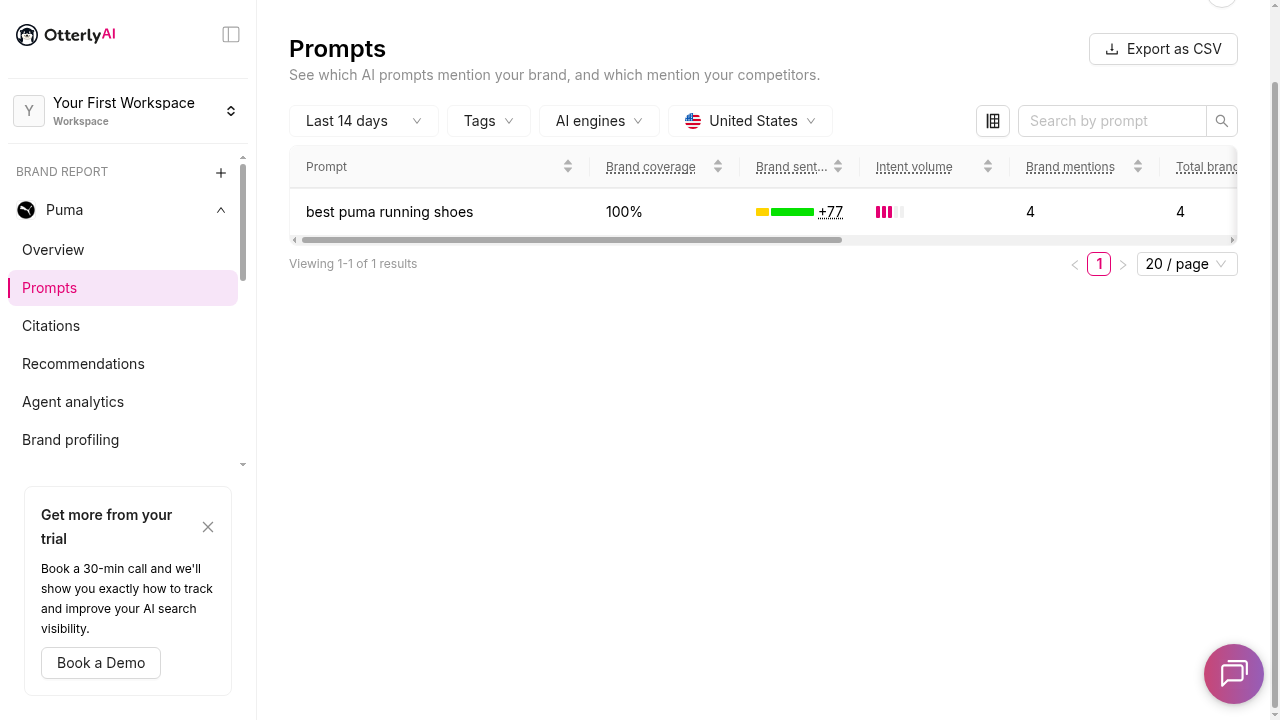
The visible Otterly report contained one highly branded prompt. It recorded 100% coverage, +77 sentiment and four mentions.
These figures do not establish that Puma has 100% AI visibility overall. They describe one branded question captured on the first available day. The dashboard showed one data point and no populated competitor set.
Otterly’s citations were more actionable than the score
Otterly identified cited pages from sources including RunRepeat, The Running Channel and The Run Testers in connection with Puma running shoes.
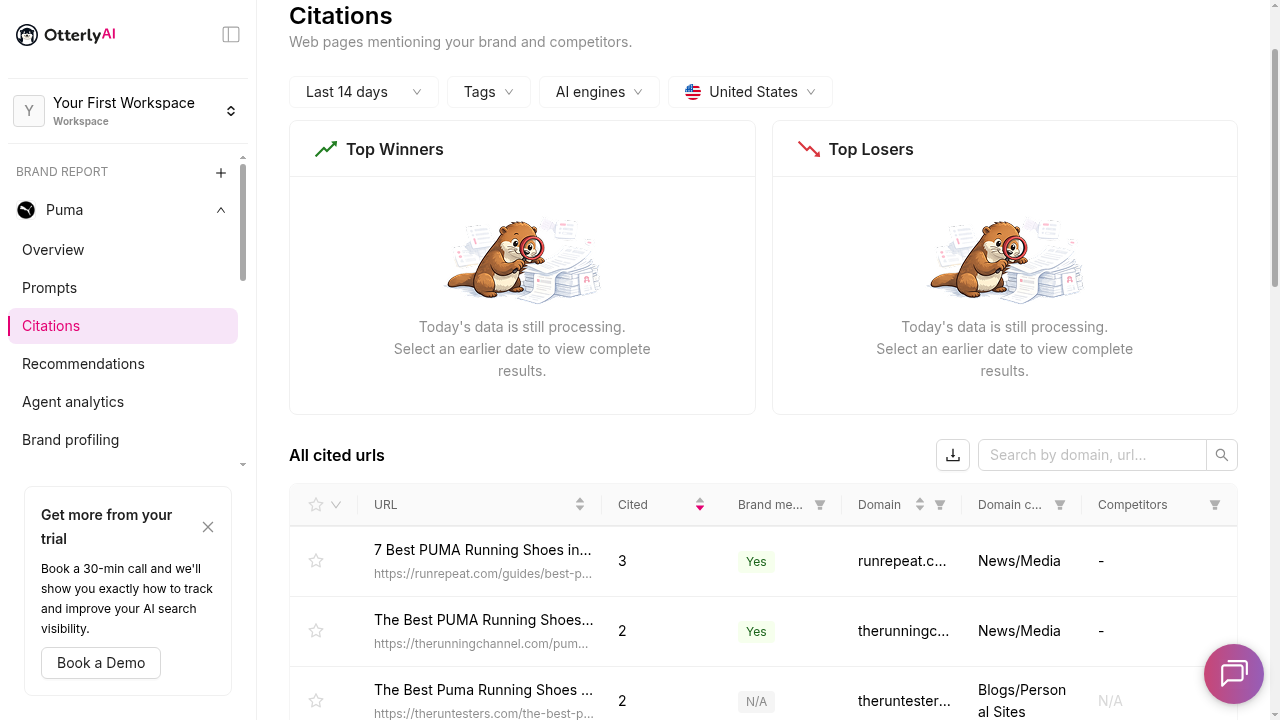
The citation report connected the Puma prompt with third-party running-shoe pages.
This gives a marketer something concrete to investigate: which external pages influence AI answers, why they are selected and whether the brand’s own pages provide equally useful evidence.
Otterly also included a query fan-out tool showing how an initial question can expand in ChatGPT and Google AI Mode.
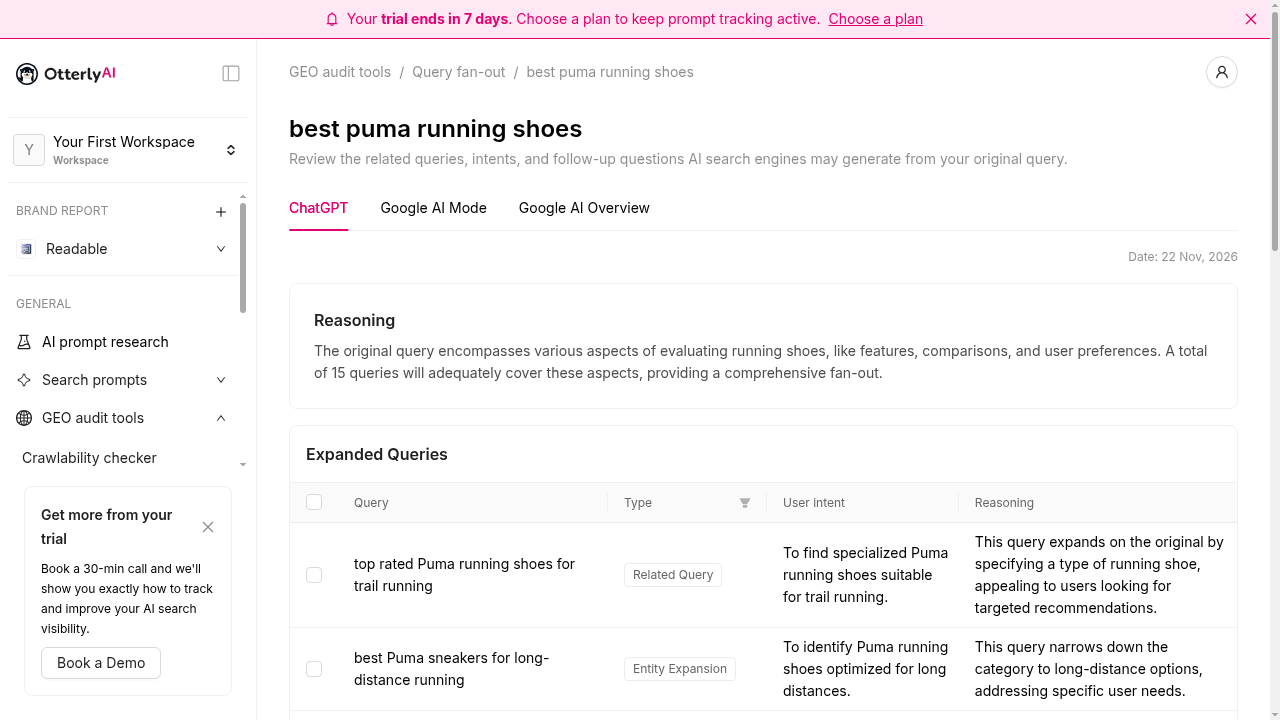
Query fan-out can help marketers expand one seed question into related research areas.
The product also displayed crawlability checks and content-readiness measures. Agent analytics required Puma’s data source to be connected, so visit and conversion measurement was not tested.
Our assessment: Otterly appears useful for teams wanting lightweight monitoring alongside citation research and practical site diagnostics. Its initial Puma score was much too narrow for a buying decision. We would repeat the analysis across branded, category, comparison and purchase-intent questions before judging its monitoring capability.
Semrush: useful domain estimates, but not a hands-on prompt project
Semrush’s Domain Overview supplied the largest top-level figures in the exercise. For puma.com, with the view set to worldwide, its AI Search panel showed:
- an AI Visibility score of 64;
- 288,600 mentions; and
- 82,700 cited pages.
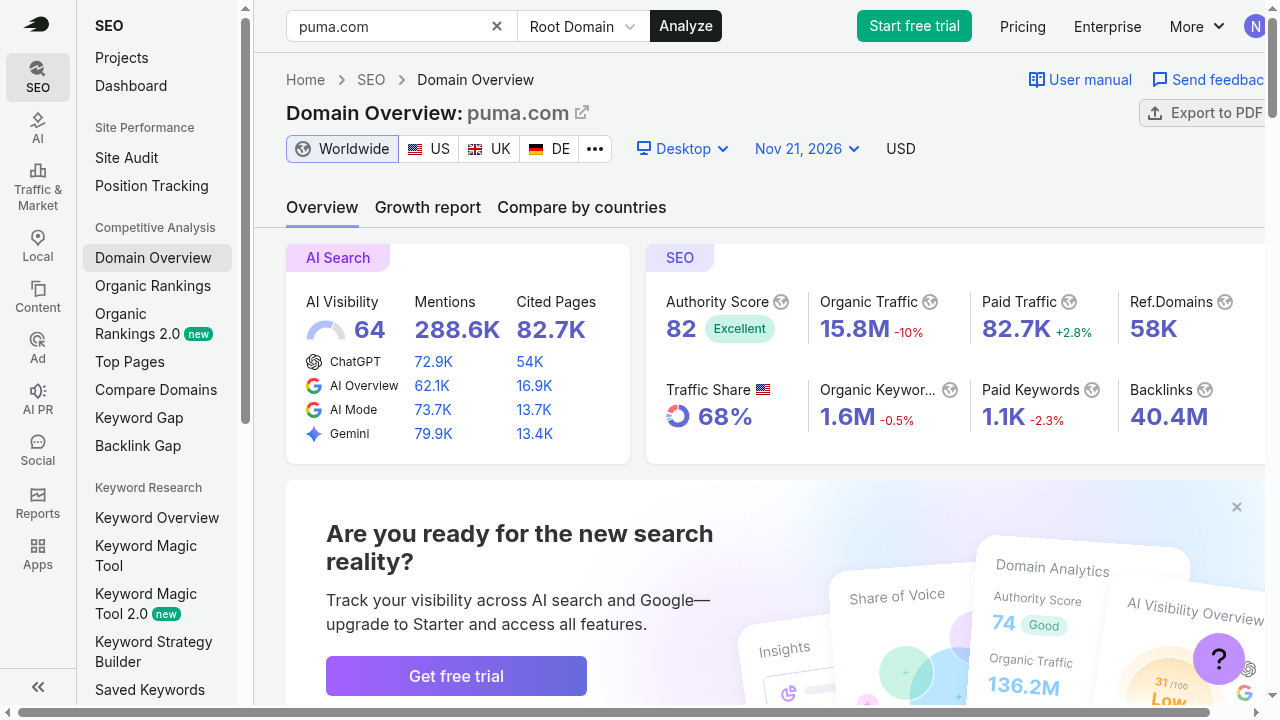
Semrush placed worldwide AI Search estimates beside established SEO metrics for puma.com.
The panel divided its estimates across ChatGPT, Google AI Overview, Google AI Mode and Gemini. It also placed them alongside familiar SEO measures such as authority, organic traffic, keywords, backlinks and referring domains.
That integration is Semrush’s clearest advantage in the evidence available. A team already using the platform can consider AI discovery in the context of its existing search presence.
However, these were domain-level estimates—not a controlled Puma prompt-tracking project. The separate AI Visibility area advertised competitor research, prompt research, brand performance, perception, narrative drivers, questions and prompt tracking, but entering it triggered a trial or upgrade screen.
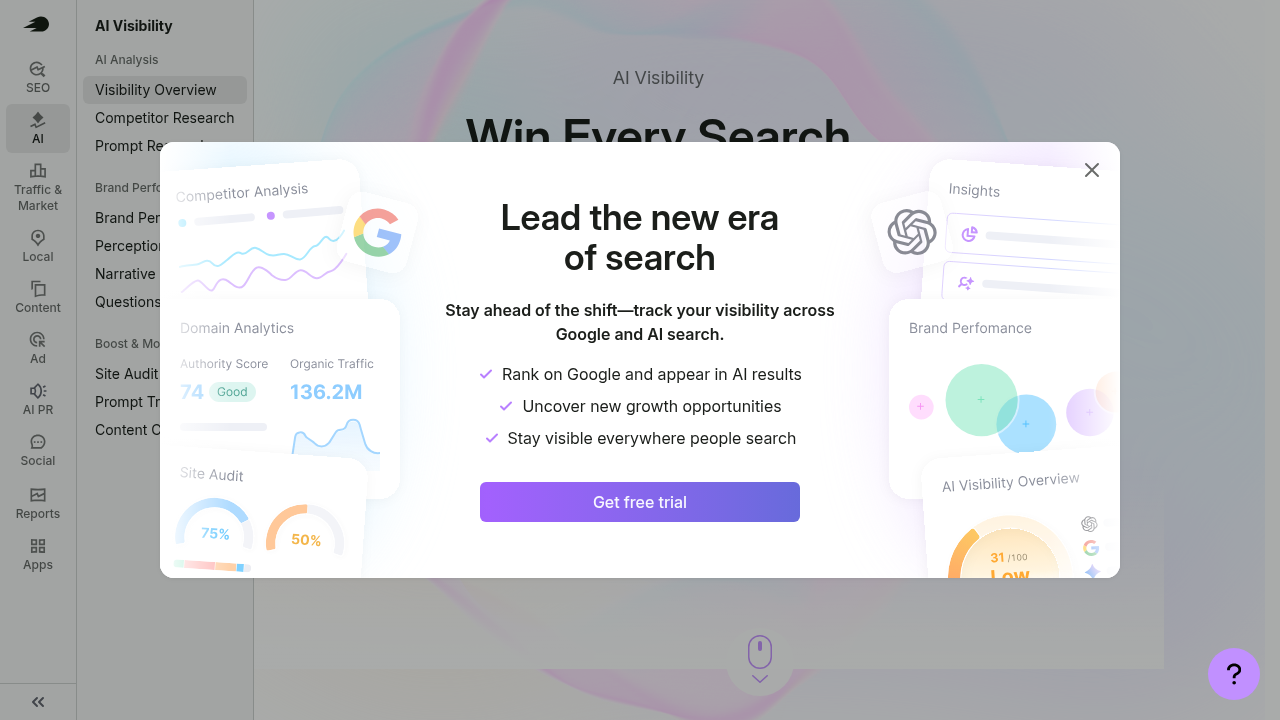
The deeper Semrush AI Visibility workflow directed the user to begin a free trial.
The Top Pages report included an “LLM Prompts” column. The Puma URLs visible in the screenshots showed zero recorded prompts. This is a useful reminder that a large domain-wide number should still be checked against page-level evidence.
Our assessment: Semrush may be the natural starting point for teams that want AI-search indicators alongside SEO research. The screenshots demonstrate scale and context, but not enough of the configurable project workflow to compare it with Peec or Otterly. Before upgrading, we would ask for a live review of prompt selection, competitors, answer-level evidence, location controls and exports.
Profound: an enterprise product with a sales-led evaluation
Profound did not expose a self-serve Puma report. The available journey led from the website to enterprise pricing and a contact-sales form.
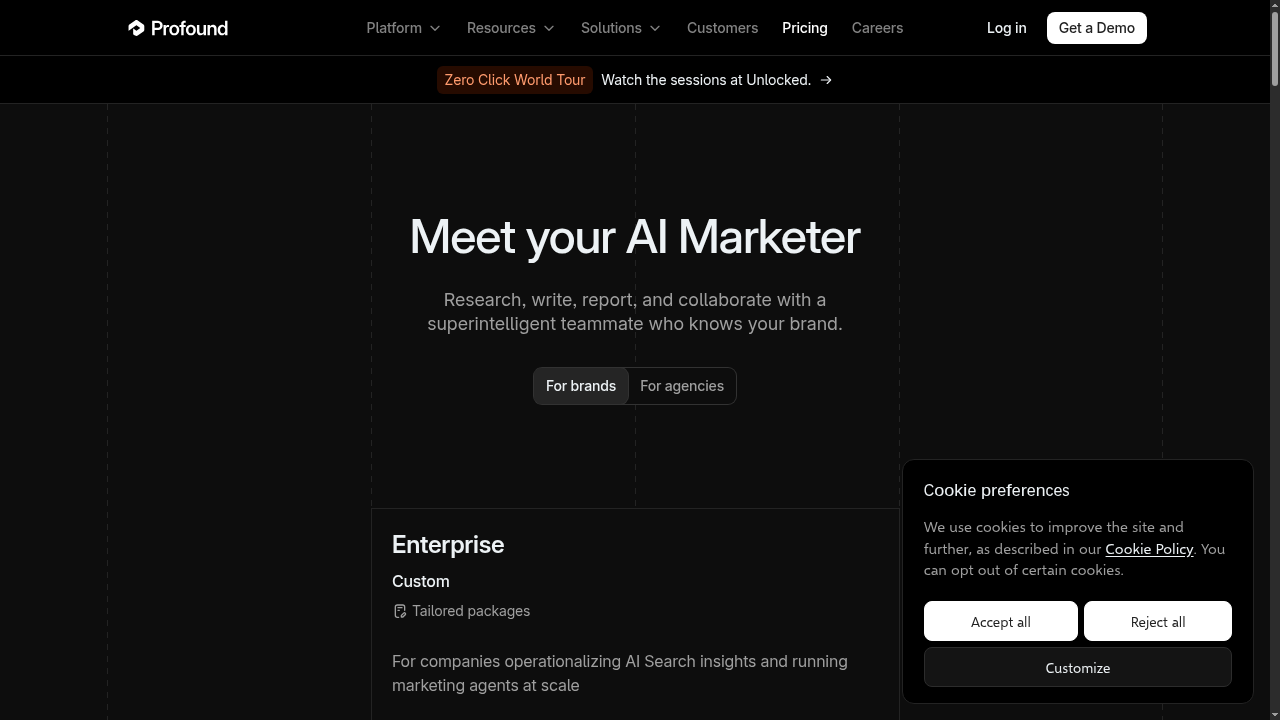
Profound presented a custom enterprise plan rather than public self-serve pricing.
This indicates a different buying process. Profound asks prospective customers to evaluate the product through a tailored demonstration rather than a public workspace.
For an enterprise buyer, that demonstration should be treated as a working session. Ask the vendor to analyse your brand, use your target market and show the answers behind every score. A generic product tour will not establish whether the platform fits your reporting and decision-making needs.
Our assessment: Profound belongs on an enterprise shortlist when the buyer is comfortable with a sales-led process. Its Puma performance, usability and outputs could not be verified from the material available to us.
Scrunch AI: a trial was available, but required payment details
Scrunch offered a seven-day trial for its Core plan, with a displayed price of $250 per month after the trial. Starting the trial required card details through a payment screen.
Scrunch displayed a seven-day trial for its Core plan, followed by a $250 monthly charge.
This creates a different evaluation trade-off. A buyer can apparently access the product without arranging a demo, but must make a billing commitment before seeing live brand results.
Our assessment: Scrunch may still be worth evaluating, but the screenshots only verify its trial and payment path. They do not provide enough evidence to assess Puma visibility, reporting depth or recommendations. Buyers should prepare their prompt set and evaluation checklist before starting the trial.
What this exercise reveals about AI visibility software
“AI visibility” is not one standard metric
Peec calculated visibility and share of voice from a generated 96-prompt set. Otterly reported coverage from one tracked prompt. Semrush displayed domain-wide estimates. The labels sound comparable, but the measurements are not.
Any vendor should be able to explain:
- the denominator behind its visibility score;
- which AI engines are included;
- how frequently questions are run;
- whether responses are location-specific;
- how position and sentiment are calculated; and
- whether historical answers can be inspected.
Prompt quality matters more than dashboard polish
A brand-heavy question set will make an established brand look highly visible. A non-branded category set reveals whether that brand is discovered when the buyer has not already chosen it.
A credible evaluation should separate branded questions, category discovery, customer problems, product comparisons, purchase intent and reputation questions. Our guide to measuring AI visibility explains why the question set is the foundation of the benchmark.
Citation data can be more actionable than a score
A visibility score identifies a gap. Citation evidence helps explain it.
The Otterly report, for example, surfaced third-party running-shoe pages associated with Puma answers. That creates a practical investigation into source authority, page structure, product evidence and content gaps. Buyers should favour platforms that connect headline measures with answer-level sources.
Evaluation access is part of the product experience
The five vendors exposed very different amounts of information before purchase. Peec generated a substantial project but blurred deeper metrics. Otterly made several tools accessible but produced a narrow initial report. Semrush showed estimates while gating its full workflow. Profound required a demo, and Scrunch required a card.
A platform that will influence content, reputation and reporting decisions should be evaluated using the buyer’s own brand and questions—not selected from a generic feature list.
A practical buyer checklist
Before choosing an AI visibility platform, ask each shortlisted vendor to run the same 40–50 questions for the same brand, country and period.
Monitoring
- Which AI engines are covered?
- Can country and language be controlled?
- Can branded and non-branded questions be separated?
- Are the original answers retained?
- Can results be exported?
Competitive analysis
- Can competitors be chosen manually?
- Does the platform discover unexpected competitors?
- Can share of voice be traced to individual questions?
- Are competitor citations and cited pages visible?
Recommendations
- Does every recommendation reference a specific question, answer or source?
- Can the product distinguish technical, content and authority problems?
- Does it prioritise work by likely impact?
- Can completed changes be compared with a stable baseline?
Measurement
- Can AI-agent visits be separated from human referral traffic?
- Can ChatGPT, Gemini and other AI referrals be measured?
- Can visibility changes be connected with visits, leads or revenue?
- What happens when an AI engine changes its interface or access rules?
Commercial fit
- How many prompts, countries and projects are included?
- Which AI models are available on each plan?
- Are exports and API access included?
- Is historical data retained when the plan changes?
- Can the team validate the product before an annual commitment?
Which platform should you shortlist?
Based only on what we could verify in this exercise:
- Shortlist Peec if you value structured onboarding, automatic prompt generation and an immediate competitor overview.
- Shortlist OtterlyAI if you want prompt monitoring combined with citation research, query fan-out and site diagnostics.
- Shortlist Semrush if your SEO team already works in Semrush and wants AI-search indicators alongside existing search data.
- Shortlist Profound if you are an enterprise buyer willing to evaluate the product through a tailored demonstration.
- Shortlist Scrunch AI if its broader product approach fits your requirements and you are comfortable starting with a card-gated trial.
The right choice cannot be determined by comparing the headline figures shown here. It depends on whether the platform can answer your commercial questions with evidence your team can inspect.
Final conclusion
The same brand received 22% visibility in Peec, 100% coverage in Otterly and a domain-level AI Visibility score of 64 in Semrush. Those results do not necessarily contradict each other. They describe different question sets, markets and measurement methods.
That is why a rigorous buying process should start with the questions, not the platform.
Define what your customers actually ask. Use the same market, competitors and time period. Require access to the underlying answers and citations. Then judge which platform turns that evidence into decisions your marketing team can act on.
Frequently asked questions
What is an AI visibility platform?
An AI visibility platform tracks whether and how a brand appears in answers generated by tools such as ChatGPT, Gemini and Google’s AI search experiences. Depending on the product, it may also monitor competitors, sentiment, citations, source pages, AI-agent visits and referral traffic.
Can scores from different AI visibility platforms be compared?
Not reliably unless the products use the same prompts, market, AI engines, run frequency and scoring definition. A percentage from one branded question should not be compared directly with a score generated from dozens of category questions or domain-wide estimates.
Which platforms offered a trial?
In the screens reviewed, Peec offered a seven-day trial, Otterly displayed seven days remaining in its trial and Scrunch offered a seven-day card-gated trial. Semrush directed the user towards a free trial for its deeper workflow. Profound used a demo-led enterprise process.
What should an AI visibility test include?
A useful test includes branded and non-branded questions, a fixed competitor set, one target market, multiple AI engines and repeated runs. Buyers should retain the original answers and citations so every headline metric can be checked.
Is the platform with the highest visibility score the best platform?
No. A high score may reflect the selected questions rather than better measurement. Product quality is better judged by evidence transparency, question controls, source analysis, recommendations, exports and the ability to connect visibility with meaningful business outcomes.
Evaluate AI visibility using the questions that matter to your buyers
See how Readable measures your brand, competitors, cited sources and website gaps using a focused set of real customer questions.