The answer first
Answer engine optimization for an Indian BFSI brand is the work of making approved product facts, eligibility rules, fees, risks, exclusions, processes and grievance information easy for AI systems to find, understand and cite without weakening compliance control.
The practical model is:
- Track the financial questions customers actually ask AI.
- Classify those questions by customer impact and claim risk.
- Build one governed source of approved facts for each priority product.
- Publish direct answers on authoritative, crawlable pages.
- Keep regulatory sources, effective dates and limitations close to the claim.
- Monitor how AI describes the brand, then correct the underlying evidence rather than trying to manipulate an answer.
For banks, NBFCs, insurers, fintechs, wealth platforms and investment firms, AEO is not a licence to publish faster. It is a reason to make the review system behind public information more precise.
This article is an operating framework for marketing, product, compliance, legal, customer-service, SEO and analytics teams. It is not legal, investment or regulatory advice. Each organisation must apply the rules that govern its entity, product, communication and distribution model.
Why BFSI AEO is different
A buyer asking for a hotel or a productivity tool can usually tolerate some ambiguity. A buyer asking about a loan, insurance policy or investment service may act on information involving money, eligibility, risk or contractual rights.
That changes the content standard. A useful BFSI answer must often distinguish:
- an educational explanation from a product recommendation;
- an illustrative rate from a customer-specific offer;
- eligibility criteria from guaranteed approval;
- historical performance from future returns;
- a product feature from a regulated disclosure;
- a general process from the terms that apply to a particular customer;
- current information from an expired campaign or superseded circular.
The Reserve Bank of India's digital-lending guidance is a useful example of why precise public facts matter. Its 2022 guidelines require regulated entities to provide a Key Fact Statement before a digital-loan contract, disclose the annual percentage rate and publish information about digital lending apps and lending service providers. RBI's later directions and consolidated guidance continue to emphasise informed choice and transparent loan information. See the RBI Guidelines on Digital Lending and the RBI's current regulatory handbook.
SEBI's requirements similarly make identity, status and investor information material. Its current guidance for investment advisers covers advertising, website disclosures and the Investor Charter. See SEBI's 2026 Master Circular for Investment Advisers and investment-adviser FAQs.
For insurance, IRDAI's Master Circular on Protection of Policyholders' Interests 2024 is part of the current source set that an insurer should use when governing customer information.
The AEO implication is not that every page should repeat a regulation. It is that a financial answer should be traceable to the current, approved product and policy truth.
Start with customer questions, then assign a risk tier
Do not begin with a list of keywords or every page on the website. Begin with the questions customers use while deciding whether to trust, compare or act.
For an Indian BFSI brand, a representative question set may include:
| Customer need | Example question | Evidence the answer needs |
|---|---|---|
| Education | What is the difference between a fixed and floating home-loan rate? | Plain-language definition, current product context and limitations |
| Eligibility | Can a self-employed person qualify for this business loan? | Approved eligibility criteria, required documents and a no-guarantee qualifier |
| Cost | What is the total cost of this loan, including fees? | Current rate range where publishable, APR or cost method, fees, taxes and effective date |
| Comparison | Which health-insurance plan is suitable for senior citizens? | Comparable benefits, exclusions, waiting periods, limits and suitability boundaries |
| Risk | Is this market-linked product guaranteed? | Explicit risk and guarantee status, approved disclosure and source date |
| Process | How do I make a claim or raise a complaint? | Current steps, channels, documents, service times and escalation route |
| Trust | Is this adviser registered and who is responsible for the service? | Registered entity name, registration details, contact information and official verification source |
Now place each question into a review tier.
Tier 1: educational and definitional
Examples include “What is a term deposit?” or “How does a waiting period work?” These answers still need accuracy, but they usually change less often and can use a lighter review cycle.
Tier 2: process and service
Examples include application steps, document requirements, branch or digital-service routes, claims processes and grievance escalation. Operations and customer-service owners should verify the answer because a broken process can harm customers even when the product description is correct.
Tier 3: product decision
This includes eligibility, fees, rates, benefits, exclusions, limits, tenure, tax treatment and availability. Answers should use the exact product version, effective date, customer segment and approved qualifiers.
Tier 4: recommendation, suitability or performance
Questions such as “Which investment is best for me?” or “Will this policy cover my condition?” require the strongest controls. A public page should not turn general information into personalised advice. The content owner should define what can be answered, what must remain conditional and where a qualified person or formal process must take over.

Risk-tiering prevents two common failures: treating every sentence as equally dangerous, which stalls useful content, or treating every AI question as ordinary marketing copy, which creates avoidable exposure.
Build a governed product-truth layer
Most BFSI content problems are not caused by a missing paragraph. They are caused by multiple versions of the truth.
A rate may appear on a product page, PDF, calculator, campaign landing page, partner page, branch circular, help centre and sales script. A policy feature may appear differently in a brochure, benefit illustration, application flow and claims article. If those surfaces disagree, an AI answer can reproduce the wrong version even when one page is correct.
For each priority product, create an approved record containing:
- regulated and public brand or entity name;
- product name, category and intended customer segment;
- eligibility criteria and the factors that remain subject to assessment;
- fees, rates, premiums or charges that may be published;
- benefits, limits, exclusions and waiting or cooling-off periods;
- risk, guarantee and performance language;
- application, servicing, cancellation, claims and grievance steps;
- relevant regulator or policy source;
- owner, approver, effective date and next review date;
- URLs where the fact currently appears.
This does not require a new customer-facing database. It requires a controlled source that marketing, product, compliance and web teams can all reference. The format can begin as a well-governed table if ownership and change control are real.

Give volatile facts a shorter path to correction
Rates, offers, eligibility, service times, fund information and campaign conditions can change faster than evergreen explanations. Mark these as volatile. Give them an explicit effective date and a named system or team of record.
If a volatile fact cannot be kept current in the page body, do not present it as timeless prose. Link to the authoritative live source or explain the variables that determine the final value.
Make product pages answer decisions clearly
A regulated disclaimer cannot rescue an unclear page. The page should first help the customer understand the decision, then present the relevant conditions and formal disclosure without contradiction.
For a priority product page, answer these questions in visible text:
- What is the product?
- Who is it designed for?
- Who may not be a fit?
- What are the main benefits and material limitations?
- What does it cost, and what can change that cost?
- What eligibility or underwriting conditions apply?
- What risks, exclusions or non-guaranteed outcomes matter?
- What happens after the customer applies or buys?
- How can the customer get help, complain or verify the provider?
- When was the information last reviewed?
Use tables only when the items are genuinely comparable. Use examples only when they are labelled and reproducible. Keep qualifications next to the claim they modify rather than placing every important condition in a distant footer.
The goal is not to make the page long. It is to remove the ambiguity an AI system or customer would otherwise have to fill in.
Create pages for real comparison and trust questions
Many BFSI sites are organised around products and corporate departments. Customers ask cross-product questions:
- fixed versus floating rate;
- secured versus unsecured borrowing;
- term insurance versus an investment-linked product;
- direct versus regular investment plans;
- cashless versus reimbursement claims;
- account, adviser or intermediary verification;
- fees, penalties, cancellation and grievance routes.
A useful comparison page should:
- define the customer question before comparing options;
- use equivalent product versions and a stated date;
- separate verifiable facts from editorial explanation;
- show trade-offs, not a universal winner;
- link to official product documents and regulator resources;
- state when individual circumstances change the answer;
- route the customer to an approved next step.
Do not publish synthetic “best product” rankings when the evidence cannot support them. A page that explains “when each option may fit” is usually more trustworthy and more durable.
Put identity, proof and escalation in retrievable HTML
Important information often sits inside PDFs, logged-in portals, calculators, accordions or client-rendered interfaces. Those formats may be necessary, but the public page still needs enough meaningful HTML to identify the entity, explain the product and point to authoritative details.
Review a focused set of pages as an AI crawler or assistant receives them:
- homepage and organisation page;
- priority product and category pages;
- rates, fees or premium-information pages;
- eligibility and document pages;
- claims, service and grievance pages;
- disclosure and policy pages;
- high-intent comparison or educational pages.
Check the returned status, server-visible text, title, main heading, canonical URL, internal links, crawl directives and consistency with structured data. Also test whether CDN, firewall or bot-management rules block legitimate crawlers.
OpenAI says publishers that want content included in ChatGPT summaries and snippets should not block OAI-SearchBot. Google says pages must be indexable and eligible for a search snippet to appear as supporting links in AI Overviews or AI Mode, and that its established SEO practices still apply. See OpenAI's publisher and developer FAQ and Google's AI features and your website.
Crawler access does not guarantee a citation or recommendation. It removes a preventable access failure.
Keep structured data aligned with visible content
Structured data can clarify the organisation, page, author, breadcrumb and other supported entities. It cannot compensate for missing or contradictory customer information.
Use only schema types that accurately describe the visible page. Keep names, URLs, dates, offers and organisational identity consistent. Do not invent ratings, reviews, prices or financial-product properties for markup.
Google explicitly says there is no special schema required for its AI features and that structured data should match visible text. That is a useful guardrail: strengthen the page for customers first, then represent the same truth accurately for machines.
Design a compliance-aware content workflow
The safest scalable model is not “compliance reviews every blog post from scratch.” It is a reusable claim system.
1. Pre-approve recurring fact blocks
Maintain approved language for entity identity, registration, risk boundaries, grievance routes and recurring product conditions. Allow authors to reuse these blocks without rewriting regulated facts each time.
2. Review the claim, not just the page
Record the exact sentence, source, owner, approval status, effective date and expiry trigger. When a fact changes, teams can find every affected URL.
3. Separate education from persuasion
An educational page should remain useful even if the reader never buys the product. Sales language can appear in the next step, but it should not distort the explanation.
4. Make freshness visible internally
Maintain a review queue based on risk and volatility. A stable definition may be reviewed less often than an interest rate or campaign. Public “last reviewed” dates should reflect a real review, not an automated timestamp change.
5. Preserve an audit trail
Keep the approved source, previous version and approver. If an AI answer is wrong, the team should be able to determine whether the problem came from stale first-party content, a third-party source, retrieval failure or answer generation.
Measure a portfolio of questions, not one screenshot
AI answers vary by wording, source availability, model and time. A single prompt is useful evidence, but it is not a market-share measurement.
Track a stable set of questions across products and customer stages:
Visibility
- whether the brand appears;
- which competitors or public institutions appear;
- whether an official brand page is cited;
- which third-party sources recur;
- whether the answer describes the product and entity correctly.
Accuracy and risk
- outdated rates, fees, terms or eligibility;
- missing exclusions or qualifications;
- confusion between the regulated entity, brand, partner and intermediary;
- unsupported guarantees or performance language;
- wrong application, claims or grievance steps.
Website readiness
- retrieval success for priority pages;
- meaningful HTML and internal links;
- consistent product facts across pages and documents;
- unresolved access or content gaps.
Customer outcome
- identifiable AI-referred visits;
- landing pages and next actions;
- application starts, qualified leads or service completion where measurement is lawful and appropriate;
- complaints or corrections caused by unclear AI-originated information.
Do not collapse these into one score. A brand can be highly visible and inaccurately represented. In BFSI, that is not success.
A 30-day rollout for an Indian BFSI team
Week 1: Establish the question and evidence baseline
- Choose one product family and one customer segment.
- Build 30 to 50 questions across education, eligibility, cost, comparison, risk, process and trust.
- Record current AI answers, citations, omissions and material inaccuracies.
- Assign every question a risk tier and an accountable reviewer.
Week 2: Reconcile the truth
- Compare the product page, official document, help content, campaign pages and partner surfaces.
- Resolve contradictory names, fees, rates, eligibility, exclusions and processes.
- Record the authoritative source and effective date for each material fact.
- Remove or redirect expired pages that can still be mistaken for current information.
Week 3: Improve the highest-value pages
- Rewrite answer openings so they state scope and conditions directly.
- Add one useful comparison or decision guide for a recurring customer question.
- Strengthen links among product, disclosure, service and grievance pages.
- Test the pages as crawlers receive them, including canonical and indexability signals.
Week 4: Review, publish and re-measure
- Complete product, compliance and legal review appropriate to the claim tier.
- Publish the approved changes with real review dates.
- Run the same question set again.
- Separate visibility movement from accuracy movement and customer outcomes.
- Expand only after owners can keep the first product family current.
Where Readable fits
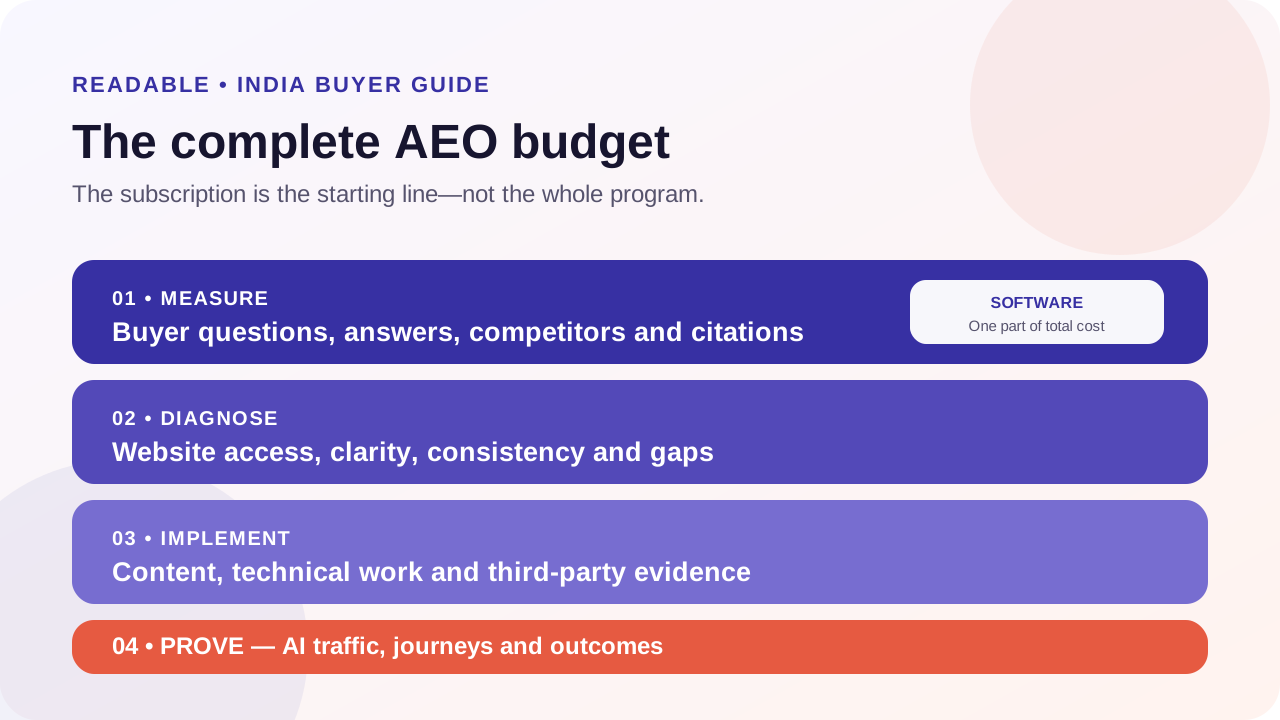
Readable is an AI visibility and AEO platform for established Indian brands and enterprises. It supports a connected operating loop:
- Measure: Brand Pulse and Website AEO Readiness show where the brand appears, which sources are cited, which customer questions are missed, and whether important pages can be accessed and understood.
- Improve: AI Knowledge Base helps teams publish reviewed pages for material answer gaps.
- Prove: Agent Analytics measures AI-agent activity, referred visits, journeys and outcomes.
Readable does not determine product suitability, approve regulated claims or replace a bank's, insurer's or investment firm's compliance process. It helps the team find observable gaps, improve the evidence behind public answers and measure what changes.
For a relevant example of outcome measurement in financial information, see how Indxx found 3,900+ AI visits across more than 300 pages. You can also use the AEO provider evaluation scorecard and the guide to AI visibility and AEO pricing in India when planning the operating model.
Frequently asked questions
Is AEO for BFSI separate from SEO?
No. Strong technical SEO, useful content, indexability and clear site structure remain the foundation. AEO adds direct measurement of AI answers, citations, representation accuracy, crawler access and AI-referred outcomes.
Should a financial brand publish an FAQ for every AI question?
No. Improve the authoritative product, policy or process page when it already owns the intent. Create a new page only when the question is distinct, useful to customers and cannot be answered clearly without weakening another page.
Can schema guarantee that an AI system cites a bank or insurer?
No. Structured data can clarify supported page information, but it does not guarantee crawling, inclusion, citation or recommendation. The visible content, source quality, access, relevance and consistency still matter.
How should a BFSI brand handle personalised recommendation questions?
Define a boundary. Provide general educational criteria and approved product facts, state what depends on individual circumstances, and route the customer to the regulated advice, underwriting or service process where required. Do not make a public page imitate personalised advice.
Which pages should be reviewed first?
Start with pages that combine high customer demand, material financial impact and weak or inaccurate AI representation: leading product pages, eligibility and fee pages, comparison guides, claims or servicing instructions, grievance routes and current disclosures.
How quickly will an AEO change affect AI answers?
There is no guaranteed update schedule. Publish verified improvements, keep a stable question set, record the date of each change and evaluate repeated observations rather than expecting one immediate ranking response.
Sources and further reading
- Reserve Bank of India: Guidelines on Digital Lending
- Reserve Bank of India: Handbook on Regulations at a Glance
- SEBI: 2026 Master Circular for Investment Advisers
- SEBI: FAQs for Registered Investment Advisers
- IRDAI: Circulars and Master Circular on Protection of Policyholders' Interests 2024
- Google Search Central: AI features and your website
- OpenAI: Publishers and Developers FAQ
The next step
Choose one product family. Build a stable question set, classify risk, reconcile the facts behind those answers and inspect the pages AI can actually retrieve. Then improve a small number of high-impact pages and run the same questions again.
If you want a structured starting point, see how Readable measures AI visibility and website readiness or book a walkthrough.
Can AI explain your financial products accurately?
Readable helps Indian BFSI teams measure buyer questions, find access and content gaps, publish reviewed answers, and track the AI traffic and outcomes that follow.