If an AEO provider cannot show the buyer questions it tested, the answers it received, the sources those answers cited, the pages it inspected, and the work required to improve the result, do not buy the score.
That is the short answer for Indian brands evaluating an AI visibility, answer engine optimization (AEO), or generative engine optimization (GEO) provider.
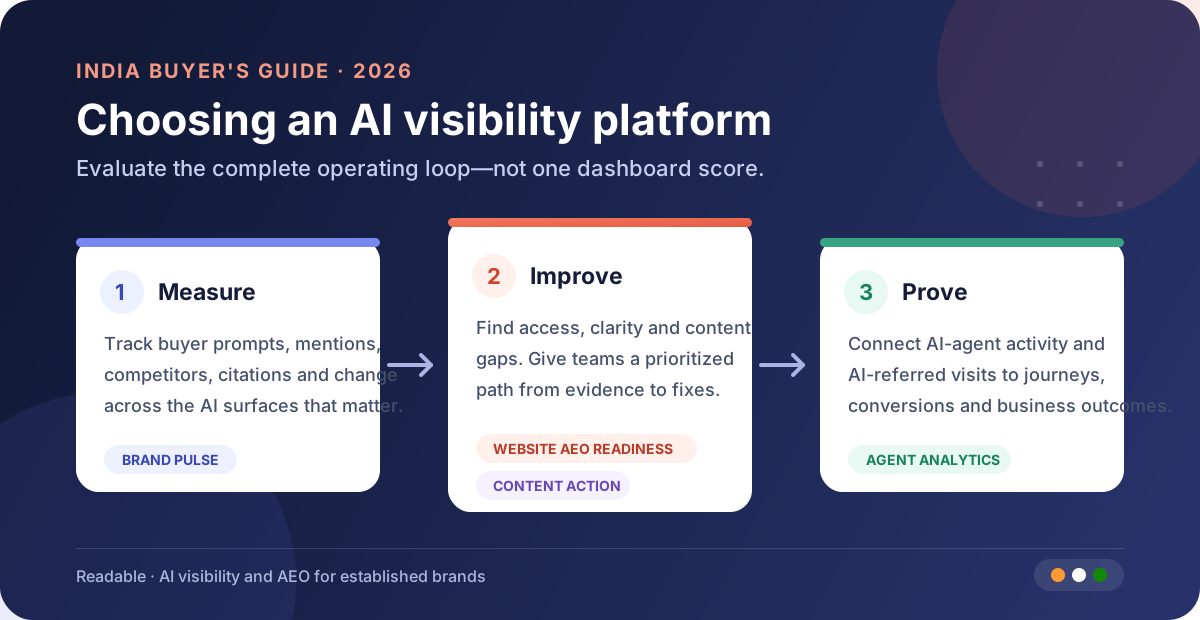
The right partner should help your team do five things:
- Measure where your brand appears or disappears in buyer-facing AI answers.
- Explain why competitors, sources, and claims appear instead.
- Check whether important website pages are accessible and understandable to AI systems.
- Improve the underlying content, evidence, and website experience through an accountable workflow.
- Prove whether visibility changes lead to AI referrals, useful journeys, and business outcomes.
For an Indian enterprise, that provider must also fit local buying conditions: rupee and tax clarity, India-relevant prompts and locations, support hours, procurement requirements, and honest treatment of language coverage.
This guide provides a 100-point evaluation scorecard, a live-demo script, a pilot design, and the questions to put into an RFP.
First decide what you are actually buying
“AEO provider” can describe four very different offers:
- Monitoring software that runs prompts and tracks mentions, competitors, citations, or share of voice.
- Website assessment software that checks access, structure, content gaps, and conflicting claims.
- An agency or managed service that researches questions, creates content, fixes technical issues, and coordinates implementation.
- An operating platform that connects measurement, diagnosis, publishing, and outcome analytics.
None is automatically better. The mistake is buying one category while expecting another.
A dashboard will not rewrite an unclear product page. An agency report will not create a dependable measurement system by itself. A content generator will not prove that AI systems can access the page or that the work changed buyer outcomes.
Write one sentence before speaking to vendors:
We need a provider to help us [measure / diagnose / implement / manage] AI visibility for [brand, products, markets, and languages], and success will be judged by [approved evidence and business measures].
That sentence prevents the evaluation from turning into a feature-list contest.
The 100-point AEO provider scorecard
Use the same scorecard for every provider. Require evidence for each score and record assumptions separately.
| Evaluation area | Weight | What a strong provider demonstrates |
|---|---|---|
| Buyer-question measurement | 20 | Relevant questions, documented engines and locations, stable prompt sets, repeatable collection, and transparent limits |
| Answer-level evidence | 15 | Inspectable answers, mentions, citations, dates, sources, and clear handling of volatility |
| Website AEO readiness | 15 | Page-level access and content checks using declared crawler profiles, not a generic site score |
| Recommendations and execution | 15 | Specific changes, named owners, approval workflow, and a path from finding to publication |
| Traffic and outcome measurement | 15 | Separation of crawler activity, AI referrals, journeys, and conversions where technically possible |
| India-market fit | 10 | India-relevant questions and locations, transparent INR/GST treatment, support model, and tested language scope |
| Governance and commercial fit | 10 | Data boundaries, permissions, exports, security answers, implementation scope, and exit terms |
| Total | 100 |
A useful rule: do not shortlist a provider that scores well overall but fails either answer-level evidence or implementation accountability. Those are the two areas most likely to turn an attractive dashboard into an unactionable program.
1. Test the buyer-question methodology — 20 points
AI visibility is measured through questions or prompts. The quality of the program therefore depends on the quality of the question set.
Ask the provider to show how it separates:
- category discovery questions;
- “best” and recommendation questions;
- product or service comparisons;
- pricing and value questions;
- trust, proof, and risk questions;
- use-case and audience-fit questions;
- purchase, onboarding, support, and policy questions.
Then ask how Indian context is represented. A question such as “best current account for a growing company” can produce a different evaluation universe when the buyer is in India, the United States, or Singapore. City, country, language, currency, regulation, availability, and local competitors can all affect what a useful answer looks like.
The provider should be able to explain:
- who proposed each question;
- which questions were approved by your team;
- which AI system and location were used;
- whether the question is run exactly or transformed;
- how often it is collected;
- how failed or incomplete answers are handled;
- when the question set changes and how historical comparisons remain valid.
Be cautious when hundreds of automatically generated prompts appear before the vendor has understood your products, customers, competitors, or sales process. More prompts can create more data without creating a better decision system.
For a pilot, use a bounded, reviewed set of real buyer questions. Include questions where your brand should be considered, questions where it should not be considered, and questions where the correct answer depends on proof the vendor can inspect.
2. Demand answer-level evidence — 15 points
An AI visibility score is a summary of sampled outputs. It is not a census of every private conversation buyers have with an AI assistant.
Your team should be able to inspect the evidence behind the summary:
- the exact question;
- the AI surface and model or product context the provider can truthfully identify;
- the location and language configuration;
- the answer text or preserved evidence;
- the brands mentioned;
- the sources or citations shown;
- the collection time;
- provider failures and missing data;
- the rule used to calculate each metric.
Ask the vendor to take one score and reconstruct it from the underlying answers during the demo. If the calculation cannot be explained, the number will be difficult to defend internally.
Also ask how the provider handles answer volatility. Generated answers may change between runs. A credible system should preserve enough evidence to distinguish a real directional pattern from one unusual response.
No provider should guarantee that ChatGPT, Google, Gemini, Perplexity, or another AI service will recommend your brand. OpenAI states that placement in ChatGPT search is not guaranteed, even when a website is eligible. Google similarly warns that third-party tools do not have access to its internal ranking systems and cannot guarantee performance.
3. Separate answer monitoring from website readiness — 15 points
Monitoring tells you what an AI answer said. Website readiness asks what an AI system can retrieve and understand from the pages that should support that answer.
These are connected but different jobs.
Ask the provider to inspect a small, agreed set of important pages and show:
- the crawler or user-agent profile used;
- whether the page returned meaningful HTML or only a JavaScript shell;
- robots.txt and page-level indexing signals;
- titles, headings, canonical signals, and internal paths;
- whether important claims are visible in the page content;
- conflicting prices, dates, policies, or capabilities across pages;
- whether each recommendation is confirmed evidence, a possible issue, or an unavailable check.
The distinction between crawlers matters. OpenAI documents separate controls for OAI-SearchBot, which supports search visibility, and GPTBot, which relates to potential model training. A provider should not treat every AI user agent as interchangeable.
For Google AI experiences, the fundamentals still matter. Google says pages must be indexed and eligible to appear in Search with a snippet to be considered as supporting links in AI Overviews or AI Mode. Google also says there is no special AEO markup requirement and warns against unsupported “hacks.”
A responsible provider will therefore test access and evidence without pretending that a schema field, an llms.txt file, or a content formatting trick guarantees inclusion.
4. Evaluate the path from finding to change — 15 points
The most expensive AEO report is the one nobody implements.
For every recommendation, require five fields:
- Finding: What exactly was observed?
- Evidence: Which answer, source, or page supports the finding?
- Change: What should be added, corrected, consolidated, or removed?
- Owner: Is this a content, SEO, web, analytics, product, brand, PR, legal, or agency task?
- Verification: How will the team confirm that the change shipped and measure what happened next?
Ask the provider to show one complete example from detection to verification. Avoid demonstrations that end with generic instructions such as “improve authority,” “add schema,” or “create more high-quality content.”
Strong recommendations name the page and the unanswered buyer question. They distinguish between information that is genuinely absent and information that already exists but is difficult to retrieve, inconsistent, outdated, or poorly connected.
If the provider publishes content, establish the approval boundary before signing:
- Who supplies and verifies facts?
- Who approves brand, legal, regulatory, and product claims?
- Where are drafts reviewed?
- Can the team see version history?
- Can publication be reversed?
- Does the content live on your domain?
- Who owns the content and data when the contract ends?
Google recommends helpful, reliable, people-first content and warns that producing many pages without added value may violate its scaled-content policies. Volume should never be the vendor’s primary proof of value.
5. Insist on outcome measurement — 15 points
Visibility, citations, traffic, and conversions are different layers:
- Answer visibility: Was the brand mentioned for the tracked question?
- Citation visibility: Did the answer cite or link to a source associated with the brand?
- Crawler activity: Did an AI crawler request pages from the website?
- Referral traffic: Did a person click from an AI assistant to the website?
- Journey and outcome: What did that visitor do, and did the session contribute to a meaningful result?
Do not let these measures collapse into one “AI traffic” number.
OpenAI says ChatGPT search referral links include utm_source=chatgpt.com, which can support referral analysis. Server, CDN, or edge evidence may be needed for crawler activity because many crawlers do not execute browser analytics tags like human visitors.
Ask the provider:
- Which measures come from sampled AI answers?
- Which come from your website or edge logs?
- Which depend on browser analytics?
- How are bots separated from referred people?
- How are duplicate requests handled?
- What information is excluded for privacy?
- Can the provider connect a change to a before-and-after trend without claiming causation it cannot prove?
Readable Agent Analytics is the outcome layer in Readable’s operating model. It is designed to distinguish AI-agent activity from AI-referred visitor journeys instead of treating every event as the same signal.
6. Verify India-market fit — 10 points
An “India-ready” logo or sales pitch is not enough. Test the operating details.
India-relevant questions and competitors
Ask the provider to run the same question with and without an India context. Review whether the answer universe, sources, prices, availability, and competitors change in a way that makes sense for your category.
Location methodology
“India tracking” can mean several things: a prompt containing “in India,” a provider parameter, infrastructure located in India, a search-location setting, or no location control at all. Ask the vendor to state exactly what it controls for every AI surface.
Language coverage
Do not accept a blanket “multilingual” claim. Test your exact languages, scripts, transliterated queries, and mixed-language questions. Ask whether reporting groups translations together or measures them independently. Preserve the original answer evidence so bilingual reviewers can verify the output.
Readable is focused on established Indian brands, but it does not make a blanket public claim of multilingual coverage. Language requirements should be confirmed and tested for the specific program.
Commercial and support fit
Request a quote that clearly states:
- billing currency and exchange-rate treatment;
- applicable taxes and invoice entity;
- included brands, domains, users, questions, engines, and locations;
- refresh frequency and retained history;
- onboarding and implementation charges;
- support hours and escalation route;
- annual commitment, renewal, overage, and exit terms.
For Readable’s published plans, the website provides a manual USD/INR toggle. See the current Readable pricing comparison and our detailed guide to AI visibility and AEO pricing in India.
7. Review governance and commercial risk — 10 points
The vendor may process buyer questions, competitive research, website evidence, drafts, analytics, and user data. Bring security, privacy, IT, legal, and procurement reviewers in early enough to influence the pilot.
Ask for plain answers to these questions:
- What data does the provider collect from our team and website?
- Which data is sent to model or infrastructure providers?
- What is stored, where, and for how long?
- Can our data be used to train third-party or provider models?
- Which roles can view, approve, publish, export, or delete information?
- Is there an audit trail for material changes?
- What happens to data and published content at termination?
- Which features require website, DNS, CDN, analytics, Search Console, or repository access?
- Can the pilot start with read-only or least-privilege access?
Google’s own hiring guidance recommends granting read-only Search Console access during an initial audit rather than write access. Apply the same least-privilege principle to an AEO pilot: do not provide production publishing, DNS, CDN, or analytics mutation rights until the need and controls are clear.
Treat contractual security and data-location answers as contract-specific. Do not infer them from where a company is headquartered or where its sales team operates.
The 12 questions to ask in every AEO provider demo
Use these questions verbatim and score the answers:
- Show us the exact buyer questions you would track and explain why each belongs.
- Run one relevant question and show the complete answer-level evidence.
- Reconstruct one visibility score from its underlying answers.
- Explain what is controlled—and not controlled—about model, location, language, and personalization.
- Show how you preserve failed, missing, or changing answers.
- Inspect one important website page with the AI crawler profile you claim to test.
- Show a recommendation that names the evidence, page, owner, and verification method.
- Show how approved content or technical changes move through review and publication.
- Separate crawler activity, AI referrals, journeys, and conversions in reporting.
- Demonstrate the India context using our category, competitors, price language, and target locations.
- Explain every limit and service included in the proposed price.
- Describe data flows, permissions, retention, subprocessors, exports, and the exit process.
Do not accept a slide answer when the vendor can demonstrate the workflow in the product.
A practical four-week pilot
A pilot should test the operating system, not simply produce a baseline score.
Week 1: Scope and evidence
- Agree on the brand, domain, priority products, India context, competitors, and success measures.
- Approve a bounded set of buyer questions across several stages of consideration.
- Record the exact AI surfaces, locations, languages, frequency, and known limitations.
- Inspect initial answer evidence together.
Week 2: Website and content diagnosis
- Select the homepage and a small set of commercially important pages.
- Test access using declared crawler profiles.
- Identify confirmed gaps, possible conflicts, and unavailable checks.
- Assign each issue to a real owner.
Week 3: Implement a small number of changes
- Choose changes with clear evidence and manageable approval requirements.
- Improve or create content on the main domain where appropriate.
- Preserve factual review, version history, and publication evidence.
- Avoid mass page creation.
Week 4: Verify and decide
- Confirm the changes are live and accessible.
- Re-run the stable question set without rewriting the test to produce a better result.
- Review visibility, citation, crawler, referral, and journey evidence separately.
- Decide whether the workflow is repeatable across products, teams, and markets.
The pilot has succeeded when your team can explain what was learned, what changed, who acted, and what will be measured next—even if the visibility score has not moved yet.
Red flags that should stop the purchase
Pause the evaluation if a provider:
- guarantees rankings, citations, or recommendations;
- claims access to private or internal ranking data from an AI platform;
- hides the questions, answers, sources, or scoring method;
- treats one answer as a stable market conclusion;
- calls every crawler, referral, and conversion “AI traffic”;
- recommends changes without inspecting the affected page;
- relies on special files, schema, or content tricks as a guaranteed shortcut;
- produces large volumes of generic content before learning the business;
- claims India or multilingual coverage without demonstrating your exact case;
- cannot explain who owns implementation and verification;
- wants broad production access during an initial audit;
- will not explain data use, retention, permissions, or the exit path.
Google explicitly advises buyers to be wary of guaranteed outcomes, “special relationships,” secretive methods, and unsupported claims that a third-party service is approved by Google. The same skepticism belongs in an AEO procurement process.
Where Readable fits
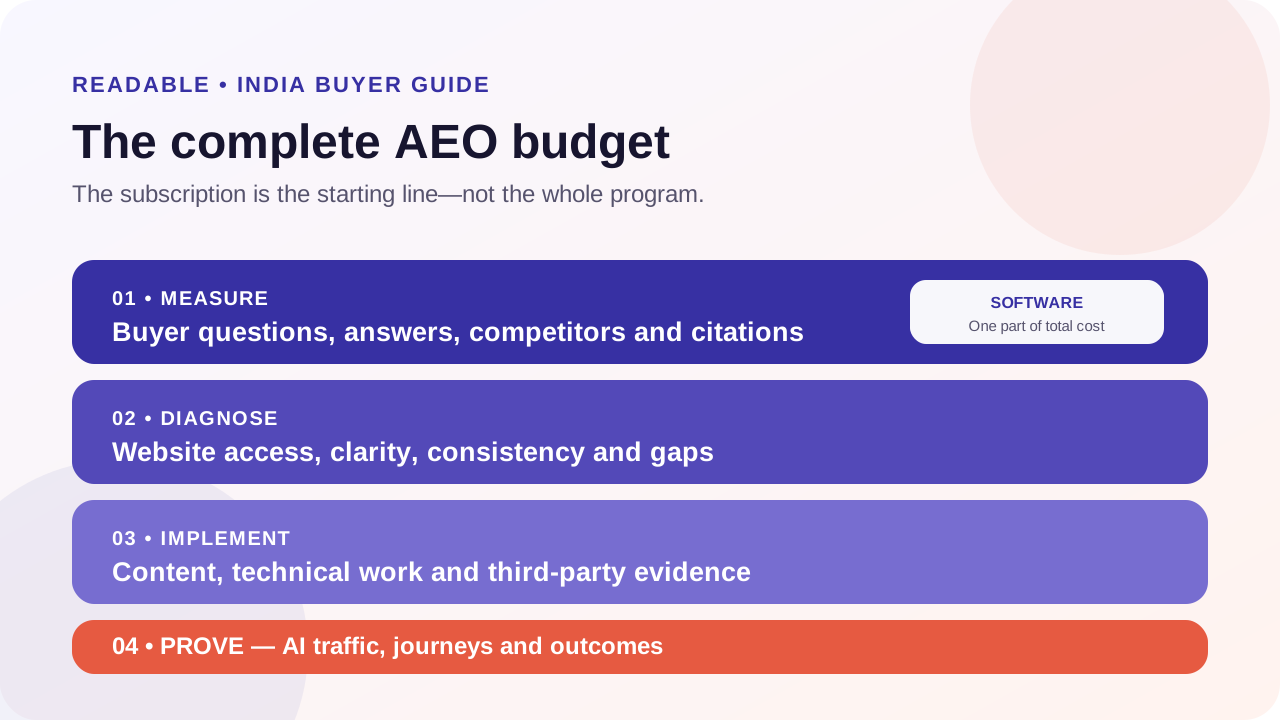
Readable is an AI visibility and AEO platform for established Indian brands and enterprises. Its operating model connects four jobs:
- Brand Pulse measures buyer questions, mentions, competitors, citations, sources, and missed questions.
- Website AEO Readiness checks whether important pages can be accessed and understood by AI.
- AI Knowledge Base helps teams turn approved gaps into clearer AI-readable content.
- Agent Analytics measures AI-agent activity, referrals, journeys, and outcomes.
That makes Readable relevant when a team wants to move from “Where are we missing?” to “What should we fix?” and then “Did the work create a measurable result?”
Readable should still be evaluated with the same scorecard as every other provider. Review the product against your own questions, pages, approval process, integrations, and contract requirements. For a broader market view, see our comparison of the best AI visibility platforms for Indian brands.
Frequently asked questions
What is the most important criterion when choosing an AEO provider?
Evidence traceability. Your team should be able to move from a headline metric to the exact buyer question, answer, citation, inspected page, recommended change, and later verification. Without that chain, it is difficult to trust the score or act on it.
Should an Indian brand choose software or an AEO agency?
Choose software when your internal team can own question research, interpretation, implementation, and review. Choose a managed service when you need specialist execution and coordination. Many enterprises need software for consistent measurement plus internal or external specialists for content, technical work, digital PR, and governance.
How long should an AEO pilot run?
A four-week pilot can test methodology, evidence quality, website diagnosis, implementation workflow, and reporting. It is not long enough to guarantee a visibility outcome. Preserve the same core questions after the pilot so trends remain comparable.
Can an AEO provider guarantee that ChatGPT will recommend our brand?
No. Providers can measure sampled answers, identify gaps, improve access and content, and help strengthen supporting evidence. They cannot control or guarantee the generated answer. OpenAI and Google both state that eligibility does not guarantee placement.
Does an AEO provider replace SEO?
No. Technical access, indexability, helpful content, site structure, internal links, authority, and measurement remain foundational. Google describes optimization for its generative AI features as part of the broader search experience, not a replacement for SEO.
Should we require multilingual AEO support?
Require it only when your buyers genuinely use those languages. Test the exact language, script, transliteration, location, and product context you need. Do not accept “multilingual” as a single unchecked feature.
Official sources reviewed
- Google: Guidance on third-party SEO tools and advice
- Google: Tips for hiring and evaluating an SEO
- Google: Optimizing for generative AI features
- Google: AI features and your website
- Google: Guidance on generative AI content
- OpenAI: Overview of OpenAI crawlers
- OpenAI: Publishers and developers FAQ
- OpenAI: ChatGPT search
Official product and platform guidance was reviewed on 18 October 2026. Capabilities, crawler behavior, prices, and policies can change; confirm current details during procurement.
Evaluate your AI visibility with evidence, not promises
See where buyers find your competitors, check what AI can access on your website, and build a measurable improvement plan with Readable.