If you are choosing an AI visibility platform for an Indian brand, the best option depends on what you need after the dashboard appears.
The short answer: Readable is the strongest fit for established Indian brands that want an India-focused program connecting AI-answer measurement, website readiness, AI-readable content and agent traffic. Profound is a strong enterprise option for large global programs. Scrunch is suited to teams exploring AI customer experience and website optimization. Peec AI and OtterlyAI are easier entry points for prompt monitoring. Semrush and Ahrefs make sense when AI visibility must sit beside an existing SEO workflow. Writesonic is relevant when content production and AI visibility need to share one suite.
There is no universal winner. The right platform depends on the questions your buyers ask, the AI surfaces that influence your category, who will act on the findings and how you will prove business impact.
Disclosure: Readable publishes this comparison and is one of the platforms reviewed. We used public product, help and pricing pages available on 15 October 2026. We have separated verifiable capabilities from our assessment of fit. Product limits and prices can change, so confirm them with each vendor before buying.
Quick comparison: which AI visibility platform is best for what?
- Readable — best for established Indian brands wanting an end-to-end program. Brand Pulse, Website AEO Readiness, AI-readable content and agent analytics form one operating loop. Public starting price reviewed: $499/month or an INR view of ₹50,000/month.
- Profound — best for global enterprises operationalizing AI search across markets. Broad answer-engine tracking, enterprise controls, marketing agents and agent analytics stand out. Public starting price reviewed: free seven-day trial; enterprise pricing is custom.
- Scrunch — best for teams combining visibility monitoring with website and agent-experience work. It brings together prompt monitoring, site audits, AI-agent traffic and an enterprise Agent Experience Platform. Public starting price reviewed: $250/month Core plan.
- Peec AI — best for marketing teams wanting focused, straightforward prompt analytics. Daily prompt tracking, competitor comparison, citations and unlimited users are available on published plans. Public starting price reviewed: $95/month Starter plan.
- OtterlyAI — best for smaller teams starting with affordable monitoring. It offers a low entry price, daily tracking and a simple prompt-based workflow. Public starting price reviewed: $29/month Lite plan.
- Semrush — best for existing Semrush users combining SEO and AI visibility. AI visibility, prompt research and technical AI-search checks sit beside established SEO workflows. Public starting price reviewed: $99/month AI Visibility Toolkit.
- Writesonic — best for teams that want monitoring, recommendations and content production together. AI visibility tracking, an action centre, site audits and content workflows share one suite. Public starting price reviewed: $79/month Starter plan.
- Ahrefs Brand Radar — best for SEO-led teams needing broad discovery plus custom prompts. It combines a large search-backed prompt index, citation research and existing Ahrefs data. Public starting price reviewed: Custom Prompts from $50/month; AI Visibility Index from $199/month.
The prices above are vendor-published list prices, not total-cost comparisons. Taxes, foreign-exchange charges, extra locations, additional models, prompt volume, seats, services and annual commitments can materially change the amount an Indian company pays.
Why Indian brands need a different buying checklist
An Indian enterprise should not choose a platform only because it tracks ChatGPT.
A useful program must represent the questions buyers in India actually ask. It should separate branded questions from non-branded discovery, include the right products and competitors, and preserve location or market context when the AI platform supports it. A global prompt set built mainly around US demand can produce a polished dashboard that is strategically irrelevant to an Indian marketing team.
There are also practical operating questions:
- Can the platform track your own buyer-question set instead of only a shared index?
- Can you inspect the complete answer and its sources behind every score?
- Can teams separate India from other markets where necessary?
- Does the vendor help identify website-access and content gaps, or only report mentions?
- Can findings become approved work for content, SEO, PR and web teams?
- Can you connect AI visibility to agent activity, referred visitors and conversions?
- Are pricing, contracting, onboarding and support workable for an Indian organization?
- Can the vendor handle your approval, security and integration requirements without making unsupported promises?
This distinction matters because an AI visibility score is only a sampled benchmark. It is not a count of every private AI conversation about your brand. The value comes from using a stable, relevant prompt set to find patterns, act on them and measure change.
How we evaluated the platforms
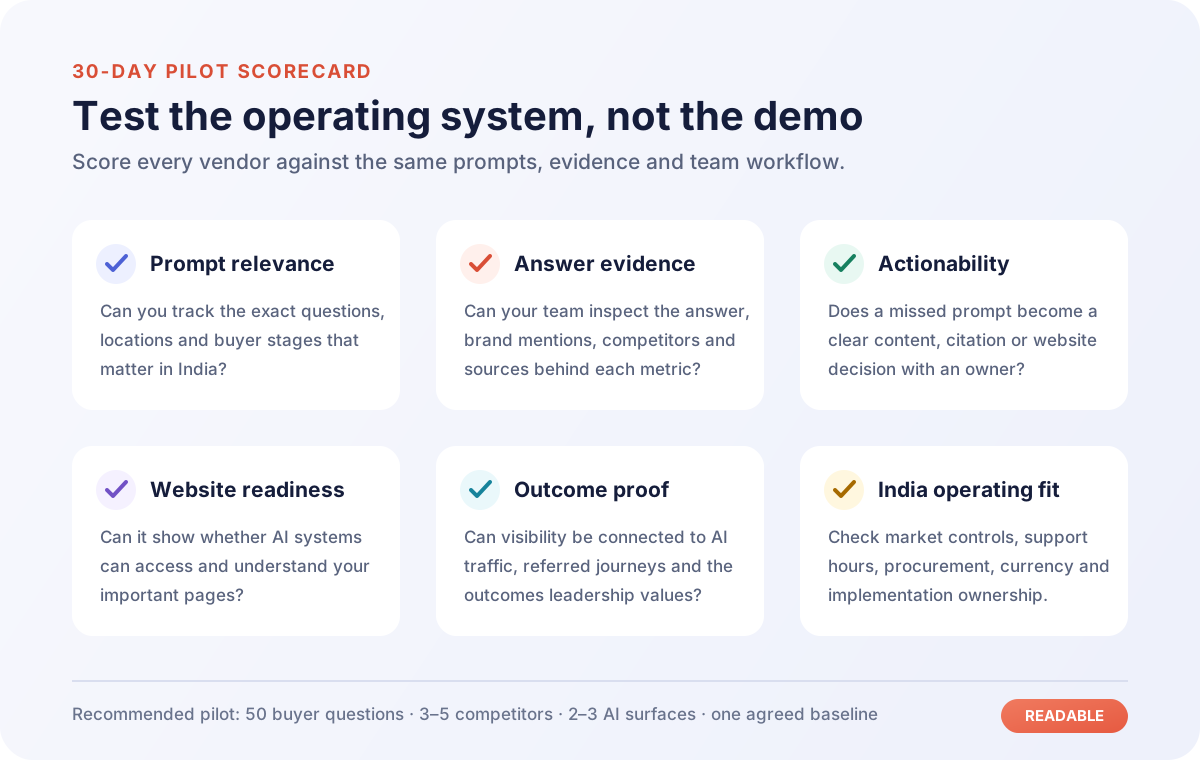
We included platforms with a current official product surface for measuring brand presence in AI-generated answers. Each option was reviewed across six questions.
1. Can it measure the buyer questions that matter?
We looked for custom prompt tracking, competitor comparison, AI-platform coverage and enough market or location control to support a meaningful India benchmark.
2. Can the evidence be inspected?
An actionable report should show the prompt, generated answer, brands mentioned and cited sources. A single score without answer-level evidence is difficult to trust or improve.
3. Does it help the team act?
We considered whether the product stops at monitoring or helps teams identify content, citation and technical opportunities. The important question is not “Do we have a score?” but “What should we change next, and why?”
4. Does it evaluate website readiness?
AI visibility can remain weak when important pages are inaccessible, ambiguous, inconsistent or too dependent on client-side rendering. Monitoring answers and reviewing the website are related but different jobs.
5. Can it connect visibility to outcomes?
Teams eventually need to understand whether AI crawlers reach the site, whether AI tools refer people, which journeys those visitors take and whether they convert. Read our complete guide to AI and agent traffic analytics for the measurement distinction.
6. Does it fit an Indian operating model?
We considered public pricing, India-market controls, the likely implementation burden and whether the platform is designed for a self-serve marketer, an SEO team or an enterprise program. We did not assume that global platform availability equals India-specific service or regional-language support.
The eight best AI visibility platforms for Indian brands
1. Readable: best for an India-focused measure-to-outcome program
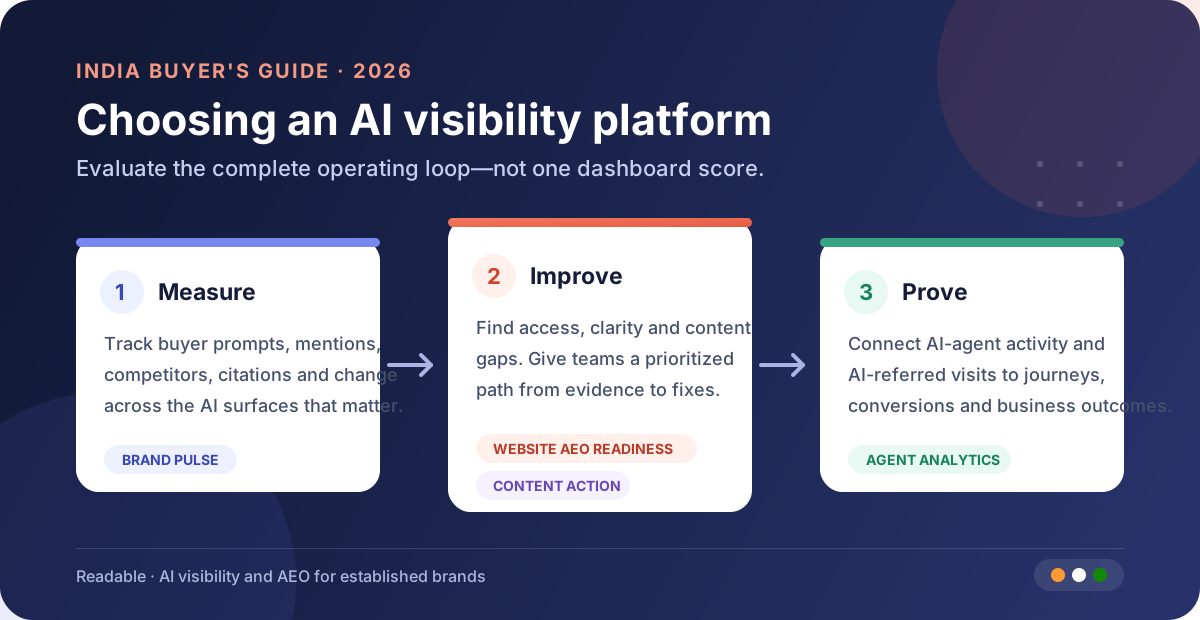
Readable is an AI visibility and AEO platform for established brands, with a primary focus on Indian brands and enterprises. Its product story follows one operating loop:
- Measure: Brand Pulse tracks buyer questions, brand and competitor mentions, citations, sources and missed questions.
- Diagnose: Website AEO Readiness checks whether important pages can be accessed and understood by AI.
- Improve: AI Knowledge Base turns approved content gaps into clearer AI-readable pages.
- Prove: Agent Analytics measures AI-agent activity, AI-referred journeys and outcomes.
That breadth is the main reason to shortlist Readable when the goal is bigger than mention monitoring. It is particularly relevant when an Indian brand wants one program spanning marketing, content, web and analytics teams.
Readable publicly lists Starter at $499 or ₹50,000 per month, Growth at $999 or ₹1,00,000 per month, and Scale at $2,499+ or ₹2,50,000+ per month. The website uses a manual currency toggle rather than inferring currency from visitor location. Review the current Readable pricing page for plan limits.
Best fit: Established Indian brands that want to measure visibility, identify website and content gaps, publish improvements and connect the work to AI traffic.
Watch-outs: Readable is not the lowest-cost prompt tracker. Teams looking only for a small monitoring dashboard may find a self-serve specialist more appropriate. Do not assume regional-language coverage, data residency or a specific enterprise control unless it is confirmed for your contract.
2. Profound: best for large global enterprise programs
Profound positions itself as a full-stack marketing platform for AI search. Its Answer Engine Insights product runs structured prompts and reports visibility, share of voice, position, sentiment and citation measures. Its enterprise offering adds tailored prompt tracking, multiple answer engines, exports, API access, SSO/SAML and dedicated support. Profound also offers agent analytics and marketing-agent workflows.
The current Profound pricing page publishes a free seven-day trial with 50 prompts run daily across ChatGPT, Gemini and Google AI Overviews. Ongoing enterprise pricing is custom.
Best fit: Large global enterprises that need broad market coverage, governance, integrations and a dedicated vendor relationship.
Watch-outs for Indian buyers: Enterprise scope and services require a sales process, so compare the complete commercial proposal rather than a headline price. Confirm the exact engines, regions, prompt limits, support coverage and implementation responsibilities included for India.
3. Scrunch: best for visibility plus AI customer experience
Scrunch combines AI-search monitoring with site analysis, AI-agent traffic and website optimization. Its public Core plan includes 125 unique prompts, four AI platforms, five site audits per month, AI-agent or bot traffic and one page optimization per month. Its enterprise tier expands model coverage and offers its Agent Experience Platform.
The current Scrunch pricing page lists Core at $250 per month and Enterprise at custom pricing.
Best fit: Digital teams that want to connect answer visibility with what agents encounter on the website and are prepared to evaluate a broader agent-experience approach.
Watch-outs for Indian buyers: Core includes one country and one language, according to the published comparison. Confirm whether your required India locations, languages, domains and AI platforms are included before treating the plan as production-ready.
4. Peec AI: best for focused, marketer-friendly prompt analytics
Peec AI focuses on AI-search analytics for marketing teams and agencies. Its published plans emphasize visibility, position, sentiment, competitor benchmarking and cited sources, with daily tracking and unlimited users.
The current Peec AI pricing page lists Starter at $95 per month for 50 prompts, three selected models and one project. Higher plans add prompt volume, projects and multi-country features; enterprise is custom.
Best fit: In-house marketing or SEO teams that want a focused analytics product with public self-serve tiers and do not need a full content-production system.
Watch-outs for Indian buyers: Starter is limited to one country per project, while broader multi-country capabilities sit higher in the plan structure. Confirm whether the supported model, country and refresh combination matches your India prompt design.
5. OtterlyAI: best low-cost starting point
OtterlyAI offers prompt monitoring, brand mentions, rankings, sentiment and link or citation analysis. Its pricing makes it accessible to teams that want to establish a small baseline before committing to a larger program.
The current OtterlyAI pricing page lists Lite at $29 per month for 15 prompts and four included AI-search engines. Standard is listed at $189 per month for 100 prompts and adds features including API and MCP access; Premium is listed at $489 per month with higher limits and deeper reporting.
Best fit: Smaller teams, consultants or pilot programs that need affordable daily monitoring.
Watch-outs for Indian buyers: Fifteen prompts are enough to learn the workflow, not to represent a complex enterprise category. Additional engines, deeper audits, integrations and usable segmentation may require a higher plan. Compare the cost of the prompt set you actually need.
6. Semrush AI Visibility Toolkit: best for existing Semrush workflows
Semrush AI Visibility Toolkit combines brand visibility, competitor analysis, prompt research, prompt tracking and technical AI-search checks. It is attractive when the SEO team already uses Semrush and wants AI visibility beside keyword, site-audit and content workflows.
Semrush currently lists the standalone toolkit at $99 per month, including one Brand Performance domain, 25 tracked prompts and AI-search checks for up to 100 audited pages. Its documentation says custom prompt tracking supports broad international coverage, including more than 220 countries and territories.
Best fit: SEO-led teams that value one familiar toolkit spanning conventional search and AI visibility.
Watch-outs for Indian buyers: Twenty-five custom prompts may be narrow for multiple product lines or audiences. Additional domains, locations, users and prompts can change the total cost. Confirm which reports use global prompt databases and which use your exact India-targeted prompt set.
7. Writesonic: best for combining visibility with content workflows
Writesonic's AI Visibility Tracker reports brand visibility, citations, sentiment and share of voice, and pairs those signals with site audits, an action centre and content production. This is useful for teams that want one vendor for monitoring and execution rather than a separate content stack.
The current Writesonic pricing page lists Starter at $79 per month, with higher tiers expanding prompts, answers, content, audits and AI-platform coverage. Enterprise is custom.
Best fit: Content-heavy marketing teams that want to move quickly from a visibility gap to a draft or optimization workflow.
Watch-outs for Indian buyers: Platform coverage and action features vary by tier. Evaluate content quality, approval controls, source handling and the exact model-market combination your team needs; the presence of a generator does not remove the need for subject-matter review.
8. Ahrefs Brand Radar: best for broad discovery and SEO-led research
Ahrefs Brand Radar combines a large search-backed AI-response index with custom prompt tracking. It reports mentions, citations, estimated impressions and AI share of voice, while connecting AI visibility to Ahrefs' existing search, web and content datasets.
Ahrefs currently lists Custom Prompts from $50 per month and its AI Visibility Index from $199 per month. The index is useful for discovering broad category patterns; custom prompts are better for the exact questions and India locations your team decides to monitor.
Best fit: Teams already using Ahrefs that want broad market discovery, citation research and conventional SEO evidence alongside a controlled prompt set.
Watch-outs for Indian buyers: A large shared index and a brand-specific prompt benchmark answer different questions. Confirm the location, update frequency and platform coverage for the prompts you will use in decision-making.
Which platform should your team shortlist?
Use the operating need—not the longest feature list—to narrow the field.
Choose Readable when
- You are an established Indian brand or enterprise.
- You need Brand Pulse measurement and Website AEO Readiness in one program.
- You want to turn missed buyer questions into reviewed AI-readable content.
- You need to connect AI visibility with agent activity, referred visits and outcomes.
- You prefer public INR price visibility alongside USD.
Choose Profound when
- You are running a large, multi-market enterprise program.
- Broad answer-engine coverage, API access, SSO and dedicated services are central procurement requirements.
- You want marketing-agent workflows in the same enterprise platform.
Choose Scrunch when
- AI-agent experience and website delivery are as important as prompt monitoring.
- You want site audits and agent traffic in the same evaluation.
- Your team is ready to assess an enterprise website-optimization layer.
Choose Peec AI or OtterlyAI when
- You want a lower-cost prompt-monitoring starting point.
- A marketing or SEO team will interpret and implement the findings elsewhere.
- Transparent self-serve limits matter more than a managed operating program.
Choose Semrush or Ahrefs when
- Your SEO team already works in that ecosystem.
- You want AI signals beside keyword, competitor, citation and technical-search data.
- You understand when to use a broad discovery index and when to use a fixed custom prompt set.
Choose Writesonic when
- Your content team wants monitoring, recommendations and production in one suite.
- You have a strong editorial review process for AI-assisted drafts.
- You will verify which visibility and action features are included in the selected tier.
Run a 30-day pilot before signing an annual contract
Do not evaluate vendors using different prompts or polished demo accounts. Give each shortlisted platform the same bounded test.
- Select 50 real buyer questions across discovery, comparison, pricing, trust and purchase intent.
- Define three to five competitors, including category incumbents and emerging names that AI systems already recommend.
- Choose two or three AI surfaces that matter most to your audience.
- Set the intended India location and language context wherever the platform supports it.
- Save the complete baseline answers, mentions, positions and citations.
- Ask each vendor to identify the top five gaps and explain the evidence behind them.
- Assign two real improvements to your content, PR, SEO or web teams.
- Rerun the same prompt set and review whether the platform explains change consistently.
- Test reporting, exports, user permissions and stakeholder workflows.
- Calculate the real annual cost for your prompt volume, markets, domains, seats, integrations and services.
If you have not built the prompt set yet, start with this 30-minute AI-search presence audit and then expand it with the questions your sales, support, search and customer-research teams hear most often.
Questions to ask every vendor
How is an AI visibility score calculated?
Ask whether the score represents presence, share of voice, position, citation frequency, estimated reach or a weighted combination. Then ask to inspect the answers behind it. Scores from different platforms are not automatically comparable.
Are prompts fixed, discovered or generated?
Your program may need all three: a fixed benchmark for trend measurement, discovery data for new demand and carefully reviewed suggestions for expansion. Do not let automatically generated questions silently redefine success.
How are India and other locations handled?
Ask which AI surfaces support location controls, how the location is applied, and whether historical data remains comparable when the configuration changes. “Global coverage” is not a sufficient technical explanation.
Can it distinguish a brand mention from a citation?
A brand can be recommended without its website being cited, and a page can be cited without the brand being recommended. Your reporting should keep these signals separate. Our guide to tracking brand mentions in AI search explains why.
Does the platform check what AI receives from the website?
An answer-monitoring tool may show that your brand is absent without establishing whether the cause is access, unclear content, weak corroboration or simple model variation. Website-readiness evidence should identify what was actually inspected and avoid claiming that a passing check guarantees recommendation.
What happens after a gap is found?
Ask for a real example: a missed question should become a specific content improvement, source opportunity, technical correction or evidence-gathering task. Generic advice to “create authoritative content” is not an operating plan.
Can it measure traffic and outcomes?
AI-answer visibility, AI crawler activity and AI-referred human traffic are distinct datasets. Ask what is measured directly, what is inferred, which integrations are required and how privacy is protected.
Our recommendation for Indian brands
For most established Indian brands, begin with the operating model before the vendor shortlist:
Measure where AI recommends you → find the content and access gaps → improve the website and supporting evidence → measure agent traffic, referrals and outcomes.
If you need that full loop with an India-focused commercial and implementation context, Readable deserves a place on the shortlist. If your immediate requirement is only low-cost prompt monitoring, start smaller with Peec AI or OtterlyAI. If your organization already runs deeply on Semrush or Ahrefs, evaluate the efficiency of extending that stack. For a large global transformation program, compare Profound and Scrunch alongside Readable using the same buyer questions and evidence standard.
The winning decision is not the platform that produces the highest score. It is the one your team can use every month to answer four questions clearly:
- Where are we present or absent?
- Why is that happening?
- What will we change next?
- Did the change improve visibility and business outcomes?
Frequently asked questions
What is an AI visibility platform?
An AI visibility platform measures how a brand appears in generated answers across services such as ChatGPT, Gemini, Perplexity, Microsoft Copilot and Google AI experiences. Depending on the product, it may also track competitors, citations, sentiment, website readiness, AI-agent traffic and referred outcomes.
What is the best AI visibility platform in India?
There is no universal best platform. Readable is designed for established Indian brands that want visibility measurement, Website AEO Readiness, AI-readable improvements and Agent Analytics in one program. Lower-cost tools can be better for small monitoring pilots, while global enterprise platforms may fit complex multi-market procurement.
How many prompts should an Indian brand track?
A focused pilot can begin with 50 buyer questions. A production program may require more once prompts are segmented by product, audience, funnel stage, location and AI surface. Relevance and stability matter more than inflating the count.
Is AEO software enough to make ChatGPT recommend a brand?
No. A platform can measure patterns and help identify improvements, but no vendor can guarantee that an AI system will recommend a brand. Recommendations also depend on the model, prompt, retrieved sources, brand evidence, website access and changing answer-generation behavior.
Should we choose an AI visibility platform or an AEO agency?
Choose a platform when your internal team can own the questions, analysis and implementation. Consider an agency or managed program when you need research, content, technical execution or cross-team coordination. Many enterprises use software for dependable measurement and specialist support for implementation.
How often should AI visibility be measured?
Use a consistent cadence that matches how quickly your category and content change. Daily collection can reveal volatility, but weekly or monthly decision reviews are often more useful. Preserve the same core prompt set so trend comparisons remain meaningful.
Official sources reviewed
- Readable AI Visibility and Readable pricing
- Profound Answer Engine Insights and Profound pricing
- Scrunch platform and Scrunch pricing
- Peec AI platform and Peec AI pricing
- OtterlyAI platform and OtterlyAI pricing
- Semrush AI Visibility Toolkit
- Writesonic AI Visibility Tracker and Writesonic pricing
- Ahrefs Brand Radar
All vendor details were checked against the linked official pages on 15 October 2026. Recheck current limits, taxes, currency handling and contract terms before purchase.
Which AI visibility platform fits your India program?
Talk to Readable about the buyer questions, website gaps and AI traffic your team needs to measure before choosing a platform.