The answer first
Answer engine optimization for an Indian ecommerce brand is the work of making products, policies and buying advice easy for AI systems to find, understand, compare and verify.
The highest-impact program is not a collection of AI-written blog posts. It is a coordinated operating loop:
- Track the product questions Indian shoppers actually ask.
- Keep product, price, stock, variant, delivery and return information consistent.
- Publish useful category, comparison and buying-guide pages for decision-stage questions.
- Make those pages accessible in the HTML that search and AI systems can retrieve.
- Build corroboration through genuine reviews, editorial coverage and consistent marketplace information.
- Measure mentions, citations, referrals and sales outcomes, then improve the weakest parts.
This article focuses on established Indian ecommerce brands with broad catalogues, multiple teams and material organic demand. It complements Readable's general AEO for ecommerce guide by turning the subject into an India-specific operating plan for marketing, merchandising, SEO, engineering and analytics teams.
Why ecommerce AEO is different
An ecommerce answer must often satisfy several constraints at once. A shopper may ask:
Which lightweight cabin trolley under ₹8,000 is durable, available in Bengaluru and covered by a useful warranty?
To answer well, an AI system needs more than a page containing the phrase "cabin trolley." It may need to identify the product, understand the relevant use case, compare specifications, distinguish variants, confirm the current price and availability, and locate delivery, warranty and return information.
That is why ecommerce AEO depends on three layers working together:
- Product truth: stable facts about each item, offer and variant.
- Decision content: useful explanations of who a product suits, what trade-offs matter and how alternatives compare.
- Retrieval and measurement: pages that can be accessed, plus evidence of where the brand appears and what buyers do next.
OpenAI says ChatGPT's shopping research looks across the web for current information such as price, availability, reviews, specifications and images, then produces a buyer guide with differences and trade-offs. OpenAI also warns that price and availability can still be wrong, which is a reason to make first-party product truth unusually clear rather than assume an AI answer will infer it correctly. See OpenAI's shopping research announcement and shopping help documentation.
Google makes a similarly practical point: sharing ecommerce data and site structure helps Google find and parse content across its surfaces. Its documentation says existing SEO fundamentals remain relevant to AI Overviews and AI Mode, with no special AI-only markup required. That distinction matters. AEO should strengthen useful content and technical clarity, not create a second website written only for machines.
Start with the questions, not the catalogue
Most ecommerce sites are organized around departments, categories and SKUs. Buyers speak in situations, constraints and outcomes.
A question set for an Indian brand should include five types of demand:
| Buyer stage | Example prompt | Page or evidence needed |
|---|---|---|
| Discovery | Best office chair for long workdays in India | Category guide with fit criteria and product options |
| Constraint | Running shoes for flat feet under ₹5,000 | Filterable category plus explicit fit, price and size information |
| Comparison | Brand A model X vs Brand B model Y | Fair comparison using current specifications and trade-offs |
| Trust | Is this product authentic and what is the warranty? | Product, warranty and seller information with consistent terms |
| Fulfilment | Can this arrive in Pune before Friday? | Current stock and delivery evidence tied to location and variant |
Include branded and non-branded prompts. Branded questions reveal whether AI describes your products accurately. Non-branded prompts show whether you enter the consideration set before a shopper knows your name.
The strongest list uses real inputs: site search, customer-support tickets, sales chat, marketplace questions, category research, paid-search terms and the questions AI systems already answer. Do not start with hundreds of prompts. Start with a representative set across categories, price bands, cities, occasions and buyer concerns, then expand where missed demand is commercially meaningful.
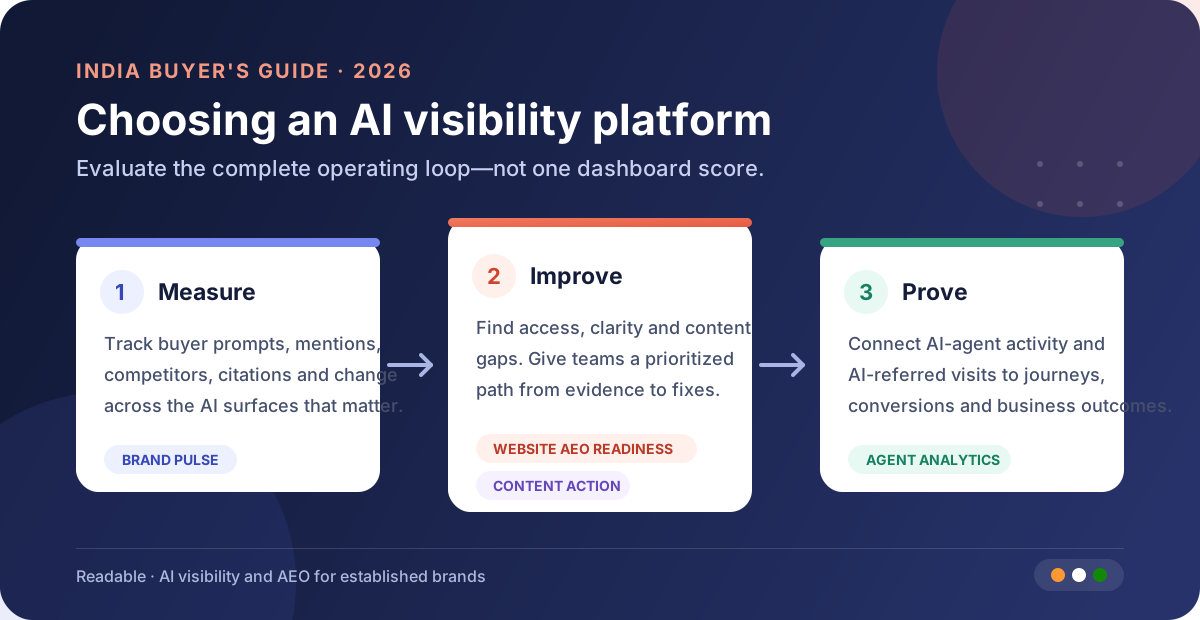
Readable's AI Visibility platform is designed for this first step. Brand Pulse measures buyer questions, brand and competitor appearances, citations, sources and missed questions. Website AEO Readiness checks whether important pages can be accessed and understood. The purpose is to move from a generic visibility score to a prioritized work list.

Build one reliable product truth layer
The same product can appear in a product information system, commerce platform, product page, mobile app, marketplace listing, Merchant Center feed, advertising feed and support article. AEO becomes fragile when those sources disagree.
For every priority SKU and variant, establish an accountable source for:
- product name and stable identifier;
- brand, model and category;
- material, dimensions, compatibility and other decision-critical specifications;
- variant relationships such as size, colour, pack or capacity;
- price, currency, offer conditions and validity;
- stock or preorder status;
- seller or manufacturer identity;
- delivery scope and timing qualifiers;
- return, exchange, warranty and cancellation rules;
- images and image descriptions;
- review totals and ratings only when they are genuine and current.
Google's Merchant Center product data specification requires or supports many of these fields, including identifiers, title, description, image, availability, price, brand and variant information. Its guidance also says product titles and descriptions should accurately match the landing page. This is a useful operational test even beyond Google: if the feed, structured data and visible page tell different stories, confidence falls and customers can be misled.
Assign ownership by field. Merchandising might own titles and category attributes; operations owns stock and delivery; legal or customer experience owns policy language; engineering owns how those facts reach the page and feeds. A weekly discrepancy report is more valuable than a one-time schema project.
Make product pages answer a decision
Many product pages display the minimum needed to transact but not enough to recommend. A good AEO product page should let a shopper or system answer:
- What is this exact product?
- Who is it for, and who should choose something else?
- Which specifications decide whether it fits the need?
- What changes when a variant is selected?
- What does it cost, and is it available?
- What delivery, return and warranty conditions apply?
- What credible evidence supports the claims?
Put the answer in visible page content. Structured data is a machine-readable representation of the page, not a substitute for missing customer information.
Google recommends ecommerce-relevant structured data such as Product, ProductGroup, Offer, BreadcrumbList, Organization, reviews where appropriate, and video markup where video is the primary page content. Its ecommerce structured-data guide explains the relevant types. Merchant Center's structured-data setup guide adds an important consistency rule: markup should be present in the server-returned HTML and match what users see.
For an Indian catalogue, check the details that commonly change the answer:
- INR price and the exact variant to which it applies;
- GST and fee presentation as shown to the buyer;
- Indian size or compatibility conventions where relevant;
- serviceability by postcode or region;
- cash-on-delivery availability if offered;
- installation, exchange or warranty conditions;
- delivery promises and exceptions;
- marketplace seller versus first-party seller identity.
Do not add a field merely because it sounds useful. Publish only information your operating systems and customer-facing policies can keep accurate.
Turn category pages into recommendation pages
Product pages describe individual items. Category pages can explain how to choose.
A category page built for buyer decisions should contain:
- A short definition of the category and the need it solves.
- The attributes that materially change the recommendation.
- Clear segments such as budget, use case, material, capacity or climate.
- A small number of representative products with honest fit statements.
- Links to deeper guides, comparisons, policies and product pages.
- Freshness signals where information changes frequently.
For example, a ceiling-fan category page could explain room size, air delivery, energy use, noise, smart controls and installation before presenting products. A skincare category page could organize information around skin type, ingredients, usage and patch-testing guidance without making unsupported medical claims. The goal is not to lengthen every category page. It is to resolve the uncertainty behind the prompt.
This is where ecommerce AEO and content strategy meet. Readable's AI Knowledge Base helps teams turn missed buyer questions into reviewed, AI-readable pages. Existing high-authority category and guide pages should usually be improved first; create a new page only when it serves a distinct intent and will not cannibalize a stronger page.
Publish comparisons that are fair enough to trust
AI shopping answers frequently compare products, but a brand-owned comparison earns trust only when it states the basis and limitations.
Use a consistent comparison method:
- name the buyer question;
- define the criteria before naming a winner;
- compare equivalent variants and current prices;
- distinguish verified facts from editorial judgement;
- cite first-party specifications and policy pages;
- say when another option is a better fit;
- date the comparison and review it when products change.
Avoid invented scores, hidden weighting and claims that cannot be reproduced. A clear "best for" statement is usually more useful than declaring one universal winner.
For India-specific comparisons, include the constraints that genuinely affect purchase: regional availability, service network, delivery, warranty, installation, local sizing, payment options and total price. Do not assume every shopper needs every field; choose the ones that change the decision for that category.
Make policies part of product discovery
Delivery, returns and warranty information is often isolated in a footer or hidden behind accordions. Yet these policies can decide whether a product is recommendable.
Create stable, crawlable policy pages and link them contextually from products and categories. Use precise language for:
- eligible products and exclusions;
- return or exchange window;
- when the window begins;
- pickup, courier or store-return method;
- who pays return shipping;
- refund timing and method;
- warranty duration, issuer and claim process;
- cancellation and preorder terms.
Google's Merchant Center documentation says return information should be easy to find and match the website. Its returns attribute guide supports product-level policy overrides and emphasizes accurate values. This is not proof that every AI system uses the same field. It is evidence that precise, consistent policy data is part of healthy commerce information.
Check access before rewriting content
A beautifully written page cannot contribute much if the systems trying to retrieve it receive an empty JavaScript shell, an interstitial, a blocked response or inconsistent content.
For the homepage, representative category pages, top product pages and policy pages, test:
- the HTML returned before client-side interaction;
- title, description, main heading and canonical URL;
- visible product facts and internal links;
robots.txt, meta robots and HTTP header directives;- CDN, firewall and bot-management behavior;
- status codes, redirects and response times;
- structured data validity and consistency with visible content;
- mobile rendering and accessibility labels.
OpenAI's publisher and developer FAQ says sites should not block OAI-SearchBot if they want content included in ChatGPT summaries and snippets. Google states that the standard technical requirements and SEO best practices for Search also apply to its AI features. Neither statement means crawler access guarantees a mention or recommendation. It means avoid preventable access failures before debating copy changes.
Earn corroboration outside your own website
First-party pages are necessary but inherently self-interested. Recommendation systems can also encounter marketplaces, publications, creator content, forums, customer reviews and retailer listings.
The ethical goal is not to manufacture mentions. It is to make accurate evidence easy to verify:
- keep marketplace listings consistent with the official product page;
- invite genuine reviews without prescribing the sentiment;
- correct factual errors through the platform's proper process;
- provide journalists and creators with current specifications and policies;
- maintain organization, contact and brand information across official profiles;
- publish evidence for material claims such as certifications or test methods.
Do not buy fake reviews, seed undisclosed endorsements or create low-quality pages on unrelated domains. Those tactics add noise and reputational risk rather than durable evidence.
Measure an operating funnel, not one visibility score
Ecommerce AEO should be evaluated from answer to outcome.
Track four layers:
1. Answer visibility
- mention rate across the tracked question set;
- citation or linked-source rate;
- share of relevant recommendations;
- accuracy of product, price and policy descriptions;
- competitor and publisher sources that repeatedly appear.
2. Page readiness
- retrieval success for important pages;
- meaningful server-rendered content;
- consistency between page, markup and feeds;
- unresolved content, access or policy gaps.
3. AI-referred behaviour
- visits from identifiable AI assistants;
- landing pages and product categories;
- engagement with comparisons, policies and products;
- add-to-cart, lead or store-locator actions.
4. Commercial outcomes
- orders or assisted conversions where attribution is defensible;
- revenue and margin by landing content;
- new-customer contribution;
- return or cancellation quality, so visibility does not reward unsuitable recommendations.
OpenAI says ChatGPT referral links include utm_source=chatgpt.com, which can support analytics for inbound ChatGPT search traffic. This is one signal, not a complete attribution system. Readable's Agent Analytics is intended to connect AI-referred visitors with the pages and actions that follow.

A 30-day rollout for an established Indian brand
Week 1: Establish the baseline
- Choose two commercially important categories.
- Build 30 to 50 questions across discovery, comparison, trust and fulfilment.
- Record current answers, mentions, sources and factual errors.
- Select the homepage, two category pages, five product pages and two policy pages for technical review.
Week 2: Repair product truth
- Compare the commerce platform, feed, markup and visible page for the selected SKUs.
- Fix identifier, variant, price, currency, stock, delivery and policy discrepancies.
- Confirm that important facts appear in retrievable HTML.
- Document field owners and update frequency.
Week 3: Improve decision content
- Rewrite weak category introductions around selection criteria.
- Add concise "best for" and limitation statements to priority products.
- Publish or update one high-intent comparison or buying guide.
- Strengthen internal links between the guide, category, product and policy pages.
Week 4: Re-measure and expand carefully
- Run the same question set again.
- Check whether citations, descriptions or shortlist presence changed.
- Review AI-referred visits and downstream actions.
- Keep improvements that helped buyers; reverse content that introduced ambiguity.
- Expand to the next category only after the workflow has clear owners.
Expect uneven movement. AI answers can vary by wording, freshness, source availability and model. Use a stable prompt set and repeated observations, then treat individual answers as evidence rather than a universal ranking.
What Readable can do in this workflow
Readable is an AI visibility and AEO platform for established Indian brands and enterprises. For ecommerce teams, the product story is a connected loop:
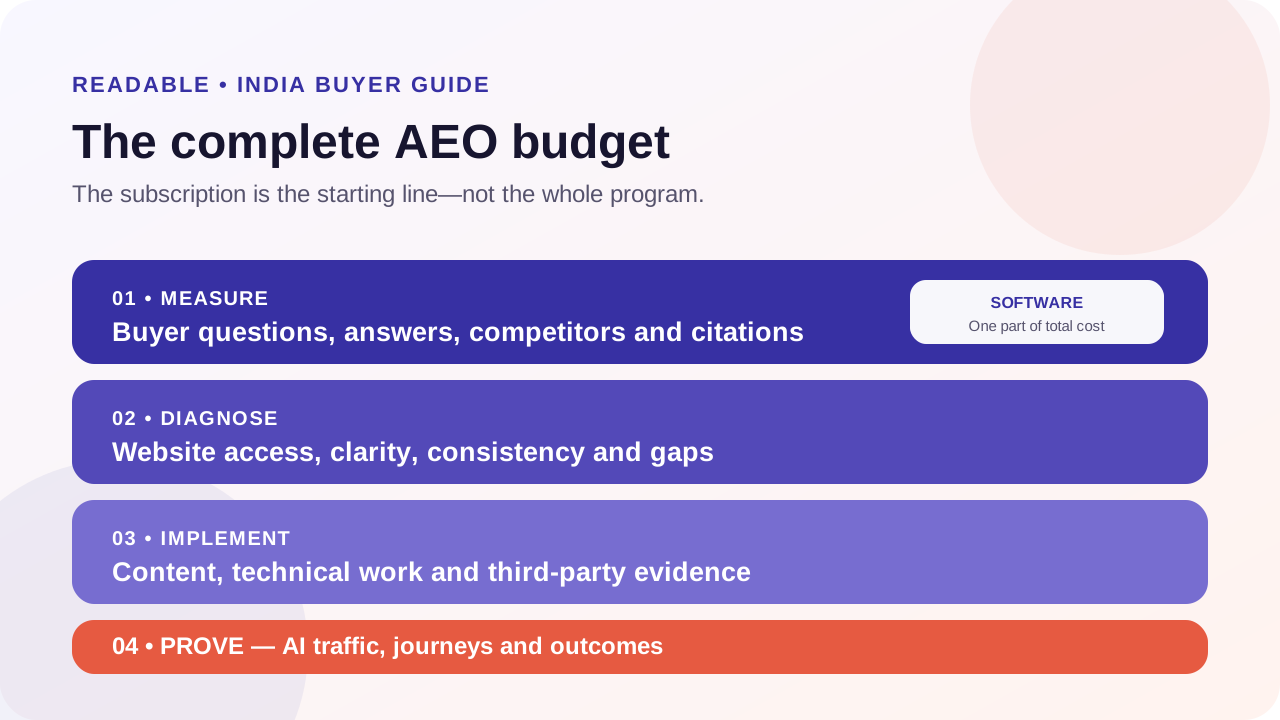
- Measure: Brand Pulse tracks buyer questions, brand and competitor appearances, citations, sources and missed questions.
- Diagnose: Website AEO Readiness checks whether important pages can be accessed and understood.
- Improve: AI Knowledge Base helps teams publish clearer, reviewed answers for material content gaps.
- Prove: Agent Analytics measures AI-agent activity, referred visits, journeys and outcomes.
Readable does not replace a product information system, commerce platform or inventory service. It helps teams identify where AI discovery is weak, prioritize the content and access work, and measure whether the program creates a better result.
You can also review the best AI visibility platforms for Indian brands, use the AEO provider evaluation scorecard, or compare AI visibility and AEO pricing in India before choosing a platform or partner.
Frequently asked questions
Is ecommerce AEO different from SEO?
It is an extension of good search, content and product-data practice, not a replacement. SEO helps pages become discoverable and useful in search. Ecommerce AEO adds explicit measurement of how AI answers represent products, which sources they use, and whether those answers lead to buyer activity.
Does product schema guarantee that ChatGPT or Google recommends a product?
No. Structured data can make product facts easier for supported systems to interpret, but it does not guarantee inclusion, ranking, citation or recommendation. The visible page, product feed, technical access, evidence quality and relevance to the buyer's constraints still matter.
Should every product page have an FAQ?
No. Add questions only when they resolve recurring product-specific uncertainty that is not already answered clearly. Do not duplicate boilerplate across thousands of pages. Important shared policies usually belong on authoritative policy pages with contextual links.
Which pages should an Indian ecommerce brand optimize first?
Start with categories that combine commercial value, non-branded demand and weak AI visibility. Within each category, prioritize the category page, representative high-volume products, a comparison or buying guide, and the policies that influence purchase confidence.
How long does ecommerce AEO take to work?
Technical and content fixes can be shipped quickly, but answer-engine visibility does not update on a guaranteed schedule. Measure the same representative question set over time, document what changed and judge the program on a portfolio of signals rather than one prompt.
Sources and further reading
- OpenAI: Introducing shopping research in ChatGPT
- OpenAI: Shopping with ChatGPT Search
- OpenAI: Publishers and Developers FAQ
- Google Search Central: AI features and your website
- Google Search Central: Best practices for ecommerce sites
- Google Search Central: Include structured data relevant to ecommerce
- Google Merchant Center: Product data specification
- Google Merchant Center: Set up structured data
- Google Merchant Center: Returns attribute
The next step
Choose one category and one stable question set. Measure where the brand appears, inspect the pages and product truth behind those answers, make a small number of verifiable improvements, and run the same test again.
If you need help connecting that loop, see how Readable measures AI visibility or review Readable pricing.
Would AI confidently recommend your products?
Readable helps Indian ecommerce teams find the buyer questions they miss, check whether AI can understand important pages, publish clearer answers, and measure the traffic and outcomes that follow.