Table of contents
- What Snapchat Just Announced: AI Sponsored Snaps Explained
- What Are Agentic Ads and Why Do They Matter Now
- How AI Sponsored Snaps Actually Work Inside Snapchat
- The Scale Opportunity: Why Snapchat's Chat Behavior Makes This Significant
- Early Performance Numbers Brands Should Know
- What This Means for Founders and Marketers Running Paid Social
- How Snapchat's Agentic Ads Compare to Other AI Advertising Tools
- Recent Snap News and Product Context
- Privacy Considerations and User Adoption Risks to Watch
- Frequently Asked Questions
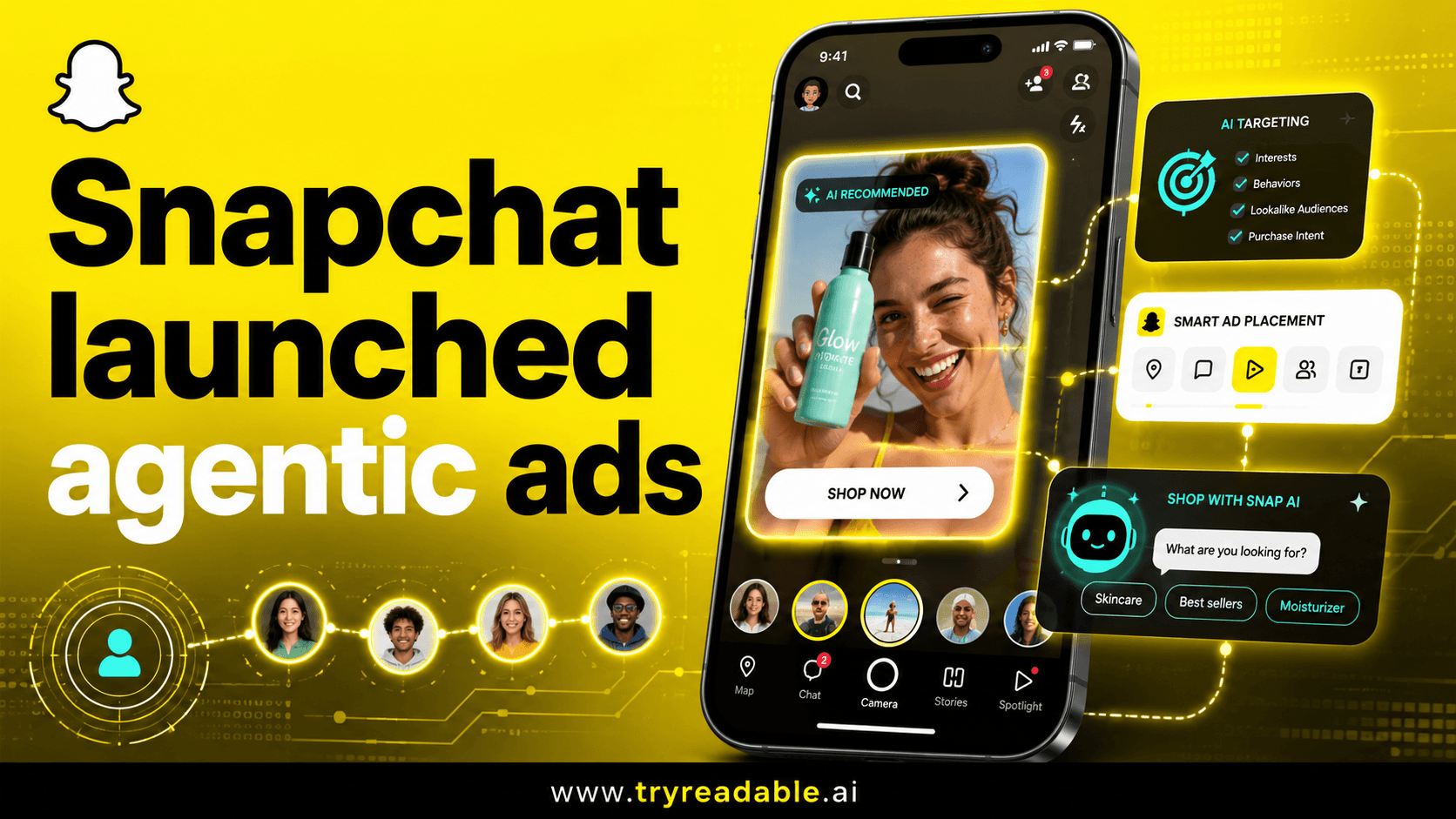
Snapchat launched agentic ads on April 28, 2026, and the advertising industry is paying close attention. The format, called AI Sponsored Snaps, places brand AI agents directly inside the Snapchat Chat inbox, where users can hold real conversations with those agents in natural language. It is not a banner. It is not a pre-roll video. It is a two-way, intent-driven interaction sitting inside the most personal real estate on the platform.
For founders and marketers who have been watching the conversational AI space, this announcement lands at an important moment. Platforms have been experimenting with AI-native ad formats for years, but Snapchat's launch represents one of the first major platform-level deployments of agentic advertising at genuine scale, backed by a user base approaching one billion monthly actives and a chat behavior that already generates hundreds of billions of messages per quarter.
This article breaks down exactly what Snapchat announced, explains what agentic ads are for readers who are newer to the term, walks through the mechanics of how AI Sponsored Snaps work, and translates the announcement into practical strategic guidance for the founders and marketers who need to decide whether this format belongs in their paid social mix.
What Snapchat Just Announced: AI Sponsored Snaps Explained
On April 28, 2026, Snap published an announcement on its official newsroom introducing AI Sponsored Snaps, a new ad format that allows users to chat directly with brand AI agents inside the Snapchat Chat tab. The announcement confirmed Experian as the first brand partner and positioned the format as a natural evolution of the existing Sponsored Snaps product.
Sponsored Snaps, the predecessor format, already placed brand messages directly inside the main Chat inbox rather than in a separate ad feed. That placement alone was a significant departure from conventional social advertising, which typically interrupts a content scroll. AI Sponsored Snaps take the same inbox placement and layer in a fully interactive AI agent, so instead of a user simply viewing a brand message and dismissing it, they can now tap the ad and begin a real conversation.
Snap's Chief Business Officer Ajit Mohan framed the strategic logic clearly in the announcement: "Conversation is becoming the most valuable real estate in advertising. AI is accelerating that shift, turning chat into the place where people discover products, ask questions, and make decisions in real time. The real opportunity isn't just putting ads into those environments, it's designing formats that feel native to how people already talk. That's what AI Sponsored Snaps are about, pairing the scale of nearly a billion monthly users with AI-powered conversations that drive real engagement and action."
That framing matters for marketers. Mohan is not describing a feature update. He is describing a thesis about where advertising value is migrating. Chat, in Snap's view, is not a secondary surface. It is the primary surface, and AI Sponsored Snaps are Snap's bet that brands willing to show up there in a genuinely useful, conversational way will outperform brands still relying on passive impression-based formats.
The timing of the launch is also notable. Snap chose to announce this format alongside strong engagement data from Q1 2026, giving the announcement a commercial foundation rather than positioning it purely as a product experiment. Experian's participation as the first confirmed brand partner signals that at least one major financial services brand has already committed to testing the format, which is meaningful given how carefully regulated industries typically approach new ad products.
TechCrunch covered the launch on the same day, noting that until now Sponsored Snaps did not allow user interaction, and that AI Sponsored Snaps represent the first time users can actually engage with a brand agent directly from the Chat inbox. That distinction is worth holding onto as you read the rest of this article, because the interactivity is what separates this format from everything that came before it on the platform.
What Are Agentic Ads and Why Do They Matter Now
Before going deeper into Snapchat's specific implementation, it is worth spending a moment on the broader concept of agentic ads, because the term is appearing more frequently in marketing conversations and not everyone is working from the same definition.
Agentic ads are interactive ad units powered by AI agents that can hold real conversations, answer questions, and guide purchase decisions. The word "agentic" refers to the agent's capacity to act autonomously within a defined scope, responding to user input dynamically rather than serving a pre-scripted sequence of messages. Unlike static display ads, video ads, or even basic chatbot pop-ups, agentic ads can interpret natural language, understand context within a conversation, and generate responses that are genuinely relevant to what the user just said.
The practical difference is significant. A static ad shows you a product image and a call to action. A video ad tells you a brand story. An agentic ad can answer the question you actually have right now, whether that is "does this work with my existing setup," "what is the difference between the two plans," or "can I get a discount if I sign up today." That shift from passive exposure to active, intent-driven engagement is what makes the format structurally different from everything that preceded it.
Agentic ads also represent a meaningful change in how the full purchase funnel can be compressed. Traditionally, a brand might use a top-of-funnel awareness ad to introduce a product, a mid-funnel retargeting ad to drive consideration, and a bottom-of-funnel conversion ad to close the sale. An agentic ad can, in theory, handle all three stages within a single conversation, because the agent can introduce the product, answer comparison questions, and deliver a discount code or a checkout link without the user ever leaving the chat.
The concept has been discussed in marketing and AI circles for several years, but platform-level deployment at scale has been limited. Most agentic ad experiments have lived in controlled environments, brand-owned chat interfaces, or pilot programs with limited reach. Snapchat's launch is one of the first times a major social platform has embedded this format natively into its core product experience and made it available to advertisers at scale. That is what makes the April 28 announcement significant beyond the Snapchat-specific context.
For a broader look at how AI is reshaping content and communication strategy, the TryReadable guides section covers related topics in practical depth.
How AI Sponsored Snaps Actually Work Inside Snapchat

Understanding the mechanics of AI Sponsored Snaps is important for marketers who need to evaluate whether their brand is technically and creatively ready to run this format. The user experience and the brand-side setup are both worth walking through in detail.
From the user's perspective, AI Sponsored Snaps appear inside the Chat inbox, clearly labeled as paid content. The labeling is important both for regulatory compliance and for user trust. When a user sees the ad, they can choose to tap it and begin a conversation. The conversation happens in natural language, meaning the user types or speaks as they would to any other contact in their Chat list, and the brand's AI agent responds in kind.
Inside that conversation, the agent can do quite a lot. According to Snap's official announcement, agents can share product recommendations, deliver discount codes, provide links to product pages or checkout flows, and offer educational content, all without the user needing to leave the chat interface. That frictionless experience is a deliberate design choice. Every time a user has to switch apps or open a browser, there is a drop-off risk. Keeping the entire interaction inside Chat reduces that friction significantly.
From the brand side, the setup involves connecting an AI agent to Snap's platform. Brands have two primary options. They can bring their own AI models, meaning a proprietary agent they have already built and trained on their product catalog, brand voice, and customer service logic. Alternatively, they can connect external APIs to power the agent, which gives brands flexibility to use third-party AI infrastructure they may already have in place. This is a meaningful design decision by Snap, because it means brands are not locked into a Snap-specific AI tool. If you have already invested in building a capable AI agent for your website or customer service stack, that investment can potentially be extended to the Snapchat surface.
Snap has also addressed the privacy question that is likely to be the first concern for any marketer evaluating this format. The company states that no private message content is shared with advertisers by default. The AI agent interacts only within the context of the conversation the user initiates with that specific brand. It does not have access to the user's other chats, their message history with friends, or any other private content on the platform. That boundary is important both for user trust and for the regulatory environment that will inevitably scrutinize this format more closely as it scales.
AI CERTs covered the format mechanics in detail, noting that during demos the agents demonstrated contextual product recommendations within seconds and that the design mimics ordinary messaging threads, which boosts familiarity for users who are already comfortable with the Chat interface.
For marketers thinking about creative strategy, the conversational format demands a different kind of preparation than a standard ad creative brief. You are not writing a headline and a body copy. You are defining the scope of what your agent can discuss, the tone it should use, the questions it should be able to answer, and the actions it should be able to take. That is closer to building a customer service playbook than writing an ad, and brands that approach it with that level of rigor are likely to see better results than those who treat it as a simple chatbot deployment.
If you want to evaluate how your existing brand content reads and communicates before deploying it through a conversational agent, TryReadable's analyze tool can help you assess clarity and readability across your messaging assets.
The Scale Opportunity: Why Snapchat's Chat Behavior Makes This Significant
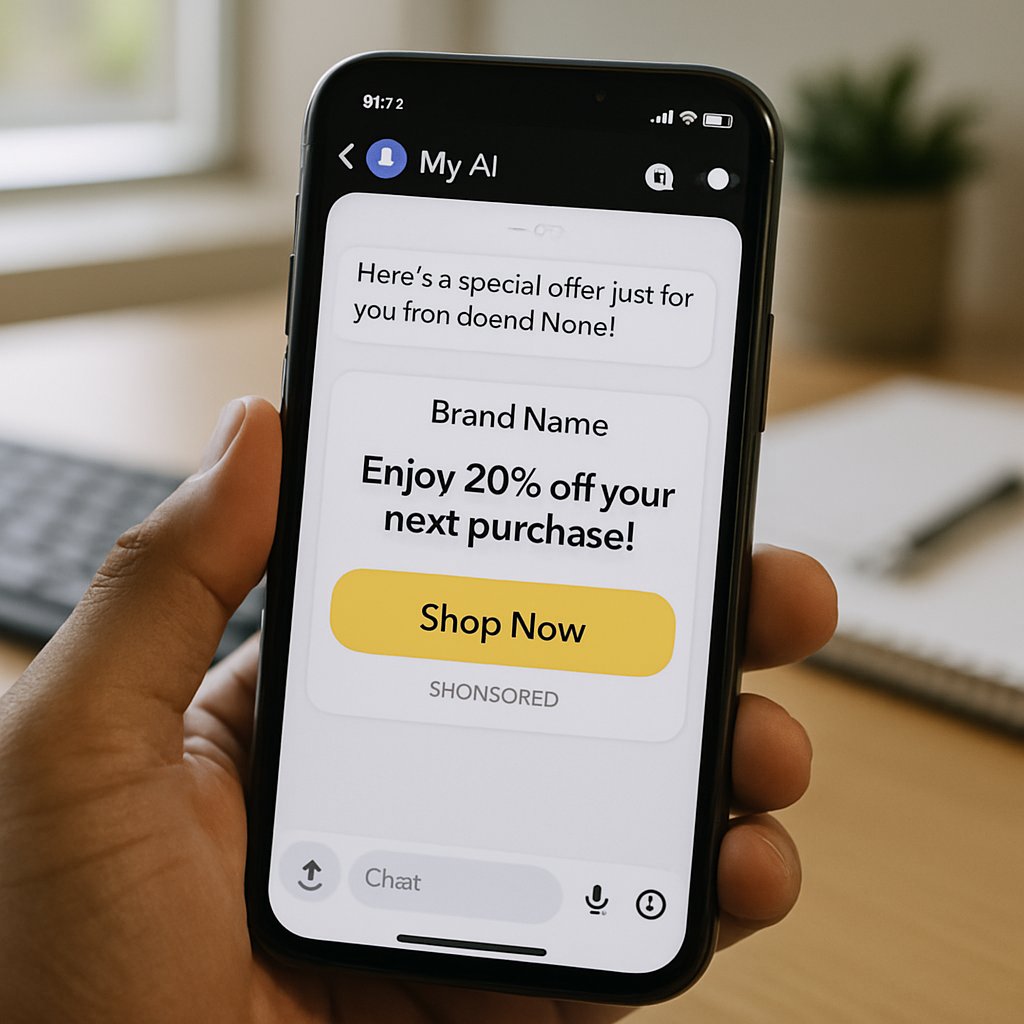
One of the most important things to understand about AI Sponsored Snaps is the scale context in which they are launching. This is not a niche format being tested on a small user base. It is launching on a platform where chat is already the dominant behavior, and where users have already demonstrated comfort with AI in that context.
Snap's announcement reported that Snapchat users sent over 950 billion chats in Q1 2026 alone. That number is worth sitting with for a moment. Nine hundred and fifty billion messages in a single quarter means that chat is not a secondary feature on Snapchat. It is the core product behavior, and it generates a volume of engagement that most platforms would consider extraordinary.
Alongside that, over half a billion Snapchatters have messaged My AI since its launch in 2023. My AI is Snap's built-in AI chatbot, and the fact that more than half the platform's user base has already engaged with it is a strong signal that Snapchat's audience is not resistant to AI in the chat context. They have already normalized it. When AI Sponsored Snaps appear in their inbox, they are not encountering AI for the first time. They are encountering a brand version of something they have already been using.
Snap's monthly active user base is approaching one billion, which gives brands a potential reach that is competitive with the largest social platforms in the world. For context, Snap's Q4 2025 filings cited by AI CERTs put the figure at 946 million monthly users, with the company projecting it will cross one billion in 2026.
The chat-native behavior on Snapchat also creates a qualitatively different advertising environment compared to feed-based platforms. On Instagram or TikTok, ads interrupt a content consumption experience. The user is watching or scrolling, and the ad is an intrusion. On Snapchat, the Chat tab is already a place where users go to have conversations. An AI Sponsored Snap that appears there and offers a genuinely useful interaction is, at least in theory, less of an interruption and more of an addition to the conversational environment the user is already in.
That distinction matters for brand perception and for performance. Ads that feel native to their context tend to perform better than ads that feel disruptive. Snapchat's bet is that a conversational ad format in a conversational environment will feel more native than almost anything else a brand can run on social media right now.
For founders evaluating whether to allocate budget to this format, the scale numbers provide a strong baseline argument. The audience is large, the engagement behavior is already established, and the AI comfort level is higher than on most other platforms. The question is not whether the opportunity is real. The question is whether your brand is ready to execute it well.
Early Performance Numbers Brands Should Know
Any new ad format needs to be evaluated against performance data, and Snap has provided some numbers that marketers should understand, along with appropriate caveats about how to interpret them.
The most directly relevant baseline comes from legacy Sponsored Snaps, the predecessor format that AI Sponsored Snaps are building on. According to Snap's official announcement, Sponsored Snaps already deliver 22 percent more conversions with nearly 20 percent lower cost per action compared to other Snapchat inventory. They also drive two times more conversions per full-screen ad view compared to other inventory on the platform.
Those are strong numbers for a format that does not yet include the interactive AI layer. The argument Snap is making is that if the non-interactive version of inbox placement already outperforms other inventory by these margins, the interactive version, which allows users to ask questions, get personalized recommendations, and receive discount codes in real time, should improve on those benchmarks further.
That logic is reasonable, but marketers should treat it as directional rather than definitive. AI Sponsored Snaps are newly launched, and independent verification of performance claims is limited at this stage. The numbers Snap has shared for legacy Sponsored Snaps are from Snap's own reporting, and while they are plausible given the format's placement advantages, they have not been independently audited in the way that more established ad formats have been.
Yahoo Finance's coverage of the launch noted that Snap is letting its nearly 950 million users chat directly with brands, framing the launch as a significant moment in the AI disruption of advertising. That framing is consistent with the performance narrative Snap is building, but it also reflects the early-stage nature of the announcement. The real performance data will come from brands like Experian who are running the format in live conditions over the coming months.
For budget planning purposes, the most useful approach is to treat the legacy Sponsored Snaps performance data as a floor. If the non-interactive format delivers 22 percent more conversions at 20 percent lower cost per action, that is already a compelling case for testing the placement. The AI layer adds a variable that could meaningfully improve those numbers, particularly for brands selling products that benefit from explanation or comparison. The risk is that poorly executed AI agents could underperform the baseline, which is why the quality of the agent matters as much as the placement itself.
Marketers who want to understand how to structure their content and messaging for AI-driven formats can explore TryReadable's brand resources for practical guidance on clarity and communication strategy.
What This Means for Founders and Marketers Running Paid Social
The strategic implications of Snapchat's AI Sponsored Snaps launch are significant, and they vary depending on what kind of brand you are running and where you are in your paid social maturity.
The most natural early fits for this format are brands that sell products requiring explanation or comparison. Financial services is the obvious example, which is why Experian's participation as the first brand partner makes sense. A user who sees a credit monitoring ad and has questions about what the service actually does, how it differs from competitors, or whether it is worth the cost can now get those questions answered in real time without leaving the platform. The same logic applies to consumer technology, insurance, software products, health and wellness services, and any category where the purchase decision involves more than a single impulse.
The full-funnel design of the format is one of its most strategically interesting characteristics. A single AI Sponsored Snap can handle awareness, consideration, and conversion within one conversation. The user discovers the brand through the inbox placement, engages with the agent to learn more, and receives a discount code or a checkout link without ever switching contexts. For brands that currently run separate campaigns for each funnel stage, this compression represents both an efficiency opportunity and a creative challenge, because the agent needs to be capable of serving all three stages depending on where the user is in their decision process.
Marketers should also evaluate whether their existing AI infrastructure can be connected to Snap's platform via API. If your brand has already built a capable AI agent for your website, customer service platform, or sales process, the incremental cost of extending that agent to Snapchat may be lower than building from scratch. If you have not yet invested in AI agent infrastructure, the Snapchat launch is a reasonable prompt to start that conversation internally, because this format is unlikely to be the last place where brands will need to deploy conversational agents at scale.
Early mover advantage in this format may be significant. As Snap scales AI Sponsored Snaps and more brands adopt the format, competition for Chat inbox placement will increase, and costs will likely rise. Brands that test the format now, while it is new and competition is limited, have the opportunity to learn what works, build agent capabilities, and establish performance benchmarks before the market becomes crowded.
Budget experimentation is warranted given the strong baseline performance of standard Sponsored Snaps. A reasonable approach for most brands would be to allocate a test budget equivalent to what you might spend on a new creative format or a new platform test, run the format for a defined period with clear performance metrics, and evaluate the results against your existing paid social benchmarks. The goal of the initial test is not to replace your existing paid social mix but to understand whether this format has a place in it.
For brands that want to think through how their messaging and content strategy needs to evolve for conversational ad formats, booking a demo with TryReadable is a practical next step.
How Snapchat's Agentic Ads Compare to Other AI Advertising Tools
Search interest in this topic frequently surfaces alongside questions about other AI advertising platforms, including tools like AdCreative.ai. That comparison is worth addressing directly, because the two categories solve different problems.
Tools like AdCreative.ai are creative generation platforms. They help marketing teams produce ad images, copy variations, and creative assets faster using AI. The output is still a passive ad unit, a banner, a social image, a video script, that gets placed in a conventional ad slot. The AI is working behind the scenes to accelerate production, not in front of the user to drive conversation.
Snapchat's AI Sponsored Snaps are a distribution and engagement format. The AI is the ad experience itself. The user interacts with the agent directly, and the quality of that interaction determines whether the ad drives a conversion. These are complementary rather than competing tools. A brand might use a creative generation platform to produce the initial visual or message that draws a user into the AI Sponsored Snap, and then rely on a conversational agent to handle the interaction once the user taps.
The practical implication for marketers is that adopting agentic ad formats does not replace the need for strong creative production. It adds a new layer of investment in agent quality, conversation design, and response accuracy. Brands that treat the agent as an afterthought and focus all their energy on the entry creative are likely to see lower performance than brands that invest equally in both.
For ad tech product launches more broadly, the Snapchat announcement fits a pattern that has been building across major platforms. Meta has been testing AI-powered ad personalization at the creative level. Google has been expanding its AI-driven Performance Max campaigns. Pinterest has introduced AI-assisted shopping features. The direction of travel across the industry is consistent: AI is moving from a production tool into the ad experience itself. Snapchat's launch is the most direct expression of that trend to date, because it puts the AI agent in a one-on-one conversation with the user rather than using AI to optimize targeting or creative selection in the background.
Recent Snap News and Product Context
For readers who arrived here looking for the latest Snap and Snapchat news, it is useful to place the AI Sponsored Snaps launch within the broader product and business context Snap has been building toward.
The April 28, 2026 launch of AI Sponsored Snaps is the most significant ad product announcement Snap has made since the original Sponsored Snaps format. It follows a period in which Snap has been investing heavily in its AI infrastructure, most visibly through My AI, the platform's built-in chatbot that launched in 2023 and has since been used by over half a billion Snapchatters.
Snap's Q1 2026 results, which accompanied the AI Sponsored Snaps announcement, showed continued growth in daily active users and messaging volume. The 950 billion chats sent in Q1 2026 represent a significant increase from prior periods and reflect the platform's success in deepening engagement among its core user base, which skews toward younger demographics in the 13 to 34 age range.
The company has also been expanding its augmented reality advertising capabilities, its creator monetization tools, and its Snap Map features during this period. The AI Sponsored Snaps launch is best understood as part of a broader strategy to make Snap's advertising products more differentiated from Meta and TikTok, where the core ad formats are more similar to each other. By betting on conversational AI as a native ad format, Snap is attempting to create a category of advertising that is genuinely difficult for competitors to replicate without the same underlying chat behavior and AI infrastructure.
For marketers tracking ad tech product launches across the industry, the Snapchat announcement is one of the more consequential of 2026 to date, both because of the scale of the platform and because of the structural novelty of the format. It is worth monitoring how Experian's early results are reported and whether Snap announces additional brand partners in the months following the launch.
Privacy Considerations and User Adoption Risks to Watch
A balanced assessment of AI Sponsored Snaps requires acknowledging the real challenges and open questions alongside the opportunity. There are several areas where founders and marketers should maintain healthy skepticism and monitor developments closely.
The first is user adoption and fatigue. Not all Snapchat users will welcome AI agents in their Chat inbox. The Chat tab is where people talk to their friends and family, and for many users, the presence of brand AI agents in that space will feel intrusive regardless of how well the format is designed. TechCrunch noted in its coverage that not everyone will be on board with AI-sponsored ads, as they introduce AI into yet another part of the Snapchat experience, and that not everyone is eager for more advanced advertising. As more brands adopt the format, the risk of user fatigue increases. If the Chat inbox becomes crowded with brand agents, users may begin to disengage from the format or from the Chat tab more broadly, which would undermine the placement advantage that makes the format compelling in the first place.
The second area is data handling and privacy. Snap states that advertiser AI agents do not access private message content, but the specifics of how conversational ad data is stored, used, and potentially shared will be scrutinized by regulators and privacy advocates as the format scales. The conversations users have with brand agents contain intent signals that are potentially more valuable and more sensitive than the behavioral data collected from passive ad impressions. How that data is handled, who has access to it, and how long it is retained are questions that will need clear, public answers as the format matures.
Regulatory attention is a real possibility. Conversational advertising sits at the intersection of AI, data privacy, and consumer protection, three areas that are already under significant regulatory scrutiny in the United States, the European Union, and other major markets. Brands running AI Sponsored Snaps should ensure their legal and compliance teams are aware of the format and have reviewed the data handling implications before committing significant budget.
Brand safety is another consideration that deserves serious attention. In a passive ad format, a poorly written headline or an off-brand image is a limited problem. In a conversational format, a poorly trained AI agent can say something genuinely damaging in a one-on-one interaction with a user. If the agent gives incorrect information, responds in a tone that conflicts with the brand's values, or fails to handle a sensitive question appropriately, the impact on brand perception can be more significant than a typical ad misfire. The conversational context creates a higher standard for agent quality, and brands should invest accordingly in training, testing, and monitoring their agents before and after launch.
For marketers who want to understand how AI-generated and AI-assisted content performs from a clarity and readability perspective, TryReadable's analyze tool provides a practical way to evaluate your content before it goes live in any format.
Frequently Asked Questions
What are Snapchat's AI Sponsored Snaps?
AI Sponsored Snaps are a new Snapchat ad format launched on April 28, 2026. They place brand AI agents directly inside the Snapchat Chat inbox, allowing users to have real conversations with those agents in natural language. Users can ask questions, receive product recommendations, get discount codes, and access checkout links without leaving the chat interface.
What are agentic ads?
Agentic ads are interactive ad units powered by AI agents that can hold genuine two-way conversations with users, answer questions dynamically, and guide purchase decisions in real time. Unlike static or video ads, agentic ads respond to what the user actually says rather than delivering a fixed message. Snapchat's AI Sponsored Snaps are one of the first large-scale deployments of this format on a major social platform.
How do AI Sponsored Snaps differ from standard Sponsored Snaps?
Standard Sponsored Snaps place a brand message in the Chat inbox but do not allow user interaction. AI Sponsored Snaps add a fully interactive AI agent to that same placement, so users can tap the ad and begin a real conversation with the brand. The interactivity is the core distinction between the two formats.
What brands are using AI Sponsored Snaps?
Experian was confirmed as the first brand partner at launch on April 28, 2026. Snap has not publicly announced additional brand partners beyond Experian as of the time of this article's publication.
How do AI Sponsored Snaps compare to tools like AdCreative.ai?
They solve different problems. Tools like AdCreative.ai help marketing teams generate ad creative assets faster using AI. AI Sponsored Snaps are a distribution and engagement format where the AI agent is the ad experience itself. The two can be complementary: a brand might use a creative generation tool to produce the entry visual for an AI Sponsored Snap, then rely on a conversational agent to handle the interaction once the user engages.
What performance data is available for AI Sponsored Snaps?
Snap has not yet published independent performance data for AI Sponsored Snaps specifically, as the format launched in April 2026. The available baseline comes from legacy Sponsored Snaps, which Snap reports deliver 22 percent more conversions with nearly 20 percent lower cost per action compared to other Snapchat inventory, and two times more conversions per full-screen ad view. These figures are from Snap's own reporting and have not been independently audited.
Are there privacy risks with AI Sponsored Snaps?
Snap states that advertiser AI agents do not access users' private message content and interact only within the conversation a user initiates with a specific brand. However, the conversations themselves contain intent signals that may be stored and used in ways that regulators and privacy advocates will scrutinize as the format scales. Brands should review data handling implications with their legal and compliance teams before committing significant budget.
What is the IMCP in the context of AI advertising?
IMCP stands for Intelligent Marketing Communication Protocol, a term used in some AI advertising and agent communication discussions to describe standardized ways for AI agents to exchange information with advertising platforms and brand systems. It is an emerging concept in the ad tech space and is not specific to Snapchat's implementation. Snap's AI Sponsored Snaps use API connections to allow brands to bring their own AI models or connect external agent infrastructure to the platform.
Snapchat's launch of AI Sponsored Snaps is a meaningful moment in the evolution of digital advertising. The format combines a high-engagement placement, a user base that has already normalized AI in chat, and a conversational mechanic that can compress the full purchase funnel into a single interaction. The performance baseline from legacy Sponsored Snaps is strong, and the strategic logic for brands selling complex or considered products is clear.
At the same time, the format is new, independent performance verification is limited, and the privacy and user adoption questions are real. The right posture for most founders and marketers is informed optimism combined with disciplined testing. Allocate a test budget, build or connect a capable AI agent, set clear performance benchmarks, and evaluate the results honestly.
The brands that will benefit most from this format are the ones that treat it as a genuine product investment rather than a media buy. The agent you deploy in the Snapchat Chat inbox is a representation of your brand in a direct, personal conversation with a potential customer. The quality of that conversation will determine whether AI Sponsored Snaps become a meaningful part of your growth strategy or a line item you quietly discontinue after a disappointing test.
The opportunity is real. The execution is what will separate the winners from the rest.
Want to make sure your brand messaging is clear and readable before deploying it through conversational ad formats? Analyze your content with TryReadable or book a demo to see how we can help your team communicate more effectively across every channel.
Sources
- The Future of Ads Is Conversational: Introducing AI Sponsored Snaps
- AI Disruption of Advertising Is Here -- Snapchat Debuts AI-Powered Chat Ads
- Snapchat brings AI-powered conversational advertising to its app | TechCrunch
- Snapchat Chatbots: Sponsored AI Reinvents Messaging Ads - AI CERTs News
- Google Search Central documentation
- Google AI Overviews documentation
- OpenAI announcement archive
- Anthropic documentation
- Schema.org structured data vocabulary
- W3C JSON-LD specification
- Google Analytics developer docs
- NIST AI Risk Management Framework
Are your paid social ads ready for conversational AI at scale?
Learn how agentic ads are reshaping user intent capture and what your team needs to test first before competitors move faster.