Table of contents
- Your Website Has a New Type of Visitor: AI Agents
- What Google Actually Said: The web.dev Guidance Explained
- What the web.dev Agent-Friendly Website Best Practices Cover
- How AI Agents Actually Read Your Website
- What Agent-Friendly Means in Practice: The Design Principles
- Why This Matters More for Founders and Marketers Than Developers
- The Gap Most Sites Have Right Now and Why It Is Hard to Fix
- How to Build Agent-Friendly Websites Without Rebuilding Your Site
- The Moment to Act Is Now
- Frequently Asked Questions
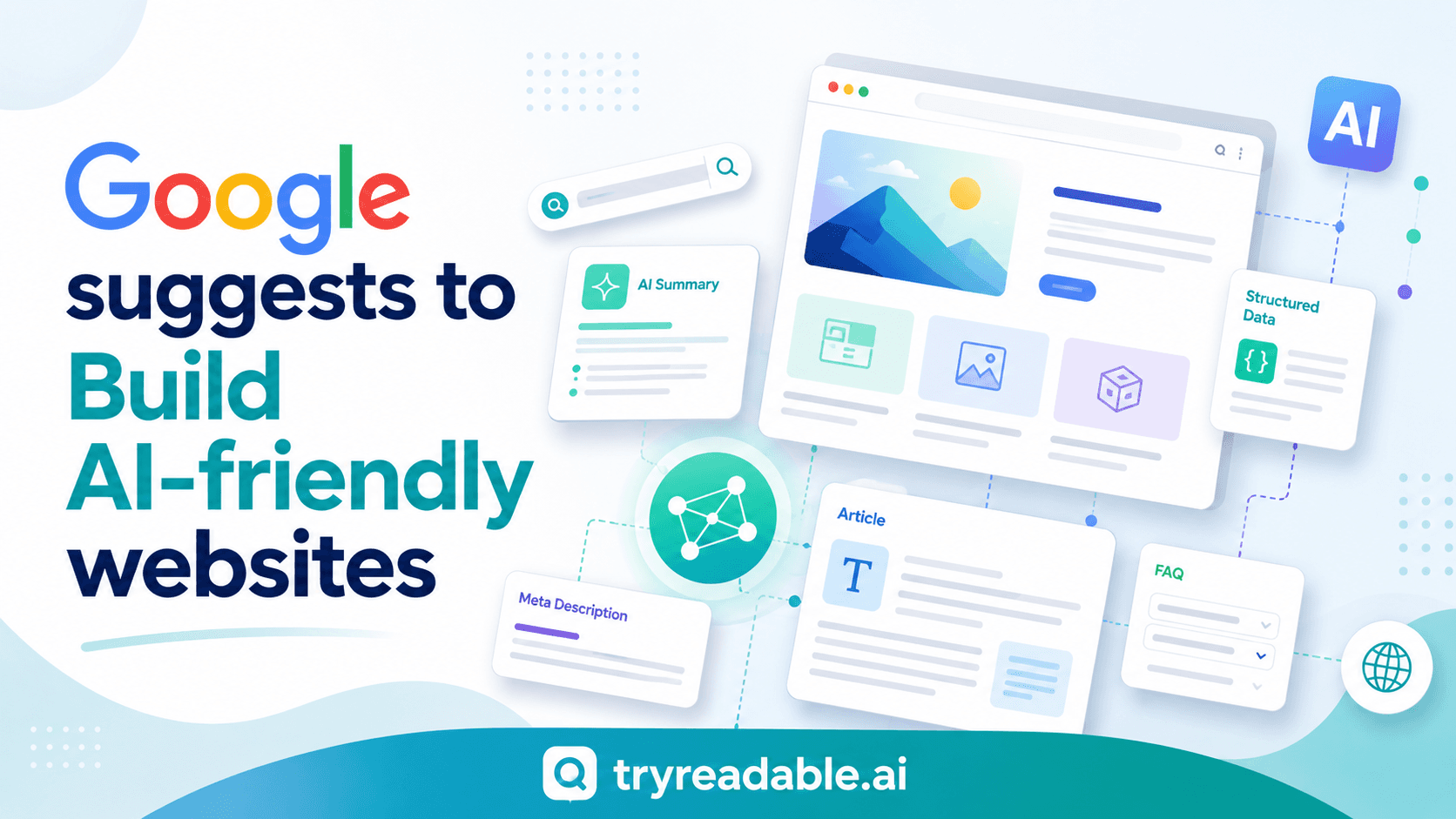
Google has made something official that many founders and marketers have been quietly sensing for months. AI agents are not just a future consideration. They are visiting websites right now, parsing content, making decisions, and acting on behalf of users. And Google wants the web to be ready for them.
In a guidance article published on web.dev, Google's official developer resource, the company explicitly tells developers to build agent-friendly websites. The framing is deliberate and significant. This is not a speculative blog post or a conference keynote. It is a structured, technical recommendation from the same platform that shaped how developers think about performance, accessibility, and Core Web Vitals.
For founders and marketers, this guidance carries a clear message: the way your website is built now determines whether AI agents can find you, understand you, and recommend you. If your site is not readable by agents, it is effectively invisible to a growing share of the discovery layer that sits between your brand and your next customer.
This article walks through what Google actually said, what it means in practice, and how TryReadable helps you act on it without a full site rebuild.
Your Website Has a New Type of Visitor: AI Agents

The opening line of Google's web.dev article is worth quoting directly. It states that your website has "a new type of visitor." That framing is not accidental. Google is signalling a structural shift in how the web works, not a marginal edge case.
Some human users are no longer navigating websites manually. Instead, they are delegating that task to AI agents. These agents, built into products like ChatGPT, Claude, Gemini, and a growing number of enterprise tools, browse the web autonomously. They visit pages, extract information, compare options, and sometimes complete actions like filling forms or initiating purchases, all without a human clicking through the experience.
This is already happening at scale. When someone asks ChatGPT to find the best project management tool for a remote team, the agent does not just search. It visits pages, reads content, and synthesises what it finds into a recommendation. When a Gemini-powered assistant is asked to book a demo with a SaaS company, it needs to understand what that company does, where the booking form is, and what the next step looks like. All of that depends on whether the website is legible to the agent.
The implications for discoverability and conversion are direct. If an agent cannot parse your homepage, it cannot include you in a recommendation. If it cannot identify your call to action, it cannot complete a task on a user's behalf. The agent-readability of your site is becoming a prerequisite for being found and chosen in an AI-mediated world.
This is not a future trend to monitor. According to Search Engine Journal's coverage of the web.dev guidance, Google is treating AI agents as a distinct visitor type that requires deliberate design consideration today. The sites that respond to this shift now will compound their advantage as agentic AI usage continues to grow.
What Google Actually Said: The web.dev Guidance Explained
The article Google published at web.dev/articles/ai-agent-site-ux is titled "Build agent-friendly websites" and sits within the AI and the web section of the platform. web.dev is not a peripheral resource. It is the canonical home of Google's developer guidance, the same place that introduced the world to Core Web Vitals, Lighthouse, and progressive web app standards. When something appears there, it carries the weight of an official recommendation.
The guidance is authored by Kasper Kulikowski and Omkar More, and it treats AI agents as a first-class visitor type that website owners need to design for deliberately. The core argument is that the best practices for agent-friendly design closely mirror the best practices for accessibility. Semantic structure, clear content hierarchy, descriptive labels, and logical navigation all serve both screen readers and AI agents for the same underlying reason: both need to understand a page without relying on visual context.
This parallel is important for founders and marketers to internalise. Accessibility has been a recognised design priority for years. The infrastructure of good accessible design, proper heading structure, meaningful link text, labelled form fields, and clean HTML, turns out to be exactly what AI agents need to function effectively on your site. If your site is already well-optimised for accessibility, you have a head start. If it is not, you have two compounding problems to address.
The web.dev guidance also introduces WebMCP as a forward-looking protocol for agent-to-site communication. WebMCP is designed to give agents a structured, machine-readable interface for interacting with websites, going beyond passive reading to enable active task completion. While WebMCP is still emerging, its inclusion in the guidance signals that Google is thinking about agent interaction as a long-term architectural consideration, not just a content formatting question.
The overall message from web.dev is clear: agent-friendly design is not optional, it is the next layer of web quality that developers and site owners need to build toward.
What the web.dev Agent-Friendly Website Best Practices Cover
Because several search queries specifically ask about the web.dev agent-friendly website best practices, it is worth summarising what the guidance actually covers in one place.
The web.dev article organises its recommendations around three broad themes.
Agent readability. The guidance explains that agents parse the underlying HTML of a page rather than rendering it visually. It recommends semantic HTML elements, server-rendered content, descriptive text for links and buttons, and alt text for images. Pages that rely on JavaScript to surface their primary content are flagged as a common failure point.
Agent navigation. The guidance identifies UI patterns that block agents from moving through a site effectively. Cookie consent walls, modal overlays, hover-only menus, and infinite scroll are all cited as patterns that create friction agents cannot resolve. The recommendation is to ensure that the core content and navigation of a page are accessible without requiring interaction.
Agent action. The guidance addresses how agents complete tasks on a user's behalf, such as filling a form or initiating a purchase. It recommends that interactive elements be clearly labelled, that form fields have descriptive labels, and that the sequence of steps required to complete an action be unambiguous from the HTML structure alone. WebMCP is introduced here as a protocol that could eventually give agents a more structured interface for task completion.
These three themes map directly to the journey an agent takes when it visits your site: first it reads, then it navigates, then it acts. A site that fails at any of these stages is partially or fully invisible to agents, regardless of how well it performs for human visitors.
As ALM Corp's breakdown of the Google guidance notes, the best practices in the web.dev article are not experimental suggestions. They are grounded in the same principles that have underpinned good web development for years, applied to a new and increasingly important visitor type.
How AI Agents Actually Read Your Website
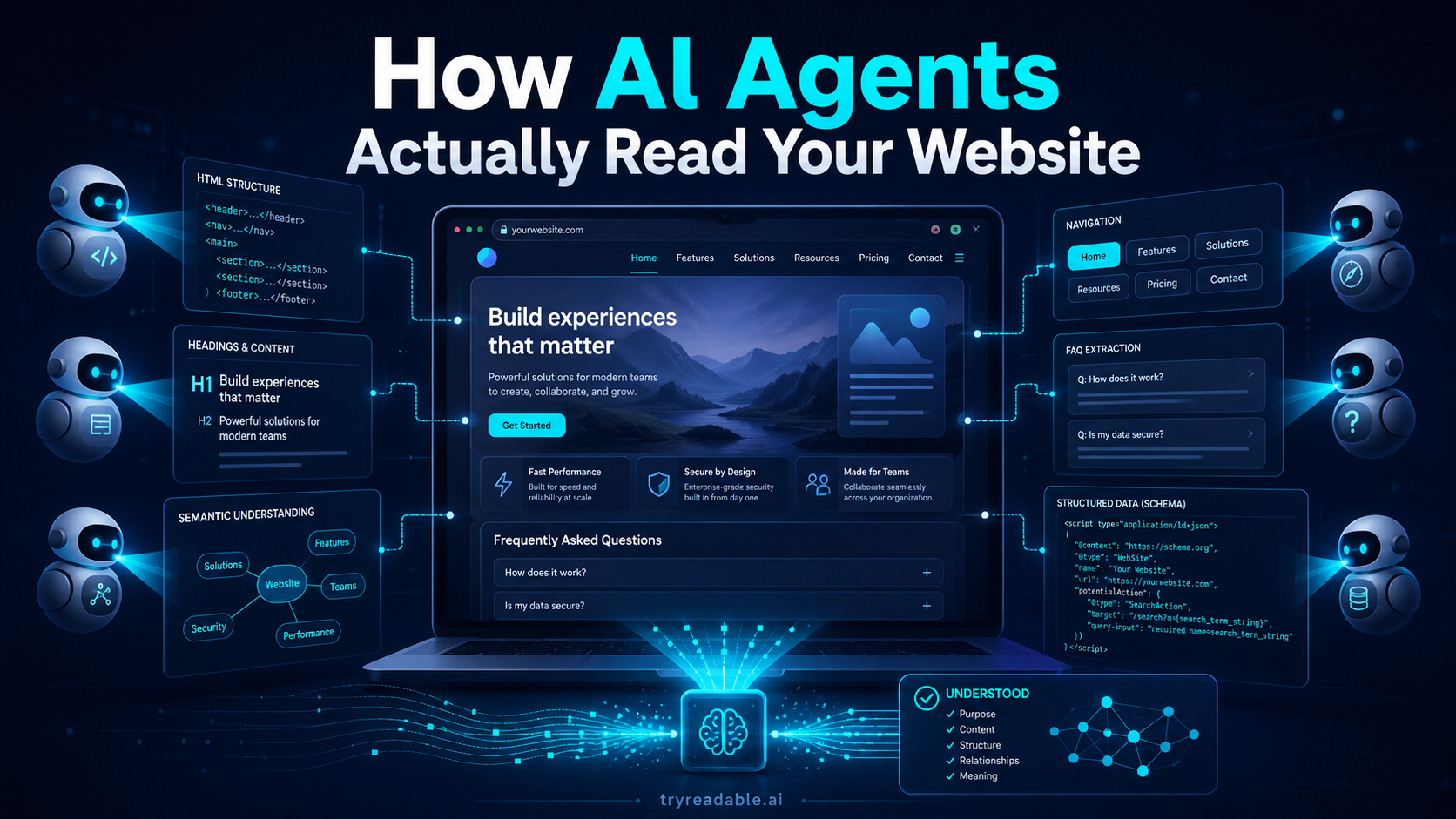
Understanding why agent-friendly design matters requires understanding how agents actually process web content. The mechanism is fundamentally different from how a human reads a page, and that difference explains why so many existing websites fail agents without their owners realising it.
Agents do not browse visually. They do not see your hero image, your brand colours, or your carefully crafted layout. What they receive is the underlying HTML, structured data, and text content of your page. They parse that content to understand what the page is about, what actions are available, and what the relationship is between different pieces of information.
This creates an immediate problem for sites built primarily for visual impact. A homepage that communicates its value proposition through a large background video, overlaid text rendered as an image, and a JavaScript-animated call-to-action button may look compelling to a human visitor. To an agent, it may be nearly empty. The video has no transcript. The image has no alt text. The button is not rendered in the initial HTML response because it depends on a JavaScript framework to load.
As Prerender's guide to agent-friendly websites explains, JavaScript-heavy or dynamically rendered pages can be effectively invisible to agents. If critical content is only available after client-side JavaScript executes, agents that do not run JavaScript will never see it. This is a widespread problem across modern marketing sites built on React, Vue, Angular, and similar frameworks.
Beyond rendering, agents rely on specific signals to understand page purpose and navigate effectively. They look for:
- Clear heading hierarchy to understand the structure and priority of content
- Descriptive link text to understand where a link leads without following it
- Labelled form fields and buttons to understand what actions are available
- Structured data and schema markup to classify the page's content type and key entities
- Logical content flow that communicates the page's purpose, offering, and next step in sequence
UI patterns that humans navigate intuitively become hard barriers for agents. Cookie consent walls that block content until dismissed, modal overlays that interrupt the content flow, infinite scroll that requires interaction to load more content, and navigation menus that only appear on hover all create friction that agents cannot resolve. The web.dev guidance is explicit that these patterns actively break agent usability.
The practical implication is that agent-readability is not just about adding a few meta tags. It requires that the fundamental structure of your pages communicates meaning through the HTML itself, not through visual presentation alone.
What Agent-Friendly Means in Practice: The Design Principles
Google's web.dev guidance translates into a set of concrete design principles. For founders and marketers, understanding these principles helps clarify what needs to change and why. For developers, they provide a checklist grounded in an authoritative source.
Use semantic HTML throughout your pages. Semantic HTML means using the correct HTML elements for their intended purpose. A heading should be an <h1>, <h2>, or <h3> tag, not a styled <div>. Navigation should be wrapped in a <nav> element. The main content area should use <main>. Calls to action should be <button> or <a> elements with descriptive text, not clickable <div> elements styled to look like buttons. Agents use these semantic signals to understand the role of each element on the page. When the HTML is semantically correct, agents can identify what is a heading, what is navigation, what is the primary content, and what is the action they should take.
Ensure critical content is in the initial HTML response. If your value proposition, product description, pricing, or call to action only appears after JavaScript loads, agents that parse the initial HTML will miss it entirely. The web.dev guidance is clear that content must be available in the server-rendered HTML, not deferred to client-side rendering. This is one of the most common and consequential failures on modern marketing sites.
Write descriptive link text, button labels, and alt text. Agents use these text strings to understand intent and navigate. A link that says "click here" tells an agent nothing. A link that says "view our pricing plans" tells an agent exactly what it will find. A button that says "submit" is ambiguous. A button that says "start your free trial" communicates the action and its outcome. Alt text on images allows agents to understand visual content that they cannot see. These are small changes with significant impact on agent comprehension.
Structure pages so their purpose is unambiguous without visual context. A well-structured agent-friendly page communicates what it is, what it offers, and what the visitor should do next through its content and HTML structure alone. If you removed all CSS and images from your page and read the raw text in order, would the page still make sense? Would the value proposition be clear? Would the call to action be obvious? If not, the page is likely failing agents.
Apply schema markup and structured data. Schema.org markup gives agents explicit, machine-readable signals about the type of content on a page. A product page with proper schema markup tells agents it is a product page, what the product is called, what it costs, and what reviews say about it. An article with schema markup tells agents who wrote it, when it was published, and what it covers. This classification layer helps agents decide whether your content is relevant to the task they are completing on a user's behalf. As ALM Corp's breakdown of the Google guidance notes, structured data is one of the highest-leverage technical investments for agent visibility.
These principles are not new inventions. They are the same principles that have underpinned good web development practice for years. What is new is the urgency. With AI agents now actively visiting and acting on websites, the cost of ignoring these principles has shifted from a missed accessibility opportunity to a missed discovery and conversion opportunity.
Why This Matters More for Founders and Marketers Than Developers
The web.dev guidance is addressed to developers, but the business consequences land squarely on founders and marketers. Understanding the stakes in business terms is essential for prioritising the work and making the case for investment.
AI agents are increasingly the first point of contact between a brand and a potential customer. When someone uses an AI assistant to research a category, compare vendors, or find a solution to a problem, the agent is acting as a gatekeeper. It visits sites, reads content, and synthesises a recommendation. The human user may never visit your site directly. They receive the agent's summary and act on it. If the agent could not read your site, you were never in the running.
This dynamic is already reshaping discovery. Traditional search placed your site in a list of results and let the human decide whether to click. AI-mediated discovery places the agent between the search and the human, with the agent deciding what to surface. The criteria for being surfaced are different. It is not just about ranking signals. It is about whether the agent can extract enough structured, meaningful information from your site to include you in a coherent recommendation.
The compounding effect is significant. Sites that are agent-readable today will accumulate citations, recommendations, and agent-driven referrals as agentic AI usage grows. Sites that are not agent-readable will be systematically excluded from this channel, not because of a penalty, but because they are simply not legible to the systems making recommendations.
For marketers, this means agent-readability is a channel investment, not just a technical hygiene task. It sits alongside SEO, content marketing, and paid acquisition as a lever for driving discovery and top-of-funnel traffic. For founders, it is a competitive moat. The companies that make their sites agent-readable now will be better positioned as the agentic web matures.
The parallel to early SEO is instructive. In the early days of search, companies that invested in making their sites crawlable and well-structured gained advantages that compounded for years. Agent-readability is at a similar inflection point. The window for early-mover advantage is open, but it will not stay open indefinitely.
If you want to understand how your current site performs for agents and other automated readers, TryReadable's analysis tool gives you a starting point.
The Gap Most Sites Have Right Now and Why It Is Hard to Fix
Most marketing websites were not built with agents in mind. They were built to convert human visitors, which means they were optimised for visual appeal, emotional resonance, and interactive experience. These are legitimate goals, but they often come at the cost of machine readability.
The typical modern marketing site has several structural characteristics that create agent-readability problems:
JavaScript-rendered content. Sites built on React, Next.js, Vue, or similar frameworks often render significant portions of their content client-side. The initial HTML response may be a near-empty shell that only becomes meaningful after JavaScript executes. Agents that parse the initial response see very little. Even agents that do execute JavaScript may encounter timing issues, hydration delays, or conditional rendering that makes content unreliable.
CMS-generated page structures. Content management systems like WordPress, Webflow, HubSpot, and Contentful generate HTML that is often cluttered with wrapper divs, inline styles, and non-semantic markup. The visual output may look clean, but the underlying HTML is frequently a tangle that makes it difficult for agents to identify the meaningful content hierarchy.
Dynamic and personalised content. Many marketing sites serve different content to different visitors based on location, device, referral source, or prior behaviour. Agents may receive a version of the page that is incomplete, redirected, or gated behind a personalisation layer that was designed for human visitors.
Cookie walls and consent overlays. Regulatory compliance has led to the widespread deployment of cookie consent banners and overlays that block content until the visitor makes a choice. Agents cannot make that choice, so they may be blocked from accessing the content entirely.
Decorative and non-descriptive elements. Hero images without alt text, icon-only buttons, link text that says "learn more" without context, and headings that are styled divs rather than semantic heading tags all contribute to a page that looks great but communicates poorly to agents.
The challenge of fixing these problems is not just technical. It is organisational. Rebuilding pages to be agent-friendly requires developer time, CMS access, design review, and content rewriting. For a site with dozens or hundreds of pages, that is a significant project. Most marketing teams do not have the developer bandwidth to audit and rewrite every page, and most developers are already stretched across other priorities.
This is the gap that most sites are sitting in right now: aware that agent-readability matters, but without a practical path to achieving it without a major rebuild. You can explore how other brands are approaching this challenge in the TryReadable brands section.
How to Build Agent-Friendly Websites Without Rebuilding Your Site
TryReadable was built specifically to close the gap between where most marketing sites are today and where Google's web.dev guidance says they need to be. The solution is called agentic pages, and it works alongside your existing site rather than replacing it.
Here is how it works. TryReadable generates clean, structured, agent-readable versions of your key pages. These agentic pages are served in parallel with your existing site. Your current design, CMS, and development setup remain completely unchanged. There is no redesign, no CMS migration, and no engineering overhaul required.
The agentic pages that TryReadable generates are built on the principles that Google's web.dev guidance outlines:
Semantic, well-labelled HTML. Every agentic page uses proper heading hierarchy, semantic sectioning elements, descriptive link text, and labelled calls to action. Agents can immediately identify the page structure, the primary content, and the available actions without any ambiguity.
Content in the initial HTML response. TryReadable's agentic pages deliver all critical content in the server-rendered HTML. There is no dependency on JavaScript execution for the value proposition, product description, or call to action to appear. Agents receive a complete, meaningful page on the first request.
Clear page purpose and next steps. Each agentic page is structured so that the offering, the audience, and the next step are unambiguous from the content alone. An agent visiting a TryReadable agentic page for a SaaS product can immediately understand what the product does, who it is for, and how to take the next step, without needing visual context.
Schema markup and structured data. TryReadable applies appropriate schema markup to agentic pages, giving agents the classification signals they need to understand the content type and key entities on the page.
The practical outcome for founders and marketers is significant. You can make your key landing pages agent-friendly in minutes, not months. You do not need to wait for a development sprint, a CMS upgrade, or a design refresh. You identify the pages that matter most for discovery and conversion, TryReadable generates the agentic versions, and those pages become immediately legible to AI agents.
This directly implements the principles Google outlined on web.dev without requiring engineering overhead. The same best practices that Google's guidance recommends, semantic structure, server-rendered content, descriptive labels, and structured data, are built into every agentic page TryReadable produces.
For founders who are watching the agentic web develop and want to be positioned ahead of the curve, this is the most direct path from awareness to action. For marketers who are responsible for discovery and top-of-funnel performance, agentic pages are a new lever that sits alongside SEO and content in the channel mix.
You can see how TryReadable's agentic pages work in practice by visiting the guides section, or if you want to understand what your current site looks like to an agent, start with the analysis tool. If you are ready to explore what agentic pages would look like for your specific site and use case, book a demo with the TryReadable team.
The Moment to Act Is Now
Google's web.dev guidance is not a warning about a distant future. It is a description of the present. AI agents from ChatGPT, Claude, Gemini, and dozens of other platforms are visiting websites today. They are extracting information, forming recommendations, and completing tasks on behalf of users who may never click through to your site directly.
The sites that are agent-readable today are already accumulating an advantage. They are being included in recommendations, cited in AI-generated summaries, and surfaced in agentic discovery flows. The sites that are not agent-readable are being systematically excluded from this channel, not through any deliberate penalty, but simply because they are not legible to the systems that matter.
Google has told the world to build agent-friendly websites. The question for every founder and marketer is not whether to respond to that guidance, but how quickly and practically they can do it.
TryReadable exists to make that response immediate and accessible. You do not need to rebuild your site. You do not need a development sprint. You need agentic pages that implement the principles Google has outlined, served alongside your existing site, making your most important pages readable to the agents that are already visiting them.
The web has a new type of visitor. Make sure your site is ready to receive them.
Frequently Asked Questions
What does it mean to build an agent-friendly website?
Building an agent-friendly website means structuring your pages so that AI agents can read, understand, and act on your content without relying on visual presentation. In practice this means using semantic HTML, delivering critical content in the server-rendered HTML response rather than through JavaScript, writing descriptive link text and button labels, adding alt text to images, and applying schema markup. Google's web.dev guidance outlines these principles in detail.
Why did Google publish guidance on building agent-friendly websites?
Google published the "Build agent-friendly websites" article on web.dev because AI agents are already visiting websites at scale on behalf of users. Agents built into products like ChatGPT, Claude, and Gemini browse pages, extract information, and make recommendations autonomously. Google wants the web to be ready for this new visitor type, and the web.dev platform is where it publishes authoritative technical guidance for developers and site owners.
What does the web.dev article at https://web.dev/articles/ai-agent-site-ux actually recommend?
The article recommends three categories of improvement. First, agent readability: use semantic HTML, serve critical content in the initial HTML response, and add descriptive text to links, buttons, and images. Second, agent navigation: remove or redesign blocking patterns like cookie walls, modal overlays, and hover-only menus that agents cannot interact with. Third, agent action: label interactive elements clearly so agents can complete tasks like form submissions on a user's behalf. The article also introduces WebMCP as an emerging protocol for structured agent-to-site communication.
What is agent readability and why does it matter for my website?
Agent readability refers to how well an AI agent can extract meaningful information from your website. A page with high agent readability delivers its content in clean, server-rendered HTML, uses semantic elements to signal structure and purpose, and labels all interactive elements descriptively. A page with low agent readability may look polished to a human visitor but appear nearly empty to an agent because its content depends on JavaScript execution or visual context to make sense. Agent readability matters because agents that cannot read your site cannot include you in recommendations or complete tasks on your behalf.
How is building for AI agents different from building for SEO?
SEO and agent-friendly design share many of the same foundations: semantic HTML, structured data, descriptive text, and crawlable content. The key difference is that AI agents do not just index your content, they act on it. An agent may need to identify your call to action, understand your pricing, or complete a form on a user's behalf. This means agent-friendly design goes beyond ranking signals to include the clarity and completeness of your page's interactive elements and content hierarchy. Sites that are well-optimised for SEO have a head start, but agent-readability requires additional attention to how actions and next steps are communicated.
What is agent-friendly infrastructure and why does it matter?
Agent-friendly infrastructure refers to the technical foundation that allows AI agents to reliably access, parse, and interact with your website. This includes server-side rendering so content is available in the initial HTML response, semantic markup so agents can identify page structure and purpose, structured data so agents can classify content, and the absence of blocking patterns like cookie walls or JavaScript-only rendering. Without this infrastructure, agents may receive an incomplete or empty version of your page and exclude you from recommendations entirely.
Can I build agent-friendly pages without rebuilding my entire site?
Yes. TryReadable generates clean, semantically structured agentic pages that run in parallel with your existing site. Your current CMS, design, and development setup remain unchanged. The agentic pages implement the principles from Google's web.dev guidance, including server-rendered content, semantic HTML, descriptive labels, and schema markup, without requiring a full site rebuild. You can start with your highest-priority landing pages and expand from there.
Sources
- Build agent-friendly websites | web.dev
- Google Tells Developers To Build For AI Agents, Not Just Humans
- Guide to Building AI Agent Friendly Websites
- Google Says Build for AI Agents: What Developers and SEO Teams Need to Do
- Google Search Central documentation
- Google AI Overviews documentation
- OpenAI announcement archive
- Anthropic documentation
- Schema.org structured data vocabulary
- W3C JSON-LD specification
- Google Analytics developer docs
- NIST AI Risk Management Framework
Are AI agents actually reading your website right now?
Find out if your site is agent-readable and learn the specific changes that let AI assistants discover and recommend you without a full rebuild.