Table of contents
- What Makes Claude Fable 5 Different From Earlier Claude Models
- The Golden Rule: Stop Over-Explaining, Start Delegating
- Old Prompt vs. New Prompt: 5 Real Scenarios for Founders and Marketers
- How to Use Effort Levels to Control Output Quality and Cost
- Instruction Following Is Stronger, So Your Instructions Need to Be Cleaner
- Prompting for Long Runs: How to Keep Fable 5 on Track in Multi-Step Tasks
- Quick-Reference Prompting Cheat Sheet for Claude Fable 5
If you have been using Claude for a while, your existing prompts are probably leaving a lot on the table.
Claude Fable 5 is a fundamentally different model from its predecessors. It is not just faster or smarter in a linear sense. It handles longer, more ambiguous, more complex tasks in ways that earlier Claude models simply could not. That means the prompting habits you built up over the last two years, the step-by-step scaffolding, the chained messages, the over-specified instructions, are now working against you.
This guide is written specifically for founders and marketers who use Claude regularly and want to get meaningfully better outputs without spending more time on prompts. We will walk through what changed, why it matters, and show you real before-and-after prompt rewrites for the scenarios you actually face.
What Makes Claude Fable 5 Different From Earlier Claude Models
Before you can write better prompts, you need to understand what changed under the hood.
According to Anthropic's official prompting documentation for Claude Fable 5, the model is specifically designed to take on problems that were previously too complex, long-running, or ambiguous for prior models. The documentation explicitly notes that Fable 5 is "particularly effective at end-to-end work that takes a person hours, days, or weeks to complete."
That is a significant claim. And it has direct implications for how you should write prompts.
Here are the three core behavioral shifts that matter most for founders and marketers:
1. It handles ambiguity without freezing.
Earlier Claude models, when given an underspecified prompt, would either ask clarifying questions or produce a hedged, generic output. Fable 5 takes more initiative. It makes reasonable assumptions, states them transparently, and moves forward. This is closer to how a senior consultant behaves when you give them a brief with gaps.
2. It is built for end-to-end execution.
Previous models were best used as step-by-step assistants. You would prompt for an outline, review it, prompt for a draft, review it, prompt for edits. Fable 5 can run the entire workflow in a single turn if you give it the right goal-level instruction. This is not just a convenience upgrade. It changes the economics of how you use AI in your workflow.
3. It follows instructions more literally.
This one cuts both ways. Fable 5 is significantly better at doing exactly what you ask. But that means vague or contradictory instructions produce confidently wrong outputs rather than the muddled-but-salvageable drafts you might have gotten before. Precision in your prompts now matters more, not less.
The teams seeing the best results with Fable 5 are those who have updated their mental model of what the model is. They are not treating it like a smarter autocomplete. They are treating it like a capable, autonomous collaborator who needs a clear brief, not a detailed script.
If you are still writing prompts the way you did for Claude 2 or Claude 3, you are underutilizing the model significantly. The rest of this guide will show you exactly how to fix that.
The Golden Rule: Stop Over-Explaining, Start Delegating
The single biggest prompting mistake founders and marketers make with Fable 5 is over-scaffolding.
Over-scaffolding means breaking your request into micro-steps, specifying every sub-task, and essentially writing the model's reasoning process for it. This made sense with earlier models because they needed that structure to stay on track. With Fable 5, it backfires.
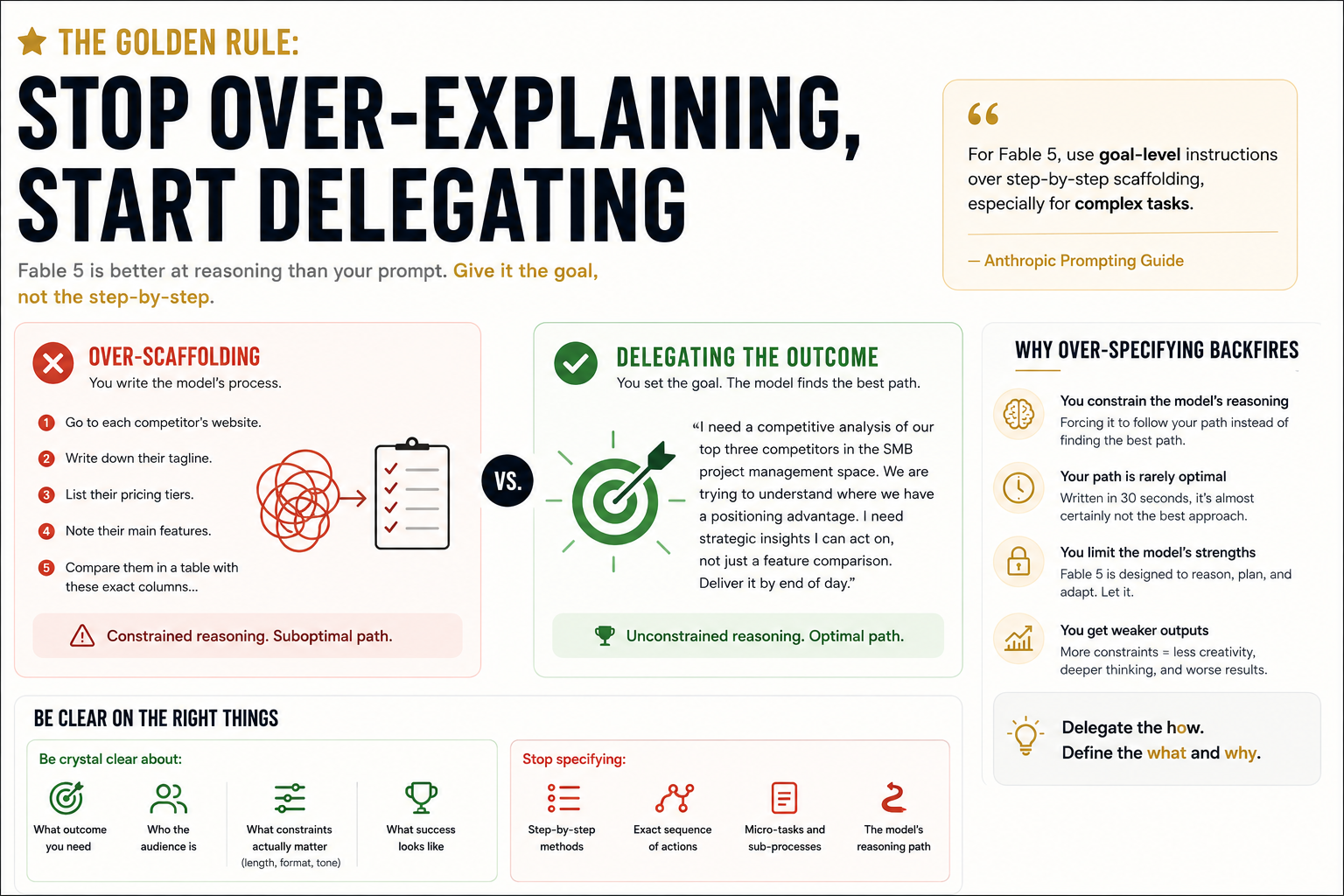
Here is why: when you over-specify the process, you constrain the model's reasoning. You are forcing it to follow your path rather than finding the best path. And your path, written in 30 seconds before you hit send, is almost certainly not the optimal path for a complex task.
The Anthropic prompting documentation makes this explicit. The guidance for Fable 5 emphasizes goal-level instructions over step-by-step scaffolding, particularly for complex or long-running tasks.
Think about it this way. Imagine you have just hired a senior marketing strategist with ten years of experience. On their first day, you need a competitive analysis done. You have two options:
Option A (micromanaging): "First, go to each competitor's website. Then write down their tagline. Then list their pricing tiers. Then note their main features. Then compare them in a table with these exact columns..."
Option B (delegating): "I need a competitive analysis of our top three competitors in the SMB project management space. We are trying to understand where we have a positioning advantage. I need strategic insights I can act on, not just a feature comparison. Deliver it by end of day."
A senior hire given Option A would be frustrated and constrained. Given Option B, they would do better work because they can apply their judgment about what matters.
Fable 5 responds the same way.
This does not mean you should be vague. There is a meaningful difference between under-specifying the process and under-specifying the goal. You should be crystal clear about:
- What outcome you need
- Who the audience is
- What constraints actually matter (length, format, tone)
- What success looks like
What you should stop specifying is the step-by-step method for getting there. Trust the model to figure that out. It is better at it than your prompt is.
Old Prompt vs. New Prompt: 5 Real Scenarios for Founders and Marketers
This is the section you will want to bookmark. For each scenario, we show the kind of prompt that worked reasonably well with earlier Claude models, and the kind of prompt that gets significantly better results with Fable 5.
Scenario 1: Writing a Cold Email Sequence
Old prompt (Claude 2/3 style):
"Write a cold email sequence for our SaaS product. First, write a subject line. Then write an opening line that references a pain point. Then write 2-3 sentences about our product. Then write a CTA. Do this for 3 emails. Make the second email a follow-up and the third a breakup email."
New prompt (Fable 5 style):
"Write a 3-email cold outreach sequence for a B2B SaaS tool that helps ops teams automate internal reporting. The audience is operations managers at companies with 50-200 employees. The tone should be direct and peer-to-peer, not salesy. The goal is to get a 20-minute discovery call. Each email should feel like it was written by a human, not a marketing team. Include subject lines."
The difference is significant. The old prompt tells the model how to construct an email. The new prompt tells the model what success looks like and who it is for. Fable 5 will make better structural decisions than your step-by-step instructions because it has seen thousands of high-performing cold email sequences and can apply that pattern recognition to your specific context.
Scenario 2: Competitive Analysis
Old prompt (Claude 2/3 style):
"Create a competitive analysis table with these columns: Company Name, Pricing, Key Features, Target Market, Weaknesses. Include these competitors: [list]. Fill in each cell."
New prompt (Fable 5 style):
"I am the founder of a project management tool targeting freelancers and small agencies. My three main competitors are [list]. I need a competitive analysis that tells me where I have a genuine positioning advantage and where I am at risk of losing deals. Give me strategic insights with your reasoning, not just a feature comparison. Flag any patterns you notice that I might be missing."
The old prompt produces a table. The new prompt produces thinking. For a founder making positioning decisions, the thinking is what you actually need. Fable 5 is capable of providing that reasoning if you ask for it explicitly.
Scenario 3: Landing Page Copy
Old prompt (Claude 2/3 style):
"Write landing page copy for our product. Include a headline, subheadline, three feature sections with headers and descriptions, a testimonial placeholder, and a CTA section. The product is a time-tracking tool for agencies."
New prompt (Fable 5 style):
"Write conversion-focused landing page copy for a time-tracking tool built specifically for creative agencies. The primary visitor is an agency owner or operations lead who has tried generic time-tracking tools and found them too rigid. The conversion goal is a free trial signup. Brand voice is confident and no-nonsense. The copy should make the visitor feel like this was built for them, not adapted for them. Structure the page however you think will convert best."
Notice that the new prompt removes the structural prescription. You are not telling Fable 5 to write three feature sections. You are telling it what the visitor feels, what they need to believe, and what action you want them to take. The model will figure out the right structure. And it will probably do it better than a generic template.
Scenario 4: Long-Form Blog Post
Old prompt (Claude 2/3 style):
[Message 1] "Write an outline for a blog post about email marketing for SaaS companies." [Message 2] "Now write the introduction." [Message 3] "Now write section 2." [Message 4] "Now write the conclusion."
New prompt (Fable 5 style):
"Write a complete, publish-ready blog post on email marketing for early-stage SaaS companies. The audience is founders who are setting up their first email sequences and have no dedicated marketing team. The goal is to rank for 'email marketing for SaaS startups' and to establish our brand as a practical, no-fluff resource. Target length is 1800-2200 words. Use H2 and H3 headings. Include at least one concrete example for each main point. Do not use filler phrases or generic advice."
This is one of the clearest demonstrations of Fable 5's capability. Earlier models needed to be walked through a long-form piece section by section because they would lose coherence or drift in tone over a long output. Fable 5 can hold the thread across a full article in a single turn. Chaining prompts is no longer necessary for most long-form content tasks, and it actually introduces inconsistency because each message starts with slightly different context.
Scenario 5: Customer Research Synthesis
Old prompt (Claude 2/3 style):
"Here are 15 customer interview transcripts. Please summarize the main themes."
New prompt (Fable 5 style):
"Here are 15 customer interview transcripts from users of our project management tool. I need to understand: what patterns emerge across multiple customers, where there are tensions or contradictions in what customers say versus what they do, and what 2-3 product or messaging decisions I should make based on this data. Give me your reasoning, not just a list of themes. Flag anything that surprised you."
The old prompt asks for a summary. The new prompt asks for analysis, synthesis, and recommended actions. Fable 5 is capable of all three if you ask for them. Most founders are leaving the most valuable part of the output on the table by asking for summaries when they could be asking for decisions.
How to Use Effort Levels to Control Output Quality and Cost
One of the most practically useful features in Fable 5 is explicit effort level control. This is a capability that did not exist in the same form in earlier Claude models, and it changes how you should think about cost and quality management.
According to Anthropic's documentation, Fable 5 supports different effort levels that affect the depth of reasoning and token usage. The three tiers are low, medium, and high.
Here is how to think about each one:
Low effort is appropriate for quick drafts, ideation, brainstorming, or tasks where you need a starting point rather than a finished output. If you are generating five subject line options to pick from, you do not need the model to reason deeply. Low effort gets you there faster and cheaper.
Medium effort is the default for most content and analysis tasks. Writing a blog post, drafting a proposal, summarizing a document. This is where most of your day-to-day work should sit.
High effort is for tasks where quality has a direct business impact. A strategic positioning document. A fundraising narrative. A complex competitive analysis that will inform a product roadmap decision. High effort means the model spends more time reasoning before it writes, which produces meaningfully better outputs for complex tasks.
The practical implication for founders and marketers is that you should be explicit about effort level in your prompts rather than letting the model guess. You can signal this directly:
- "This is a quick draft, prioritize speed over polish."
- "This is a high-stakes document. Take your time and reason carefully before writing."
- "Use high effort. This will be sent to investors."
Matching effort level to task type is not just about cost management, though that matters. It is also about output quality. A model running at low effort on a complex strategic task will produce a shallower output than the same model running at high effort. And a model running at high effort on a simple brainstorm is overkill that adds latency without adding value.
For reference on how AI writing tools can affect content quality more broadly, Moz's guide to AI content and Semrush's content marketing research both note that output quality is heavily influenced by how well the task is specified, which aligns with the effort-level principle.
Instruction Following Is Stronger, So Your Instructions Need to Be Cleaner
Here is the double-edged sword of Fable 5's improved instruction following: it will do exactly what you say. Not approximately what you meant. Exactly what you said.
With earlier models, vague instructions produced vague outputs. With Fable 5, vague instructions produce confidently wrong outputs. The model will pick an interpretation of your ambiguous instruction and execute it with precision. If it picked the wrong interpretation, you get a polished version of the wrong thing.
This is actually a feature, not a bug. It means the model is more reliable and predictable. But it puts more responsibility on you to write clean instructions.
Here are three practical rules for writing cleaner instructions with Fable 5:
Use positive framing. Tell the model what to do, not what to avoid. "Write in a conversational tone" is cleaner than "Don't be too formal." The model handles positive instructions more reliably than negative constraints, especially when the negative constraint is subjective.
Avoid conflicting constraints. If you say "write a comprehensive overview" and also "keep it under 300 words," you have given the model two instructions that cannot both be satisfied. It will pick one and ignore the other, and you will not know which one it picked until you read the output. Resolve conflicts in your prompt before you send it.
Specify format only when it actually matters. A common mistake is adding format instructions out of habit. "Use bullet points" or "write in paragraphs" should only appear in your prompt if the format genuinely affects the output's usefulness. Unnecessary format constraints can interfere with the model's ability to structure information in the most logical way.
Here is a concrete example of the difference:
Vague instruction:
"Write a short post about our new feature."
Clean instruction:
"Write a LinkedIn post under 150 words announcing our new automated reporting feature. The audience is SaaS founders who manage small ops teams. End with one clear CTA to try it free. Tone should be excited but not hypey."
The vague instruction leaves four things undefined: platform, length, audience, and CTA. Fable 5 will make assumptions about all four. They might be reasonable assumptions. But they might not match what you actually needed. The clean instruction removes the guesswork.
For more on writing clear AI instructions, OpenAI's prompting best practices guide covers similar principles around specificity and positive framing that apply across models. Anthropic's general prompting best practices are also worth reading alongside the Fable 5-specific guidance.
If you want to check whether your content outputs are hitting the right readability level for your audience, TryReadable's analyzer can help you assess and improve the clarity of what Fable 5 produces before you publish.
Prompting for Long Runs: How to Keep Fable 5 on Track in Multi-Step Tasks
One of Fable 5's most significant capability upgrades is its ability to handle long autonomous runs. This is the agentic use case: giving the model a complex, multi-step task and letting it work through it without constant human intervention.
For founders and marketers, this opens up workflows that were not practical before. A full market research report. An end-to-end content strategy with briefs, outlines, and drafts. A complete onboarding email sequence with segmentation logic.
But long runs introduce a specific challenge: drift. Over a long task, the model can gradually shift its interpretation of the goal, change its tone, or lose track of constraints you specified at the start. This is not a failure of intelligence. It is a structural challenge of maintaining coherence over a very long context.
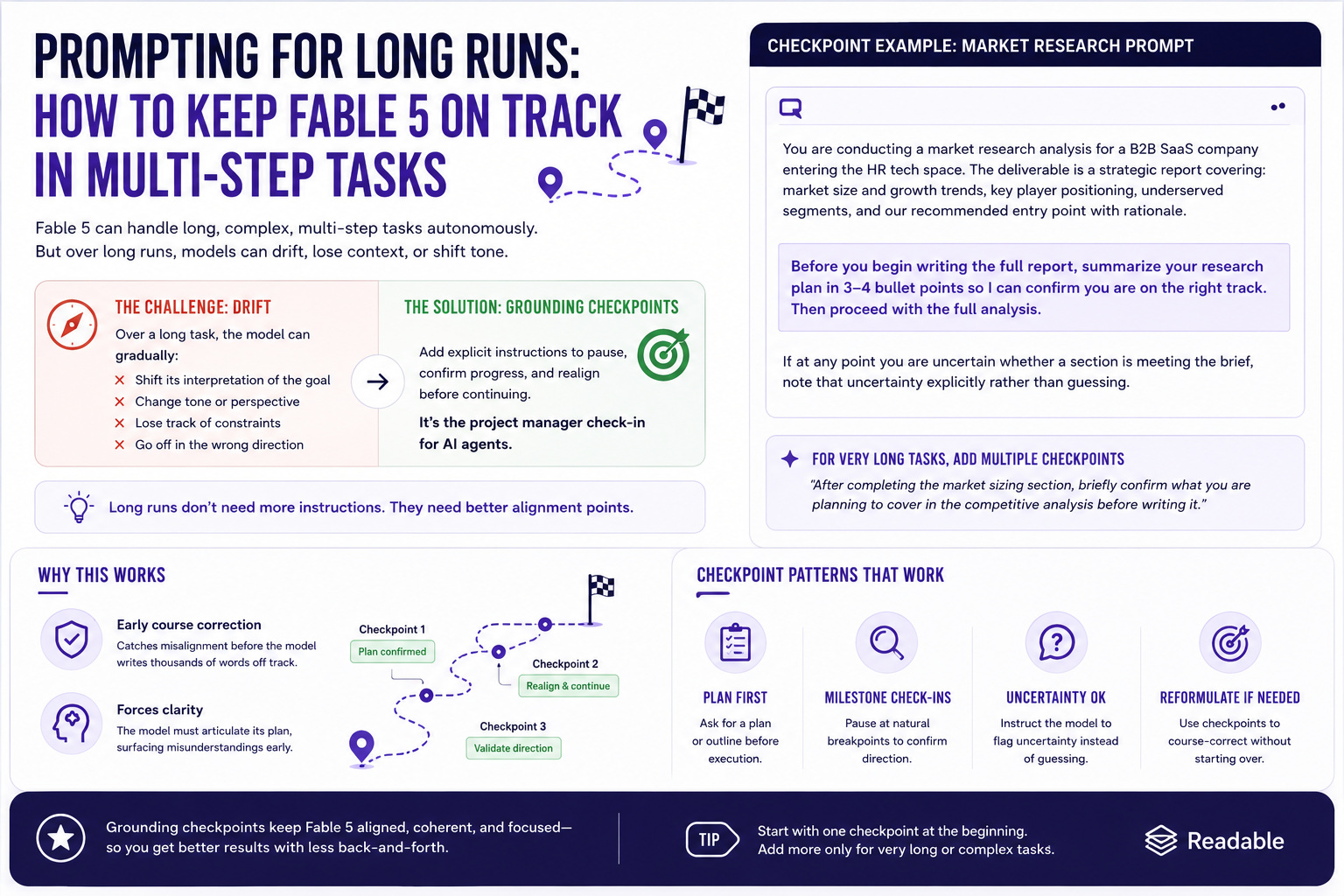
The solution is grounding checkpoints. These are explicit instructions in your prompt that tell the model to pause, confirm its progress, and realign before continuing.
Here is what a market research prompt with a grounding checkpoint looks like:
"You are conducting a market research analysis for a B2B SaaS company entering the HR tech space. The deliverable is a strategic report covering: market size and growth trends, key player positioning, underserved segments, and our recommended entry point with rationale.
Before you begin writing the full report, summarize your research plan in 3-4 bullet points so I can confirm you are on the right track. Then proceed with the full analysis. If at any point you are uncertain whether a section is meeting the brief, note that uncertainty explicitly rather than guessing."
The checkpoint instruction ("summarize your research plan before you begin") does two things. It gives you a moment to course-correct before the model has written 2000 words in the wrong direction. And it forces the model to articulate its interpretation of the task, which surfaces any misunderstandings early.
For very long tasks, you can include multiple checkpoints:
"After completing the market sizing section, briefly confirm what you are planning to cover in the competitive analysis before writing it."
This is not micromanaging. It is the equivalent of a project manager asking for a status update at a natural milestone. It keeps the work aligned without interrupting the model's autonomous execution.
Anthropic's research on agentic AI behavior highlights that maintaining task coherence over long runs is an active area of development, and user-side grounding techniques like checkpoints are currently one of the most effective ways to manage it.
For teams building more complex AI-assisted workflows, LangChain's documentation on agent design and Microsoft's guidance on AI orchestration both cover related principles around task grounding that complement the Fable 5-specific approach.
If you are using Fable 5 as part of a broader content operation and want to see how other teams are structuring their AI workflows, TryReadable's brand case studies include examples of how marketing teams are integrating AI into their content pipelines.
Quick-Reference Prompting Cheat Sheet for Claude Fable 5
Use this section as your daily reference. Print it, bookmark it, or paste it into your prompt library.
Do This
Give goal-level instructions. Tell the model what success looks like, not how to achieve it. "Write a competitive analysis that helps me identify our positioning advantage" beats "Write a table with these columns."
Specify audience and tone explicitly. Every prompt for content or communication should include who it is for and what voice it should use. These two variables have more impact on output quality than almost anything else.
Set effort level explicitly. Signal whether this is a quick draft or a high-stakes deliverable. "This is a first draft, prioritize speed" or "Use high effort, this goes to the board" changes how the model allocates its reasoning.
Use positive framing. State what you want, not what you want to avoid. "Write in plain language" is cleaner than "Don't use jargon."
Include grounding checkpoints for long tasks. For any task that will produce more than 1000 words or involve multiple distinct sections, ask the model to confirm its plan before executing.
Specify format only when it matters. If the format genuinely affects usability (a table for comparison, a numbered list for a process), specify it. Otherwise, let the model choose.
Do Not Do This
Do not over-scaffold. Stop breaking prompts into micro-steps. Fable 5 does not need you to write its reasoning process for it.
Do not chain prompts unnecessarily. For most long-form tasks, a single well-written prompt will produce better results than five sequential messages. Chaining introduces context drift and inconsistency.
Do not use vague qualifiers. Words like "good," "detailed," "comprehensive," and "high-quality" are meaningless without context. Replace them with specific criteria. "Detailed" means nothing. "Covering at least three concrete examples per section" means something.
Do not give conflicting constraints. If you ask for something comprehensive and something short in the same prompt, resolve that tension before you send it.
Do not specify the process when you care about the outcome. If you want a great landing page, describe the visitor, the goal, and the brand. Do not describe the sections. Trust the model to figure out the structure.
The One-Line Prompt Formula
When in doubt, use this structure:
[Role or context] + [Desired outcome] + [Constraints or format] + [Effort signal]
Example:
"You are writing for a B2B SaaS brand targeting ops managers. Write a LinkedIn post announcing our new integration with Slack. Under 120 words, one CTA, conversational tone. Quick draft."
That single sentence covers context, outcome, constraints, and effort level. It is everything Fable 5 needs to produce a useful output on the first try.
A Note on Readability
One thing that does not change regardless of which Claude model you use: your outputs still need to be readable for your audience. Fable 5 can produce sophisticated, nuanced content, but sophisticated does not always mean clear. Before you publish anything generated with AI assistance, run it through a readability check to make sure it lands at the right level for your readers.
TryReadable's analyzer is built specifically for this. It gives you a readability score and flags sentences that are too complex, too long, or likely to lose your audience. It takes about 30 seconds and can save you from publishing content that is technically correct but practically unreadable.
If you want to see how TryReadable fits into a broader content workflow, book a demo or explore the guides section for more practical resources on AI-assisted content.
Claude Fable 5 is a genuine step change in what AI can do for founders and marketers. But the teams getting the most out of it are not the ones with the most sophisticated prompts. They are the ones who have updated their mental model of what the model is capable of and stopped holding it back with over-specified instructions.
Give it a goal. Give it context. Get out of the way.
That is the Fable 5 prompting mindset. Everything else in this guide is just the details.
Sources
Are your Claude prompts still built for an older model?
Fable 5 rewards delegation over scaffolding, and most teams are still writing prompts the old way. Let's show you how to restructure yours for the capabilities that actually exist now.