Table of contents
- What Is ChatGPT 5.5 and Why Your Old Prompts May Not Work
- How GPT-5.5 Interprets Prompts Differently Than Earlier Models
- Core Principles of Effective GPT-5.5 Prompting
- 4 Side-by-Side Examples: Old Prompts vs. GPT-5.5 Prompts
- Personality, Tone, and Behavior: Setting It Once in GPT-5.5
- Migrating Your Existing Prompt Library to GPT-5.5
- Common GPT-5.5 Prompting Mistakes Founders and Marketers Make
- Getting the Most Out of GPT-5.5 as a Founder or Marketer
If you have been using ChatGPT for marketing copy, competitor research, or product messaging, you have probably built up a library of prompts that reliably get you good results. The problem is that many of those prompts were written for GPT-4 or earlier models, and they carry habits that no longer serve you well in GPT-5.5.
OpenAI recently launched GPT-5.5 as their latest production model and published updated guidance on how to write effective prompts for it. The behavioral changes are significant enough that prompts relying on role-play tricks, chain-of-thought nudges, or excessive repetition will often produce worse results than a clean, direct instruction would. For founders and marketers who depend on AI-assisted workflows, understanding these changes is not optional. It is the difference between getting a mediocre first draft and getting something you can actually use.
This guide walks through exactly what changed, why it matters, and how to rewrite your prompts to take full advantage of what GPT-5.5 can do.
What Is ChatGPT 5.5 and Why Your Old Prompts May Not Work

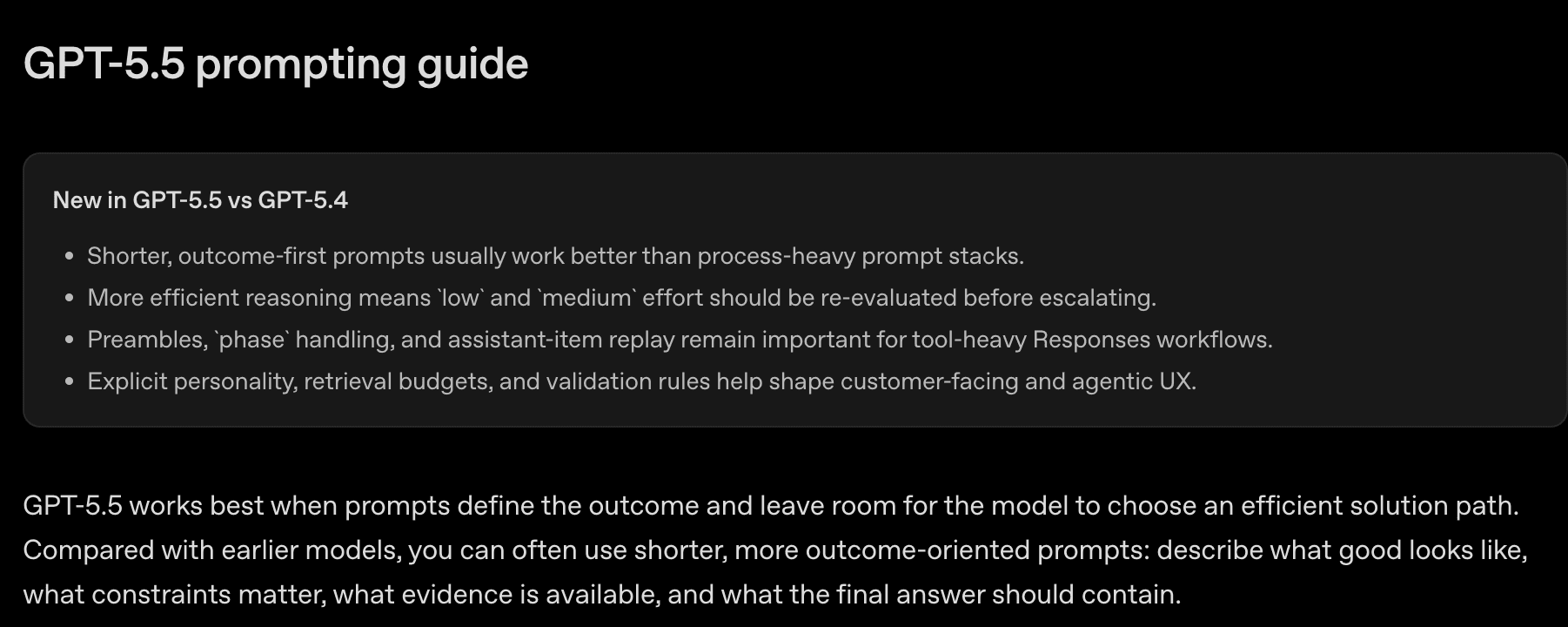
GPT-5.5 is OpenAI's latest model, positioned as the current recommended default for most API and ChatGPT use cases. According to OpenAI's official guide on using GPT-5.5, the model represents a meaningful step forward in instruction-following, reasoning consistency, and response calibration compared to GPT-4 and GPT-4o.
The core improvement is not just raw capability. It is how the model interprets and executes instructions. GPT-5.5 has been trained to follow prompts more precisely and literally, which sounds like a straightforward upgrade until you realize that most prompts written for earlier models were designed to work around those models' limitations. When the limitations disappear, the workarounds become noise.
Here is a concrete example of the problem. In GPT-4, a common technique was to open a prompt with something like "You are an expert copywriter with 20 years of experience writing for SaaS companies." This role-play framing helped the model calibrate its tone and expertise level because GPT-4 needed that kind of scaffolding to produce confident, professional output. GPT-5.5 does not need that scaffolding. It already has strong defaults for professional writing. When you add the role-play framing anyway, you are not improving the output. You are adding ambiguity that the model now has to interpret before it can get to your actual request.
The risk of carrying over old prompt habits is real and measurable. Teams that migrate to GPT-5.5 without updating their prompts often report that outputs feel slightly off, overly literal, or less creative than expected. In most cases, the issue is not the model. It is that the prompt was written for a different model's behavior.
Understanding this tension is the first step. The next step is understanding exactly what changed.
How GPT-5.5 Interprets Prompts Differently Than Earlier Models
OpenAI's prompt guidance documentation outlines several behavioral changes in GPT-5.5 that directly affect how you should write prompts. These are not minor tweaks. They represent a shift in the model's fundamental relationship with instructions.
GPT-5.5 follows instructions more literally and precisely. In earlier models, there was a degree of interpretive flexibility. If you asked for "a short email," the model might produce something between 50 and 200 words depending on context. GPT-5.5 takes "short" more seriously. If you want a specific length, specify it. If you want a specific format, describe it. The model will not fill in gaps with assumptions the way GPT-4 often did. This is mostly a feature, but it requires you to be more deliberate about what you actually want.
It is less reliant on prompt hacks like role-playing tricks or excessive repetition. The techniques that prompt engineers developed to coax better behavior out of GPT-3 and GPT-4 were largely compensating for those models' inconsistency. GPT-5.5 is more consistent by default. Telling the model to "remember, this is very important" or repeating your core instruction three times in different ways does not improve output quality. It adds token overhead and can actually confuse the model about which instruction to prioritize.
It handles ambiguity differently. Earlier models would often make a best guess when a prompt was unclear. GPT-5.5 is more likely to ask for clarification, especially in multi-turn conversations. This is a significant behavioral change for marketers who have built workflows around prompts that were intentionally vague to allow the model creative latitude. If you want creative latitude, you now need to explicitly grant it rather than relying on the model to infer it from ambiguity.
Personality and tone are more consistent without heavy system prompt engineering. GPT-4 could drift in tone over a long conversation, which is why many teams built elaborate system prompts to keep the model on track. GPT-5.5 maintains its configured personality more reliably across a session. This means you can invest in a well-written system prompt once and trust it to hold, rather than re-specifying tone and voice in every user turn.
These changes are documented in OpenAI's official migration guidance and are worth reading in full if you are managing a team that uses AI heavily in production workflows. The Using GPT-5.5 guide is the authoritative reference.
Core Principles of Effective GPT-5.5 Prompting
Before getting into specific examples, it helps to have a clear framework. OpenAI's prompt guidance for GPT-5.5 clusters around a few foundational principles that apply across use cases.
Be direct and specific. Verbose framing is no longer needed. The instinct to warm up a prompt with context-setting preamble comes from working with models that needed it. GPT-5.5 does not. If you want a subject line for a cold email targeting mid-market CFOs, say that. You do not need to explain what a cold email is, describe the general landscape of B2B outreach, or establish your credentials as a marketer. Get to the instruction.
Use the system prompt to set behavior, not the user turn. This is one of the most important structural changes for teams building repeatable workflows. In GPT-4, many teams put everything in the user turn because the system prompt felt like an afterthought. In GPT-5.5, the system prompt is where you configure the model's behavior, persona, output format, and constraints. The user turn is where you give the specific task. Mixing these two layers creates confusion and inconsistency.
Structure multi-step tasks clearly rather than bundling them. If you need the model to analyze a competitor's positioning, identify three key weaknesses, and then draft a response strategy, break that into clearly labeled steps. GPT-5.5 handles structured multi-step instructions well, but it will not automatically decompose a bundled request the way GPT-4 sometimes did. Explicit structure produces more reliable results.
Leverage preambles to improve response speed and relevance. OpenAI's guidance notes that starting the assistant's response with a partial preamble can significantly improve both the speed and relevance of the output. For example, if you want a bulleted list of ad copy variants, you can end your prompt with "Here are five ad copy variants:" and the model will continue from that point rather than spending tokens on an introductory sentence. This technique is particularly useful for high-volume marketing tasks where you are processing many prompts in sequence.
These principles are not abstract. They translate directly into better outputs when applied consistently. The next section shows exactly what that looks like in practice.
4 Side-by-Side Examples: Old Prompts vs. GPT-5.5 Prompts
This is the core of the guide. Each example covers a real marketing use case, shows the kind of prompt that worked in GPT-4, and then shows the rewritten version optimized for GPT-5.5. The differences are instructive.
Example 1: Writing a Cold Email
Old prompt (GPT-4 style):
You are an expert B2B sales copywriter with 15 years of experience writing cold emails for SaaS companies. You understand the psychology of busy executives and know how to write emails that get responses. Write a cold email to a VP of Marketing at a mid-market e-commerce company. The email should be short, personalized, and have a clear call to action. Remember, the goal is to get a meeting, not to sell the product. Make it conversational and human.
New prompt (GPT-5.5 style):
Write a cold email to a VP of Marketing at a mid-market e-commerce company. Goal: book a 20-minute discovery call. Tone: direct and conversational, not salesy. Length: under 120 words. Include: one specific pain point related to attribution tracking, a brief value statement, and a low-friction CTA asking for a specific time slot.
What changed and why: The old prompt uses role-play framing ("You are an expert...") and repeats the goal in multiple ways ("get a meeting, not to sell the product" and "Make it conversational and human"). GPT-5.5 does not need the role-play scaffolding to produce professional copy, and the repeated goal framing adds ambiguity rather than clarity. The new prompt is shorter, more specific, and trusts the model to execute without hand-holding. It also specifies a word count, a specific pain point category, and a structural requirement, which gives GPT-5.5 exactly the kind of precise instruction it is built to follow.
Example 2: Summarizing a Competitor Analysis
Old prompt (GPT-4 style):
I want you to think step by step about this competitor analysis document. First, read through it carefully. Then, identify the most important themes. Then, think about what those themes mean for our positioning. Finally, write a summary that captures the key insights. Let's think through this together. Here is the document: [document text]
New prompt (GPT-5.5 style):
Summarize the following competitor analysis. Output format: three sections labeled "Key Themes," "Positioning Implications," and "Recommended Actions." Each section should contain 2-3 bullet points. Be concise and specific. Here is the document: [document text]
What changed and why: The old prompt uses chain-of-thought nudges ("think step by step," "let's think through this together") that were a common technique for improving GPT-4's reasoning quality. GPT-5.5 applies structured reasoning natively without needing these nudges. Adding them does not improve the output and can make the response more verbose than necessary. The new prompt skips the reasoning scaffolding entirely and instead specifies the exact output structure. GPT-5.5 will handle the reasoning internally and deliver a clean, structured result.
This is one of the most significant behavioral changes for marketers who have built research and analysis workflows. If your prompts are full of "think step by step" or "let's reason through this carefully," those phrases are now doing nothing useful. Remove them and replace them with output structure instructions.
Example 3: Generating Ad Copy Variants
Old prompt (GPT-4 style):
Write 5 Facebook ad copy variants for our project management tool. Here are some examples of good ad copy we have written before: [example 1] [example 2] [example 3]. Make sure each variant is different from the others. Make sure each variant is under 150 characters. Make sure each variant has a clear benefit. Make sure each variant has a CTA. Do not repeat the same phrases across variants.
New prompt (GPT-5.5 style):
Generate 5 Facebook ad copy variants for a project management tool targeting remote engineering teams. Each variant must: be under 150 characters, lead with a distinct benefit, and end with a CTA. Output as a numbered list. Do not repeat phrases across variants.
What changed and why: The old prompt uses three few-shot examples and repeats the constraints four times in slightly different ways. In GPT-4, few-shot examples helped calibrate tone and format. In GPT-5.5, zero-shot performance on well-specified tasks is strong enough that the examples are often unnecessary and can actually constrain the model's output to mimic the examples rather than generate genuinely varied copy. The repeated constraints ("make sure... make sure... make sure...") are also unnecessary. State each constraint once, clearly. GPT-5.5 will follow it.
The new prompt is roughly half the length of the old one and will typically produce more varied, higher-quality variants because the model is not anchored to the provided examples.
Example 4: Drafting a Product Positioning Statement
Old prompt (GPT-4 style):
I need you to help me write a product positioning statement. This is really important. The positioning statement needs to capture what makes our product unique. It needs to speak to our target audience. It needs to differentiate us from competitors. Remember, the goal is to create a positioning statement that our whole team can rally around. This is for a B2B analytics platform targeting data teams at Series B startups. The key differentiator is that our platform is the only one that combines real-time data with natural language querying. Please write a positioning statement that captures all of this. Remember to make it memorable and clear.
New prompt (GPT-5.5 style):
Write a product positioning statement for a B2B analytics platform. Target audience: data teams at Series B startups. Key differentiator: combines real-time data with natural language querying. Format: one sentence under 30 words, followed by a two-sentence supporting statement. Tone: confident and specific, not generic.
What changed and why: The old prompt states the goal five times in different ways and includes phrases like "this is really important" and "remember to make it memorable." These are filler phrases that GPT-4 sometimes responded to by producing more emphatic output. GPT-5.5 does not respond to emphasis cues. It responds to clear, specific instructions. The new prompt states the goal once, specifies the audience and differentiator precisely, and gives a clear format requirement. The result will be more focused and usable than anything the old prompt would produce.
Personality, Tone, and Behavior: Setting It Once in GPT-5.5
One of the most practically useful improvements in GPT-5.5 for marketing teams is its improved personality consistency. In GPT-4, tone could drift noticeably over a long conversation, especially if the conversation covered multiple topics or the user's messages varied in style. This led many teams to re-specify brand voice in every message or to build elaborate system prompts with multiple redundant tone instructions.
GPT-5.5 maintains tone and persona reliably from the system prompt across a full session. This means you can invest in writing a good system prompt once and trust it to hold without reinforcement.
For a marketing team, a well-configured system prompt might look like this:
You are a senior content strategist for [Company Name], a B2B SaaS company that helps e-commerce brands reduce customer acquisition costs through better attribution.

Tone: Direct, confident, and practical. Avoid jargon. Write like a smart colleague, not a consultant.

Audience: Founders and marketing leaders at e-commerce companies with $5M-$50M in annual revenue.

Output defaults: Unless instructed otherwise, use plain prose without excessive bullet points. Keep responses concise. Do not add disclaimers or caveats unless they are materially important.
With this system prompt in place, you do not need to re-specify brand voice, audience, or tone in individual user messages. You can simply give the task: "Write a LinkedIn post about our new attribution dashboard feature." The model will apply the configured behavior without prompting.
This is a significant workflow improvement for teams that use ChatGPT across multiple people or sessions. Rather than relying on individual team members to remember the right tone instructions, you encode them once in the system prompt and standardize output quality across the team.
If you are building marketing workflows at scale, this is also worth thinking about in the context of your broader content operations. Tools like TryReadable can help you evaluate whether the content your team is producing, whether AI-assisted or not, is landing at the right reading level and clarity for your target audience.
Migrating Your Existing Prompt Library to GPT-5.5
If your team has been using ChatGPT for a while, you probably have a collection of prompts that have been refined over time. Some of them are in shared documents. Some are in individual team members' heads. Some are embedded in tools or automation workflows. Migrating this library to GPT-5.5 is not a one-time task, but it is manageable if you approach it systematically.
Start with an audit of prompts that rely on workarounds. The highest-risk prompts are those that use jailbreak-style framing ("ignore previous instructions"), excessive role-play scaffolding, chain-of-thought nudges, or repeated constraints. These prompts were written to compensate for limitations that no longer exist. In GPT-5.5, they will either produce no improvement or actively degrade output quality. Flag them for rewriting first.
Use OpenAI's migration guidance to identify prompts likely to break. OpenAI's Using GPT-5.5 documentation includes migration quickstart guidance that covers the most common patterns that need updating. If your team uses the API, OpenAI's Codex tooling can also help identify prompts in your codebase that are likely to underperform with the new model.
Prioritize testing prompts used in high-frequency marketing tasks first. If you have a prompt that runs 50 times a day to generate social media captions, that is a higher priority than a prompt you use once a month for a quarterly report. Focus your migration effort where the volume and business impact are highest.
Use this simple checklist when rewriting each prompt:
- Remove redundant goal statements. State the goal once, clearly.
- Remove role-play framing unless it is genuinely necessary for the task.
- Remove chain-of-thought nudges ("think step by step," "let's reason through this").
- Remove repeated constraints. State each constraint once.
- Move behavior instructions (tone, persona, format defaults) to the system prompt.
- Add specific output format instructions if the task has a predictable structure.
- Remove few-shot examples unless zero-shot performance is genuinely insufficient.
This checklist will handle the majority of migration cases. For complex prompts embedded in automation workflows, you may need to test more carefully, but the principles are the same.
If you are working with a team that produces a high volume of AI-assisted content, it is also worth building a review process that checks output quality against your brand standards. Resources like TryReadable's guides cover how to evaluate content clarity and readability at scale, which becomes increasingly important as AI output volume grows.
Common GPT-5.5 Prompting Mistakes Founders and Marketers Make
Even with the best intentions, teams switching to GPT-5.5 make predictable mistakes. Here are the most common ones, and how to avoid them.
Over-explaining context the model no longer needs. This is the most common mistake. Founders and marketers who have been using ChatGPT for a while have learned to provide extensive background context to get good results. In GPT-5.5, the model's improved instruction-following means that most of that context is unnecessary. Providing it anyway does not hurt in a catastrophic way, but it adds token overhead, slows responses, and can dilute the clarity of your actual instruction. A good rule of thumb: if you are writing more than two sentences of context before your actual request, ask yourself whether each sentence is genuinely necessary for the model to complete the task.
Using few-shot examples when zero-shot now performs better. Few-shot prompting, providing two or three examples of the output you want before asking the model to produce its own, was a reliable technique for improving output quality in GPT-3 and GPT-4. In GPT-5.5, zero-shot performance on well-specified tasks is strong enough that examples are often counterproductive. They anchor the model to the style and structure of your examples, which reduces variety and can produce outputs that feel like imitations rather than original work. Test zero-shot first. Only add examples if the zero-shot output is genuinely missing something important.
Treating GPT-5.5 like a search engine rather than a reasoning collaborator. Some marketers use ChatGPT primarily as a fast way to retrieve information or generate boilerplate. GPT-5.5 is capable of significantly more sophisticated reasoning than that, and prompts that treat it as a lookup tool leave most of its value on the table. If you are asking GPT-5.5 to "list five benefits of email marketing," you are not using the model well. A better use is to ask it to analyze your specific email program's performance data and identify which benefit claims are most likely to resonate with your current audience segment. The model can reason about your specific situation if you give it the information and the task.
Ignoring structured output options that simplify downstream use of results. GPT-5.5 has strong support for structured outputs, including JSON formatting and clearly labeled sections. Many marketing teams still receive outputs as unstructured prose and then manually reformat them for use in other tools. This is unnecessary work. If you need the output in a specific format for a CRM, a content calendar, or a reporting dashboard, specify that format in the prompt. OpenAI's structured output documentation covers how to request JSON and other structured formats reliably. Using structured outputs also makes it easier to build automated workflows where GPT-5.5 outputs feed directly into other systems without manual processing.
Neglecting to test prompts after migration. This sounds obvious, but many teams migrate prompts by rewriting them and then assume the new version is better without actually testing it. GPT-5.5's more literal instruction-following means that small wording changes can have larger effects on output than they would have in GPT-4. Build a simple testing habit: run the old prompt and the new prompt on the same input, compare the outputs, and make a judgment about which is better before retiring the old version.
Getting the Most Out of GPT-5.5 as a Founder or Marketer
The shift from GPT-4 to GPT-5.5 is not just a model upgrade. It is a change in the prompting paradigm. The techniques that made you effective with earlier models, role-play framing, chain-of-thought nudges, repeated constraints, extensive few-shot examples, were compensating for limitations that no longer exist. Carrying those techniques forward does not make you more effective. It makes you less effective.
The good news is that GPT-5.5 is genuinely easier to prompt well once you understand its behavioral changes. Direct, specific instructions produce better results than elaborate scaffolding. System prompts that configure behavior once are more reliable than per-message tone instructions. Structured output requests produce more usable results than unstructured prose requests.
For founders and marketers, the practical implication is straightforward. Audit your most-used prompts, apply the migration checklist from this guide, and test the results. You will likely find that your rewritten prompts are shorter, cleaner, and more reliable than the originals.
If you want to go deeper on AI-assisted content quality, the TryReadable analyze tool can help you evaluate whether your AI-generated content is landing at the right clarity and reading level for your audience. And if you are building a content operation that relies heavily on AI, booking a demo is a good way to see how TryReadable fits into that workflow.
For additional reading on prompt engineering best practices, OpenAI's prompt engineering guide is the most authoritative current reference. The Anthropic prompt engineering documentation is also worth reading for comparative perspective, as is Lilian Weng's overview of prompting techniques which provides useful historical context for how the field has evolved.
The model has improved. Your prompts should too.
Sources
- Prompt guidance | OpenAI API
- Using GPT-5.5 | OpenAI API
- Google Search Central documentation
- Google AI Overviews documentation
- OpenAI announcement archive
- Anthropic documentation
- Schema.org structured data vocabulary
- W3C JSON-LD specification
- Google Analytics developer docs
- NIST AI Risk Management Framework
Are your ChatGPT prompts built for an older model?
GPT-5.5 interprets instructions differently than earlier versions, and old prompt habits can actually hurt your output quality. Let's audit your workflow and rebuild it for what works now.