Table of contents
- What Is Personal Intelligence in Google Search?
- How Personal Intelligence Differs from Normal Google Search (With Examples)
- The Four Core Capabilities Marketers Need to Understand
- Why This Changes the Rules for Content Visibility
- What Marketers Must Do to Make Content Ready for Personal Intelligence Search
- How to Audit Your Existing Content for Personal Intelligence Readiness
- FAQ: Personal Intelligence in Google Search for Marketers
If you have been watching the SEO and content marketing space over the past few months, you have probably heard the phrase "Personal Intelligence in Google Search" thrown around. Some people are treating it as a minor feature update. Others are calling it the most significant shift in how Google works since the search engine launched in 1998.
The truth sits closer to the second camp.
At Google I/O 2026, Google announced a set of changes that fundamentally alter the relationship between a user, their personal data, and the results they see in Search. For founders and marketers who have built traffic strategies around keyword rankings and blue-link clicks, this is not a tweak to the algorithm. It is a structural change to what Search is.
This guide explains exactly what Personal Intelligence is, how it differs from the Google Search you have used for the past two decades, what the new system can do, and -- most importantly -- what you need to do right now to make sure your content remains visible inside it.
What Is Personal Intelligence in Google Search?
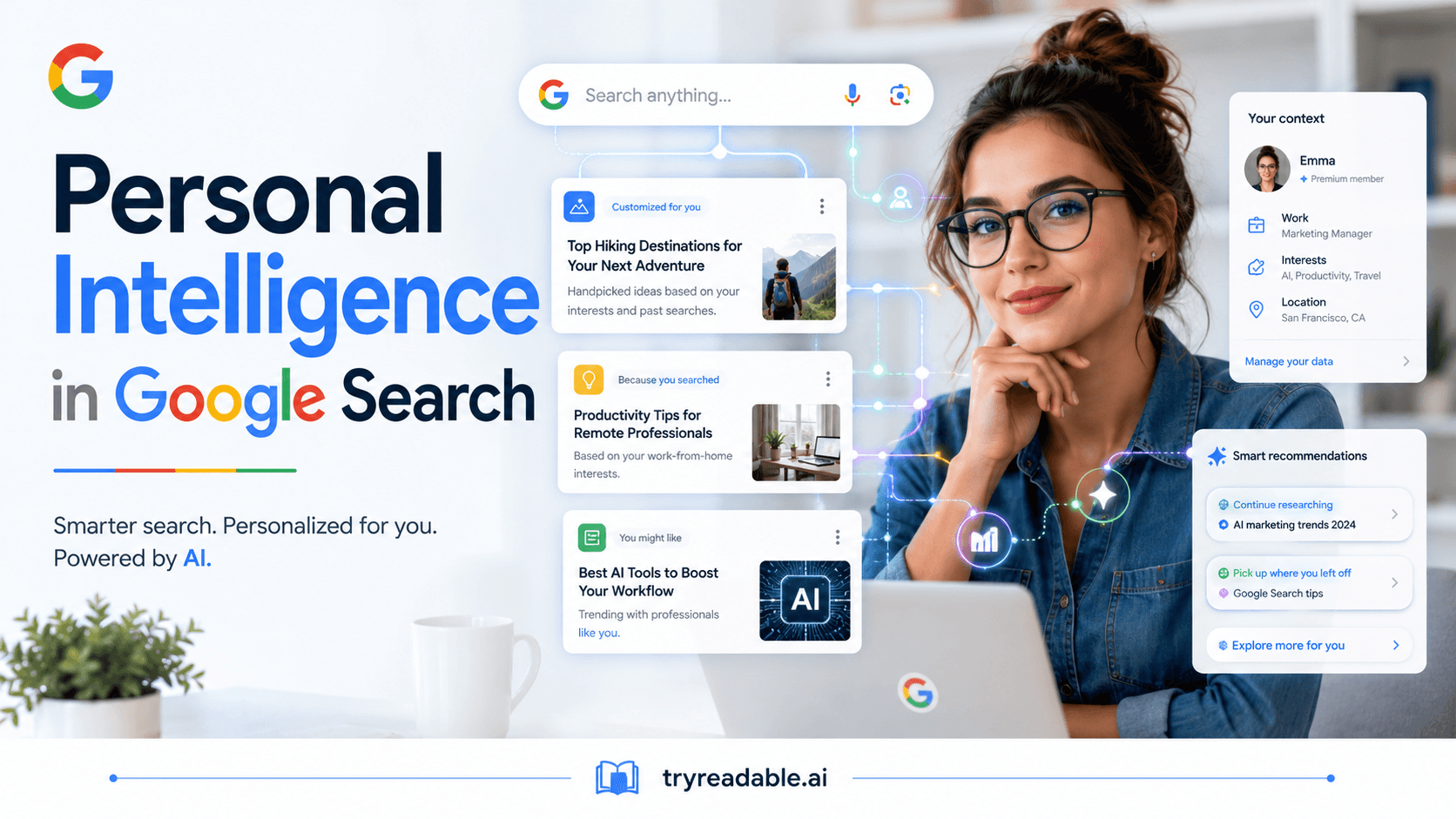
Personal Intelligence is Google's feature that connects Search to a user's personal data -- specifically Gmail, Google Photos, and other Google services -- to deliver contextually relevant, personalized answers rather than a universal ranked list of results.
The feature was announced and significantly expanded at Google I/O 2026. It is now rolling out across AI Mode in Search, the Gemini app, and Gemini in Chrome. According to Google's own announcements, it is powered by Gemini 3.5 Flash, which became the default model in AI Mode worldwide as part of the same rollout.
To understand why this matters, you need to understand what Google Search has always been at its core: a document retrieval system. You type a query, Google matches that query against an index of web pages, and it returns a ranked list of documents it believes are most relevant. Every user typing the same query gets roughly the same results, adjusted only by location and some light personalization signals like search history.
Personal Intelligence breaks that model entirely.
Instead of retrieving documents, Google is now building a personal AI assistant layer on top of Search. That assistant has access to your emails, your photos, your calendar, your purchase history, and your past conversations with Google's products. When you ask a question, the answer is not pulled from a universal index and ranked. It is synthesized specifically for you, using your personal context as the primary filter.
Google's expansion announcement describes this as "bringing the power of Personal Intelligence to more people," framing it as a natural evolution of the AI Mode that has already crossed one billion monthly users. The rollout is expanding to nearly 200 countries, which means this is not a limited experiment. It is the new default direction for Search.
For marketers, the implication is immediate: the content you publish is no longer competing only against other content for a ranking position. It is competing to be the source that a personalized AI assistant trusts enough to cite when it builds a custom answer for a specific user.
How Personal Intelligence Differs from Normal Google Search (With Examples)
The easiest way to understand the magnitude of this shift is through a direct comparison. Let us use a query that any B2B marketer or SaaS founder would recognize.
The query: "best project management tool for remote teams"
Normal Google Search response: Google returns a ranked list of articles -- "Top 10 Project Management Tools," comparison posts from G2 and Capterra, a few sponsored listings from Asana, Monday.com, and Notion, and maybe a featured snippet pulling a short answer from one of the top-ranking pages. Every person who types this query sees essentially the same results, adjusted slightly for location or whether they are logged in.
Personal Intelligence Search response: Google cross-references the user's Gmail threads to see what tools their team has discussed or complained about. It checks their Google Calendar to understand how many people are on their team and how they schedule work. It looks at past searches to understand whether they have already evaluated specific tools. It may even check Google Shopping history to see if they have purchased software recently. The result is not a ranked list of articles. It is a synthesized recommendation: "Based on your team of six using Google Workspace and the Slack threads you have been having about task tracking, here is why Notion might fit better than Asana for your specific workflow."
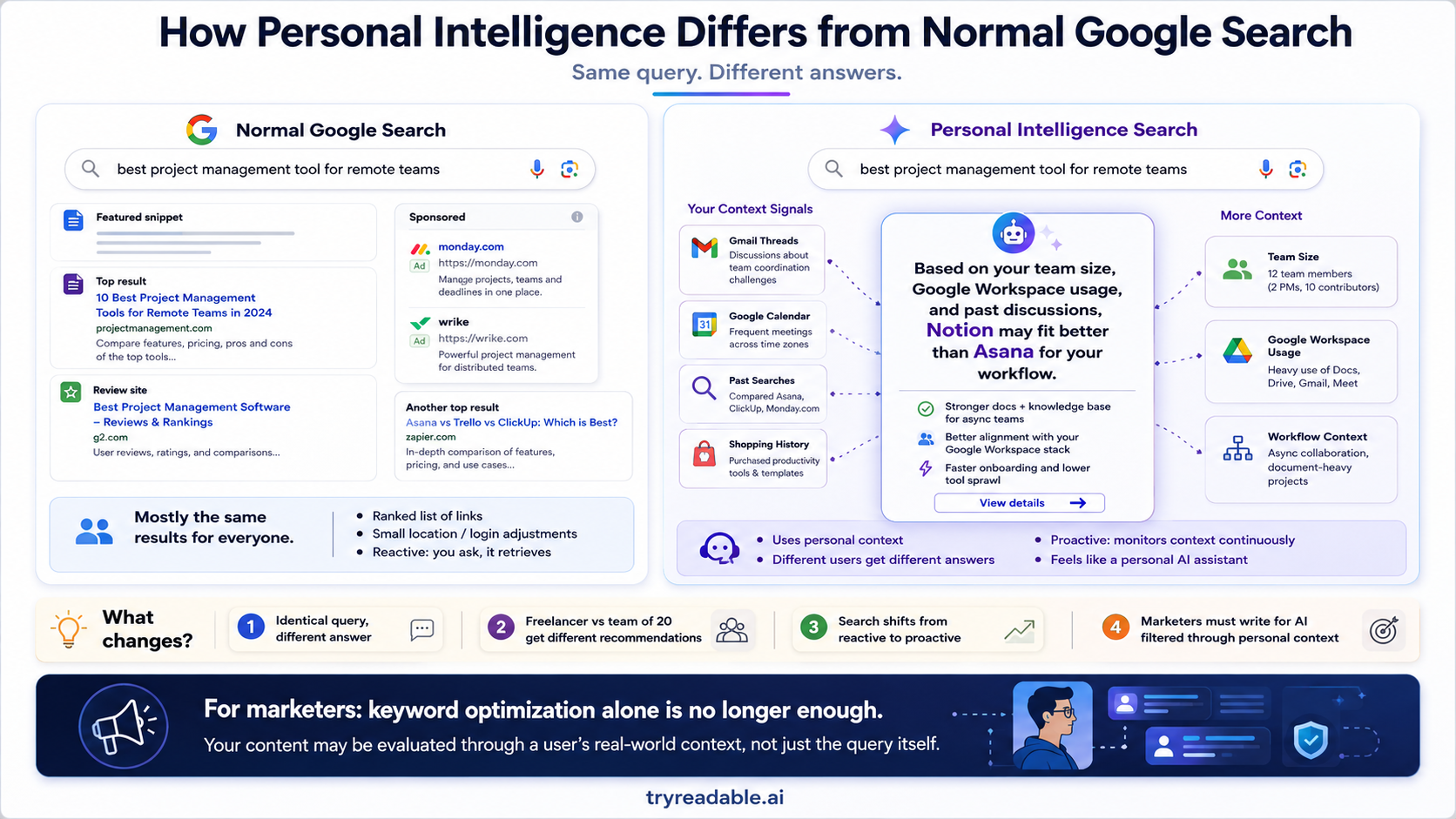
Two people typing the exact same query can now receive entirely different answers. A freelancer with a two-person operation gets a different recommendation than a startup founder managing a distributed team of twenty. The query is identical. The answer is not.
This is the core of what India Today's coverage of I/O 2026 described as Google no longer wanting Search to "feel like a search engine" -- it wants it to feel like a personal AI assistant.
The shift also changes the nature of the task. Normal Search is reactive: you ask, it retrieves. Personal Intelligence Search is proactive: the system monitors your context continuously and surfaces answers before you even know you need to ask. According to Times of India's coverage of the I/O 2026 keynote, Google introduced agents that scan the web on a user's behalf around the clock -- meaning a user does not need to type a new query to receive a new, relevant answer.
For marketers, this creates a challenge that keyword optimization alone cannot solve. You are no longer writing for a ranking algorithm that treats all users equally. You are writing for an AI that filters everything through a specific person's life.
The Four Core Capabilities Marketers Need to Understand
Personal Intelligence is not a single feature. It is a bundle of capabilities that work together to create the personalized assistant experience. Marketers need to understand each one because each has different implications for content strategy.
1. Search Agents
Search agents are autonomous programs that scan the web continuously on a user's behalf. Unlike a traditional search query, which requires the user to initiate a new search, agents run in the background and surface updates without any new input from the user.
Practically, this means a user could set an agent to monitor pricing changes for a category of software, track news about a competitor, or watch for new content on a specific topic. When the agent finds something relevant, it surfaces it directly in the user's Search or Gemini interface.
For content marketers, this changes the discovery model. Your content does not only need to rank when someone searches. It needs to be the kind of content that an agent, scanning on behalf of a user with a specific context, would identify as relevant and surface proactively. That requires content that is specific, timely, and clearly scoped to a defined problem -- not broad, evergreen keyword posts designed to capture volume.
2. Personal Data Hooks
This is the capability that gives Personal Intelligence its name. Integration with Gmail and Google Photos means that answers are filtered through a user's real purchase history, travel plans, communications, and personal records.
If a user has been emailing a vendor about a software contract, Google's AI can factor that context into a search about alternatives. If they have photos from a recent trip, a search about travel insurance can reference where they have actually been. If their Gmail contains receipts from a specific brand, that brand becomes part of their personal data ecosystem.
For marketers, this creates both an opportunity and a risk. If your brand is present in a user's personal data -- through purchase confirmations, support emails, or Google Shopping transactions -- that presence can positively influence what Personal Intelligence recommends to them. If your brand is absent from that ecosystem, you are invisible to the most personalized layer of the answer.
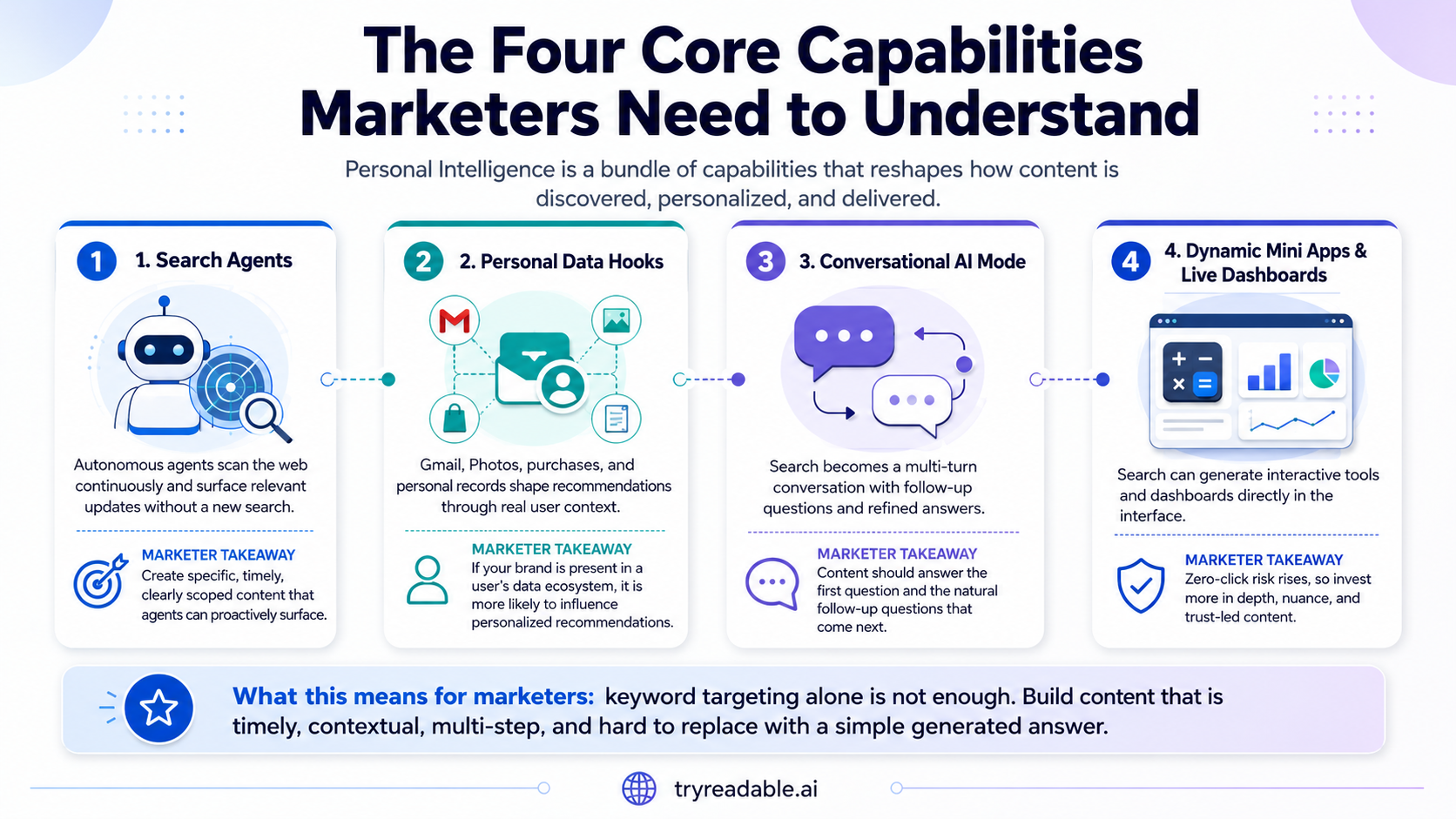
3. Conversational AI Mode
AI Mode transforms Search from a single-shot query system into a multi-turn conversation. A user does not just ask one question and get one answer. They ask a question, receive an answer, ask a follow-up, receive a refined answer, and continue until they have what they need.
This has a direct implication for content structure. A single piece of content may now need to answer not just the primary query but the two or three follow-up questions that naturally arise from it. If your article answers "What is CRM software?" but does not address "How do I migrate my existing contacts?" or "What does implementation actually cost?", the AI may cite your article for the first question and then move to a competitor's content for the follow-up.
Content that anticipates the full conversation arc -- not just the entry-point query -- is more likely to be cited across multiple turns of an AI Mode interaction.
4. Dynamic Mini Apps and Live Dashboards
One of the most disruptive capabilities announced at I/O 2026 is Search's ability to generate custom interactive tools on the fly. A user searching for a mortgage calculator does not need to click through to a financial website. Google can generate a functional calculator directly in the Search interface, customized to the user's location and financial context.
This capability -- sometimes called "mini apps" or "live dashboards" -- significantly increases zero-click risk for certain content categories. If Google can build a functional tool from your content without sending the user to your site, the traffic value of that content drops to near zero even if your content is the source being used.
Marketers need to identify which of their content types are most vulnerable to this dynamic and shift investment toward content that requires depth, nuance, or brand trust that a generated mini app cannot replicate.
Why This Changes the Rules for Content Visibility
The numbers behind this shift are not speculative. According to Times of India's reporting on the I/O 2026 keynote, AI Mode crossed one billion monthly users within a year of launch. AI Overviews now reaches 2.5 billion users. The majority of searches are now mediated by AI before a user sees a traditional link.
That means the traditional keyword-to-blue-link model -- the foundation of SEO for the past two decades -- is no longer the primary path to content visibility. It is a secondary path, and it is shrinking.
When Google's AI synthesizes a personalized answer from a user's context plus web content, the content that gets cited must meet a higher bar than keyword relevance. It must be authoritative, well-structured, and directly answer specific questions. Generic content that ranks because it targets a high-volume keyword but does not provide genuine depth is increasingly invisible to the AI layer.
Zero-click risk is also accelerating. If Personal Intelligence can answer a query using a user's own data plus a synthesized summary from web content, the user may never visit your site at all. They get the answer. You get no traffic. This is not a hypothetical future scenario -- it is already happening at scale with AI Overviews, and Personal Intelligence deepens it further.
The strategic implication is a fundamental shift in what "visibility" means for content marketers. Brand visibility now depends on being the source the AI trusts and cites, not just ranking on page one. That requires a different kind of content investment: depth over volume, structure over keyword density, topical authority over individual post optimization.
For a practical framework on how to assess your current content's readiness for this environment, the TryReadable content analysis tool can help you identify which pages have the structural and readability characteristics that AI systems favor when selecting sources to cite.
What Marketers Must Do to Make Content Ready for Personal Intelligence Search
Understanding the shift is one thing. Knowing what to do about it is another. Here are the specific content strategy changes required to remain visible in a Personal Intelligence-driven Search environment, with concrete examples for each.
Cover the Full Decision Journey, Not Just Awareness
Most content marketing programs are heavily weighted toward top-of-funnel awareness content. "What is X," "Introduction to Y," "Why Z matters" -- these posts capture search volume but they do not answer the task-specific questions that agents and AI Mode are increasingly surfacing.
Personal Intelligence favors content that answers intent at every stage of a decision. Instead of only publishing "What is CRM software," also publish "How to migrate from spreadsheets to a CRM in under a week," "What to tell your team when you switch CRM platforms," and "CRM onboarding checklist for a team of ten." These task-specific pieces are exactly what agents surface when a user's context signals they are in the middle of a decision, not just researching a category.
A practical audit: look at your content library and count how many posts answer "what is" versus how many answer "how to" or "what happens when." If the ratio is heavily skewed toward awareness, you have a gap that Personal Intelligence will exploit.
Structure Content for Extractability
Gemini does not read your content the way a human does. It parses it for extractable answers -- clear statements that directly respond to a specific question. Content that buries its key insight in the third paragraph of a long introduction, or that uses flowing prose without structural signposts, is harder for the AI to parse accurately.
Structure your content with clear headers that mirror the questions users ask. Use bullet points for lists of steps, features, or considerations. Implement schema markup -- specifically FAQ schema, HowTo schema, and Article schema -- to give Gemini explicit signals about what your content contains and how it is organized.
A concrete example: if you are writing about email marketing benchmarks, do not just present data in paragraph form. Use a structured table with clear labels, add an FAQ section that answers "What is a good open rate for B2B email?" as a direct question-and-answer pair, and mark up the page with FAQ schema. That structure makes it significantly more likely that your data gets cited in an AI Mode response rather than a competitor's less-structured version of the same information.
For a deeper look at how readability and structure affect AI citation rates, the TryReadable guides section covers the technical and editorial dimensions of content optimization for AI-mediated search.
Build Topical Authority Clusters
A single well-optimized post is no longer sufficient to establish the kind of authority that Google's AI recognizes as trustworthy. Personal Intelligence and AI Mode favor domains that demonstrate comprehensive, interconnected expertise on a subject.
A SaaS founder covering project management should aim to own 30 or more interlinked pieces on that topic -- covering methodology, tool comparisons, team dynamics, remote work specifics, integration guides, and case studies -- not just a few high-volume posts targeting broad keywords. The AI's assessment of your domain's authority is based on the breadth and depth of your coverage, not just the performance of individual pages.
This is not a new SEO concept, but Personal Intelligence makes it more urgent. When the AI is deciding which source to cite for a personalized answer about project management for a specific user's context, it is more likely to trust a domain that has demonstrated comprehensive expertise across the topic than one that has a single high-ranking post.
Optimize for Conversational and Multi-Turn Queries
Because AI Mode is a conversation, not a single query, your content needs to anticipate the follow-up questions that naturally arise from your primary topic. This means building FAQ sections that address the second and third questions a reader would ask, using "next question" subheadings that mirror a conversation flow, and creating internal links that guide a reader (and an AI parsing your content) through a logical progression of related questions.
For example, an article about choosing a project management tool should not just answer "What should I look for in a project management tool?" It should also address "How do I get my team to actually use it?", "What does migration from our current system look like?", and "How do I evaluate whether it is working after three months?" Each of those follow-up questions is a potential turn in an AI Mode conversation, and if your content answers them, you are more likely to be cited across multiple turns rather than just the first.
Internal linking that mirrors this conversation flow also helps. Linking from your primary article to your migration guide, your onboarding checklist, and your evaluation framework creates a content cluster that the AI can traverse when building a multi-turn response.
Appear in the Personal Data Ecosystem
This is the most novel implication of Personal Intelligence and the one most marketers have not yet thought through. If your product is purchased via Google Shopping, if your brand is discussed in Gmail threads, or if your content is saved or shared through Google's ecosystem, that data can influence what Personal Intelligence recommends to users who have that data in their personal context.
This means that brand presence in Google's ecosystem -- not just search rankings -- becomes a visibility signal. Ensuring your products are listed and optimized in Google Shopping, that your customer communications are clear and branded (since they may appear in Gmail), and that your content is structured to be saved and referenced are all now part of a broader visibility strategy.
For brands looking to understand how their current content performs against these new visibility criteria, TryReadable's brand analysis tools provide a structured assessment of content authority and structure signals.
How to Audit Your Existing Content for Personal Intelligence Readiness
Knowing what to build going forward is important. But most marketing teams have an existing content library that needs to be assessed and updated. Here is a practical checklist you can apply immediately.
Check Your Opening 100 Words
Personal Intelligence and AI Mode systems often extract the most relevant answer from the beginning of a piece of content. If your top-performing pages lead with brand story, generic category context, or a lengthy introduction before getting to the actual answer, you are losing citation opportunities.
Test this yourself: read only the first 100 words of your five most important pages. Does each one answer a specific, actionable question? If not, rewrite the opening to lead with the answer, then provide the context and depth below it. This single change can significantly improve how often your content is cited in AI-generated responses.
Test Your Content in AI Mode Today
The most direct way to assess your current visibility is to search your target queries in AI Mode and see whether your domain appears in the cited sources. If it does not, look carefully at what the cited sources do differently. Are they more structured? Do they answer the question more directly? Do they have more comprehensive coverage of the topic?
This is not a one-time exercise. As Personal Intelligence expands and the AI's citation patterns evolve, regular monitoring of your AI Mode visibility should become part of your content performance review process.
Review Your Schema Markup
FAQ schema, HowTo schema, and Article schema all increase the likelihood of your content being accurately parsed and cited by Gemini. Many content teams implemented basic schema markup years ago and have not revisited it since. Given how central schema is to AI citation, it is worth a full audit.
Check whether your FAQ sections are marked up with FAQ schema. Check whether your how-to guides use HowTo schema with clearly defined steps. Check whether your article pages have complete Article schema including author, date, and topic signals. Tools like Google's Rich Results Test can help you identify gaps quickly.
Assess Content Depth
Personal Intelligence favors sources that cover a topic comprehensively. Thin 500-word posts targeting a single keyword are increasingly insufficient -- not because word count is a ranking factor, but because shallow content does not provide the depth of answer that an AI system needs to confidently cite a source for a complex, personalized query.
Audit your content library for posts that cover important topics but do so superficially. Prioritize expanding these pieces with additional sections, examples, data, and FAQ coverage rather than publishing new thin content on adjacent keywords. A single comprehensive 2,500-word guide on a topic will outperform five 500-word posts on related keywords in an AI-mediated search environment.
For a structured approach to assessing and improving your content's depth and readability for AI systems, book a demo with TryReadable to see how the platform evaluates your content against the criteria that matter most in the current Search environment.
Check for Topical Gaps
Map your existing content against the full decision journey for your primary topics. Identify where you have awareness content but no task-specific content, where you have how-to guides but no evaluation frameworks, and where you have product content but no migration or onboarding guides. These gaps are exactly where Personal Intelligence will route users to competitors.
Prioritize filling the gaps that correspond to the highest-intent stages of the decision journey -- the moments when a user's personal context (their emails, their calendar, their purchase history) signals they are ready to act, not just research.
FAQ: Personal Intelligence in Google Search for Marketers
Does Personal Intelligence mean my content will be shown less?
Not necessarily. It means generic, low-specificity content will be shown less, while authoritative, well-structured content that directly answers real questions has a stronger chance of being cited. The shift is not uniformly negative for content marketers -- it is selective. Content that was ranking primarily because of keyword optimization and link volume, without genuine depth or structural clarity, will lose visibility. Content that was always genuinely useful and well-organized may actually gain visibility as the AI prioritizes quality over keyword match.
Can I opt my content out of being used in AI Mode answers?
Google provides some controls via robots.txt directives, specifically the googlebot-extended directive that can limit AI training and summarization use. However, opting out of AI Mode citation also removes you from a growing share of search traffic. Given that AI Mode already has over one billion monthly users and is expanding, opting out is effectively choosing to be invisible to the majority of Search interactions. For most content marketers, the better strategy is to optimize for citation rather than opt out of it. For technical details on available directives, Google's Search Central documentation provides the most current guidance.
Does Personal Intelligence affect paid search and Google Ads?
Google has not announced direct changes to paid placements as part of the Personal Intelligence rollout. Paid ads continue to appear in Search results. However, as organic AI answers absorb more queries -- particularly informational and consideration-stage queries -- the competitive and cost dynamics of paid search are likely to shift. Advertisers may find that the queries where paid ads appear are increasingly the high-commercial-intent queries that AI Mode does not fully satisfy, which could increase competition and cost-per-click for those placements. Monitoring your paid search performance alongside organic AI Mode visibility is increasingly important.
How soon do I need to act?
AI Mode already has over one billion monthly users and Personal Intelligence is expanding to nearly 200 countries according to Google's own expansion announcement. The time to adapt content strategy is now, not after traffic drops are visible in your analytics. Traffic declines from AI-mediated search are often gradual at first and then sudden -- by the time the drop is obvious in your data, competitors who adapted earlier will have established the topical authority and structural quality that the AI system trusts. The content investments you make in the next six months will determine your visibility position for the next several years.
What types of content are most at risk from Personal Intelligence?
Content that answers simple, factual questions is most at risk from zero-click behavior -- the AI can synthesize the answer without sending the user to your site. Content that provides tools, calculators, or templates is at risk from Google's dynamic mini app capability. Content that is thin, generic, or primarily keyword-optimized without genuine depth is at risk from being passed over in favor of more authoritative sources. Content that is least at risk includes deep guides, original research, case studies, and content that requires brand trust or human judgment to evaluate -- the kinds of content that an AI can cite but cannot fully replace.
How does this affect B2B content marketing specifically?
B2B content marketing is particularly affected because B2B purchase decisions involve exactly the kind of multi-turn, context-dependent research that Personal Intelligence is designed to support. A buyer researching enterprise software is likely to have relevant context in their Gmail (vendor communications, internal discussions), their calendar (demo bookings, team meetings), and their search history (competitor research, category exploration). Personal Intelligence can synthesize all of that context into a highly personalized recommendation. B2B marketers who build content that addresses the full decision journey -- from category awareness through vendor evaluation to implementation planning -- are best positioned to be cited across the multiple turns of that research process.
The shift from document retrieval to personal AI assistant is not a future scenario. It is the current state of Google Search, expanding to billions of users right now. The marketers and founders who treat this as a reason to double down on the content quality, structural clarity, and topical depth that AI systems trust will find that Personal Intelligence creates new visibility opportunities. Those who continue optimizing for the keyword-ranking model that defined the previous era will find their traffic eroding in ways that are difficult to reverse.
The practical steps are clear: audit your existing content for structural quality and depth, build out the task-specific and decision-stage content that agents surface, implement schema markup that makes your content parseable, and establish topical authority clusters that signal comprehensive expertise to Google's AI. Start with the TryReadable content analyzer to get a baseline assessment of where your current content stands against these criteria.
The era of typing keywords and scrolling blue links is ending. The era of AI-mediated, personally contextualized answers is here. Your content strategy needs to reflect that reality today.
Sources
- Google Search’s I/O 2026 updates: AI agents and more
- Personal Intelligence in AI Mode and Gemini expands in the U.S.
- Google Search is changing after 25 years, you will not see blue links anymore - India Today
- Google Search gets its biggest upgrade in 25 years: Here's what's actually changing
- Google Search Central documentation
- Google AI Overviews documentation
- OpenAI announcement archive
- Anthropic documentation
- Schema.org structured data vocabulary
- W3C JSON-LD specification
- Google Analytics developer docs
- NIST AI Risk Management Framework
How will Personal Intelligence reshape your content's path to visibility?
Learn how to position your content as a trusted source for personalized AI answers before this shift accelerates across search.