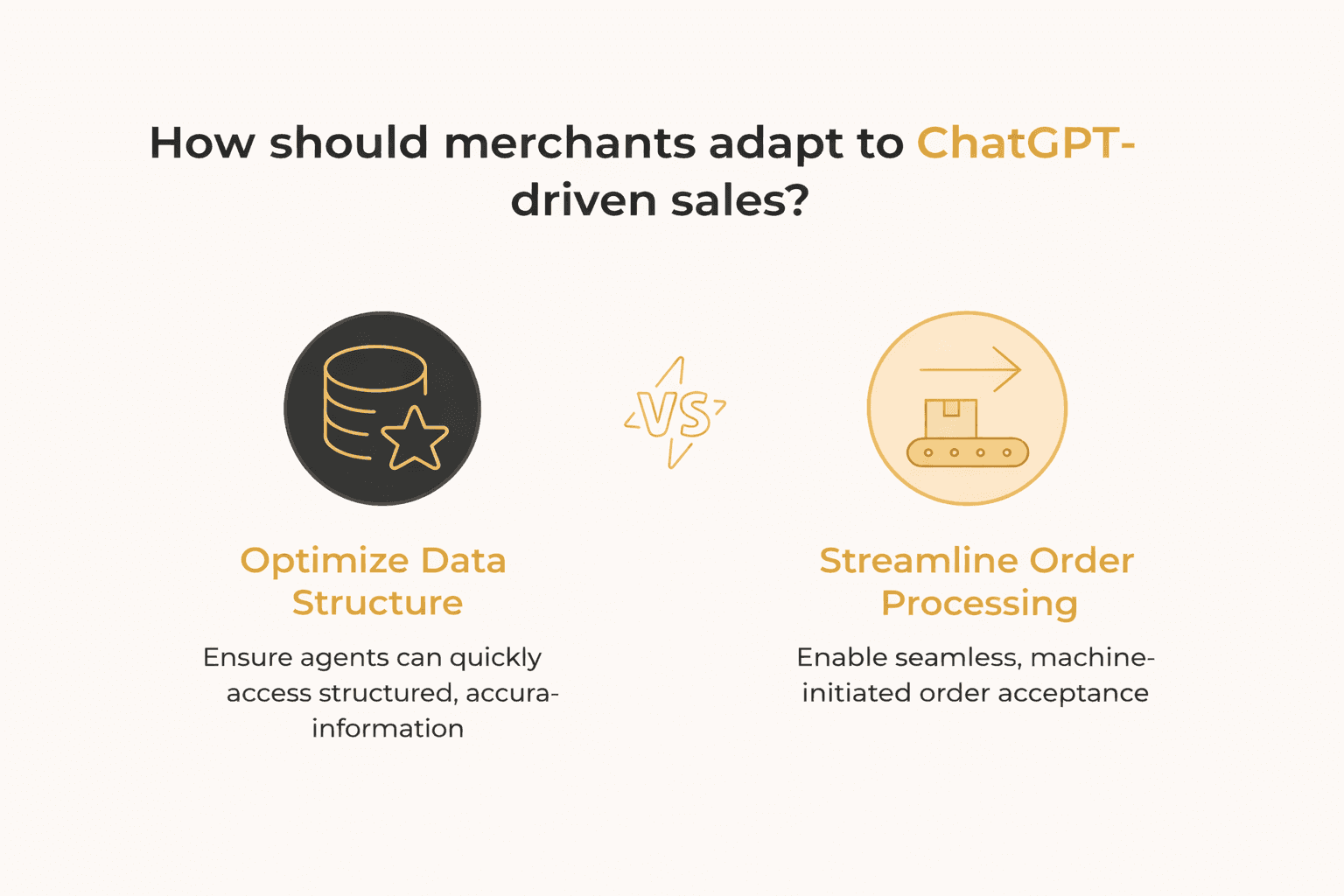
ChatGPT is no longer just answering questions. It is increasingly helping users discover products, compare options, and complete purchases directly inside the conversation.
For brands, this creates a new acquisition channel where buyers never open Google, never browse category pages, and never land on your site unless the AI chooses you.
If your products are not structured, accessible, and trusted by AI systems, you simply do not exist in these buying flows.
This guide explains what “selling on ChatGPT” actually means, how AI agents decide which products to recommend, and what you need to do now to make your catalog visible, accurate, and purchasable in AI-driven commerce.
What “selling on ChatGPT” actually means
Selling on ChatGPT does not mean running ads inside a chatbot or building a branded plugin experience.
It means your products can be discovered, evaluated, and ordered by an AI agent acting on behalf of a user.
Instead of a traditional funnel:
Search → Category → Product page → Cart → Checkout
The funnel collapses into a single instruction:
“Find me a standing desk under $1,000 that ships this week and doesn’t require a subscription.”
The AI retrieves product data from trusted sources, compares options, validates price and availability, and may initiate checkout through integrated ordering systems.
If your product data cannot be reliably retrieved and validated, the agent excludes you automatically.
Visibility becomes a data problem, not a design or branding problem.
How AI agents choose which products to show
AI systems prioritize products that meet three conditions:
1. Machine-readable product truth
Agents rely on structured, consistent product data including:
- Title and description
- Price and currency
- Inventory status
- Variants and configurations
- Dimensions and specifications
- Shipping constraints and timelines
- Return and warranty policies
If this data is fragmented, hidden behind heavy JavaScript rendering, inconsistent across pages, or missing entirely, the agent cannot confidently recommend your product.
Ambiguity equals exclusion.
2. Real-time accuracy
AI systems avoid recommending products that might fail at checkout.
If price, availability, or delivery estimates are unreliable or stale, agents downgrade or remove your listings to protect user trust.
Accuracy matters more than marketing polish.
3. Programmatic purchase capability
To complete a transaction, agents need stable endpoints that allow them to:
- Create carts
- Validate pricing and shipping
- Submit orders securely
- Confirm fulfillment
If ordering requires brittle browser automation or manual workflows, the AI may stop at recommendation instead of conversion.
Why this changes ecommerce strategy
AI commerce shifts where competition happens.
You are no longer competing on:
- Page design
- Conversion rate optimization
- Visual merchandising
- Brand storytelling
You are competing on:
- Data clarity
- System reliability
- Speed of retrieval
- Confidence of facts
- Operational consistency
Your website becomes a data source first and a marketing surface second.
Brands that treat product truth as infrastructure will outperform brands that treat it as content.
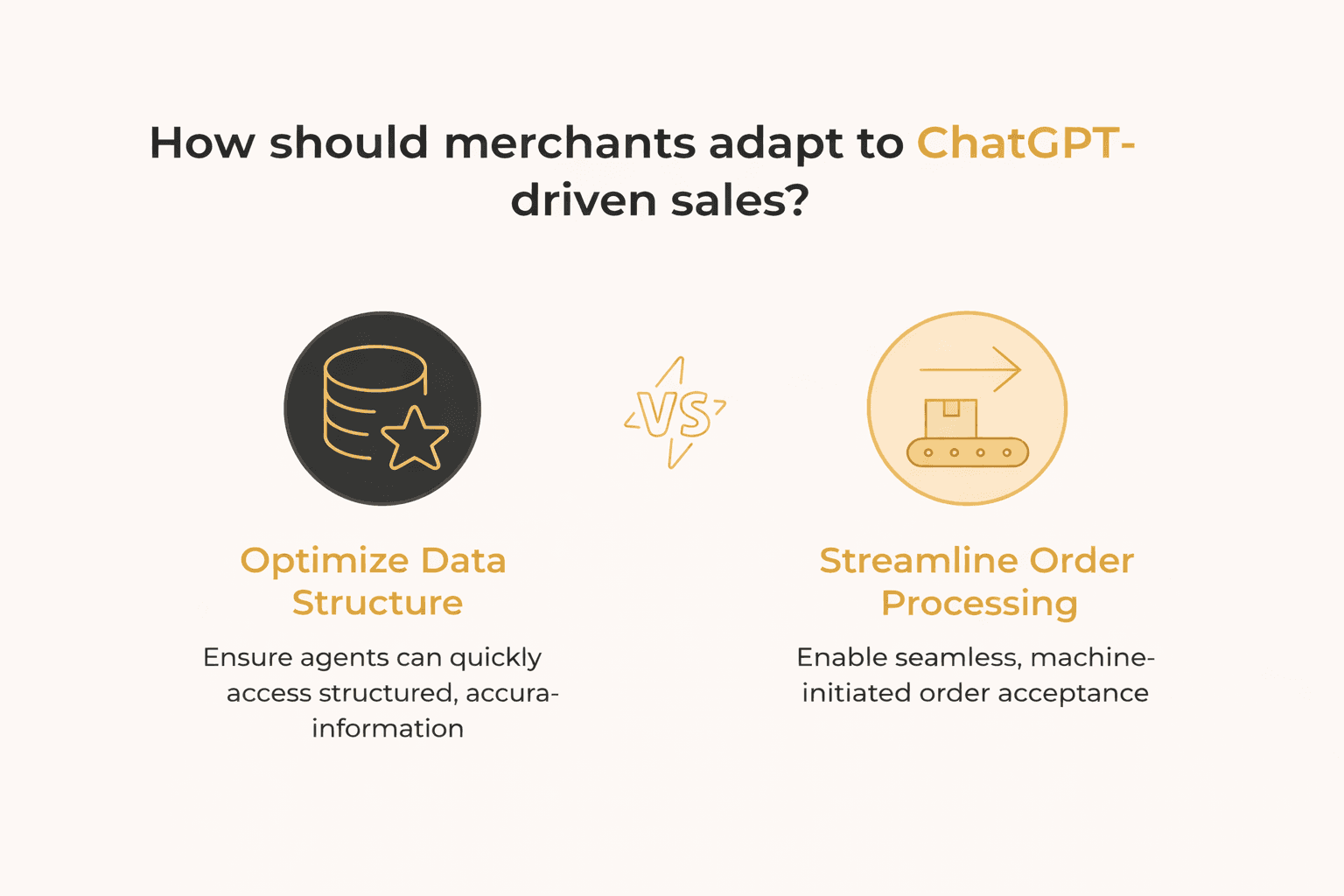
How to prepare your catalog for ChatGPT commerce
Step 1: Normalize your product data
Audit every SKU for completeness and consistency:
- Are prices always explicit and machine readable?
- Are variants clearly structured, not implied in prose?
- Are availability and lead times stated clearly?
- Are policies accessible without authentication or scripts?
If an AI cannot extract a fact cleanly, assume it does not exist.
Step 2: Publish agent-friendly endpoints
Expose stable URLs or feeds where agents can reliably retrieve product truth.
Avoid:
- Login walls
- Session-bound rendering
- Client-side data hydration
- Dynamic content that requires user interaction
Agents operate under tight time budgets and strict parsing constraints.
Step 3: Maintain real-time inventory and pricing integrity
Connect inventory systems so price and stock reflect reality.
Inconsistencies between systems reduce trust signals and suppress visibility.
If your site says “in stock” but fulfillment cannot guarantee delivery, the AI will stop recommending you.
Step 4: Enable programmatic ordering
Implement APIs or lightweight order endpoints that allow agents to place orders safely.
Start small with a limited SKU set to validate reliability before expanding.
This is where AI commerce moves from awareness to revenue.
A simple one-week starting plan
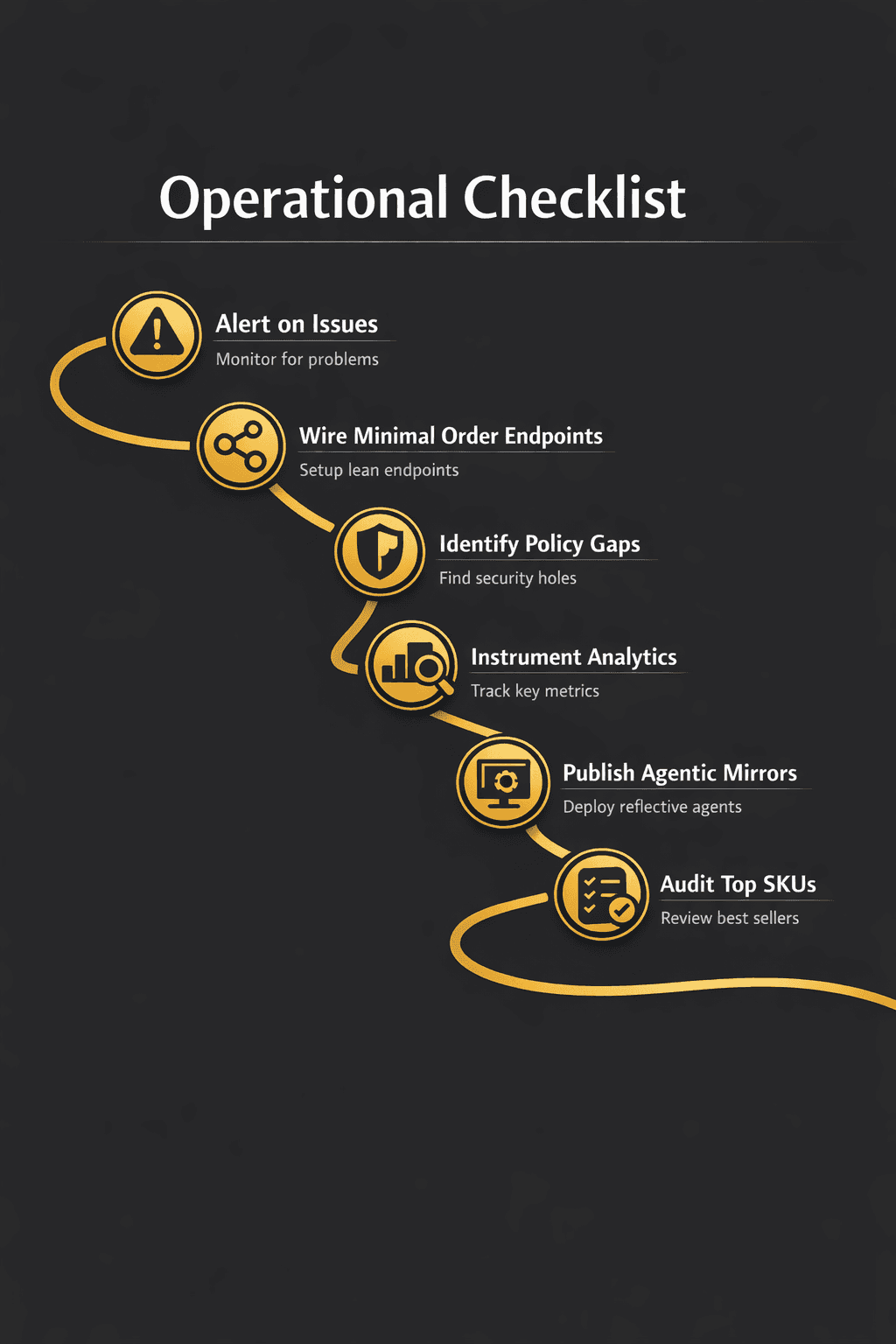
Day 1–2: Data auditIdentify missing or ambiguous product facts across top SKUs.
Day 3–4: Endpoint validationConfirm agents can retrieve clean product data without blockers.
Day 5: Inventory synchronizationEnsure pricing and availability match fulfillment systems.
Day 6: Order flow testingPrototype a minimal programmatic checkout flow.
Day 7: Measurement setupTrack agent referrals, parse success, and conversion reliability.
Where Readable fits
Readable helps brands understand how AI agents discover, evaluate, and interact with their product data.
It surfaces where agents fail to extract critical facts, where visibility drops, and how ordering flows behave in real environments.
Instead of guessing how AI systems interpret your site, you get direct operational signals to guide improvements.
The real opportunity
AI commerce is still early.
The winners will not be the loudest brands or the prettiest websites.
They will be the most operationally clear, reliable, and machine-understandable.
If your product truth is strong, AI agents will find you, trust you, and transact with you.
If it is not, no amount of branding will save you.
Could ChatGPT become a sales channel for your business?
If your products may be discovered, compared, or purchased through AI conversations, talk to us about what ChatGPT needs before it can confidently recommend you.