Most product development still assumes the primary user is a human navigating screens.
That assumption is expiring.
As AI agents take on multi-step tasks like researching, planning, and transacting, the interface stops being your differentiator. The differentiator becomes whether an agent can understand your capabilities, call the right actions, and complete outcomes reliably.
This is not a UX evolution. It is a product architecture shift: from UI-centric experiences to agent-executable systems.

The era of human interfaces is ending
Today’s product work is heavily focused on translating backend complexity into human-friendly inputs: forms, toggles, filters, onboarding, dashboards.
That work exists because humans need help converting intent into structured actions.
Agents do not.
Agents can express intent, plan tasks, and execute steps programmatically. When that becomes normal, your UI becomes optional and your execution layer becomes the product.
The shift: UI-centric to API-centric
Human-first products are optimized around navigation.
Agent-first products are optimized around execution.
If an agent can take a goal, break it into steps, and call your endpoints to complete it, you’ve eliminated the slowest part of the funnel: the human.
What matters most in an agentic world:
- Clear, discoverable actions
- Predictable schemas
- Strong constraints and validation
- Reliable results and state changes
Your new user is an intelligent agent
The new product user is not distracted. It is systematic.
Agents:
- Understand goals via conversation
- Plan and sequence tasks
- Invoke APIs and workflows
- Summarize outcomes back to the user
So the product requirements change. You are no longer designing to hold attention. You are designing to support delegation.
Product development at zero: the new rules
Here’s the practical translation of “agent-first” product thinking.
Old world: human-first
- Build UI for human actions
- Define user journeys and screens
- Educate users via onboarding and UX cues
- Track CTR, sessions, DAU, funnel steps
- Optimize for engagement and time-on-product
New world: agent-first
-
Build APIs for agent execution
-
Enable intent mapping and task orchestration
-
Feed structured context to inference engines
-
Track task completion, agent queries, API usage
-
Optimize for outcome clarity, accuracy, reliability
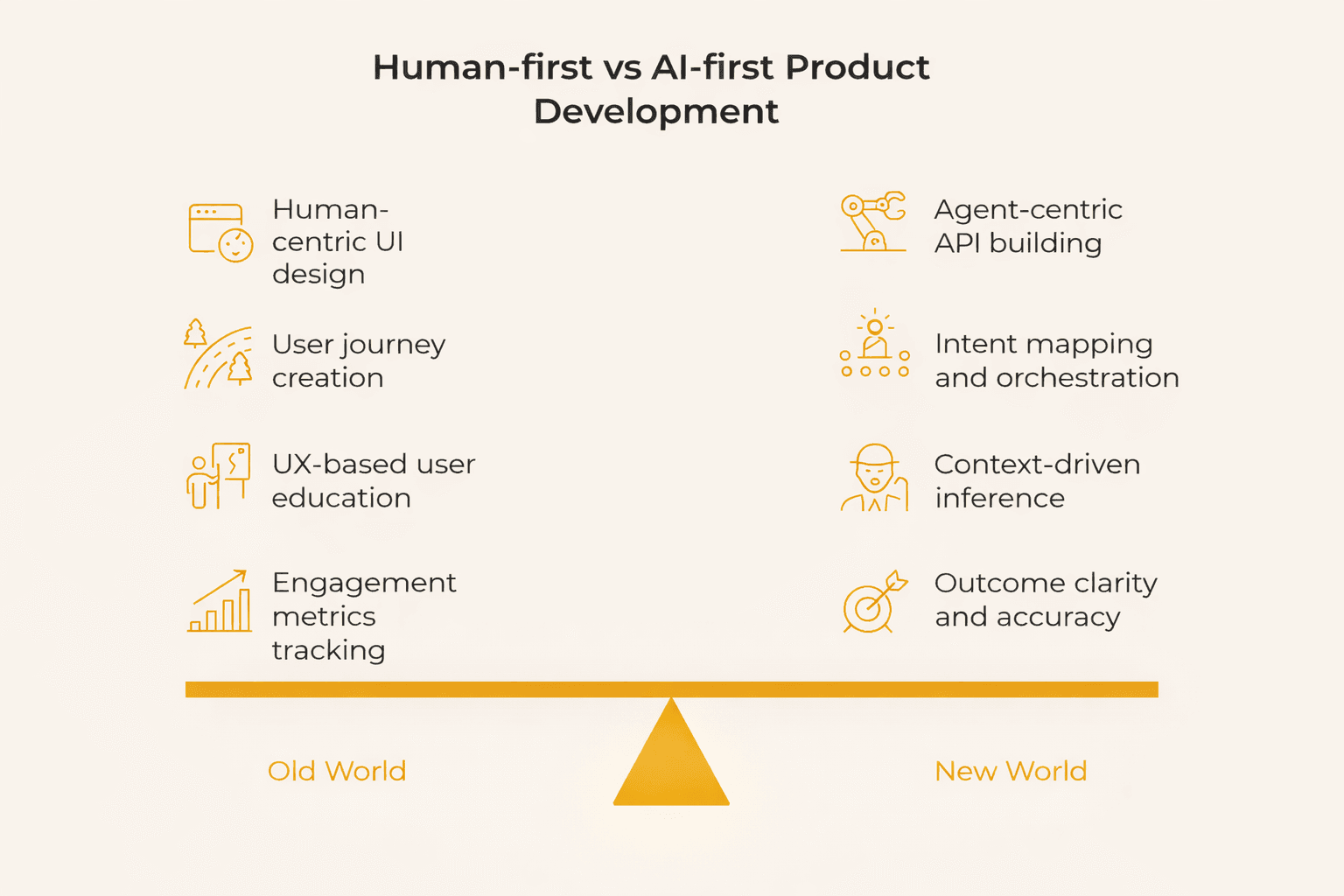
If you keep optimizing engagement while agents optimize outcomes, you will lose the surface where decisions are being made.
The agent-first product checklist
This is the part teams can actually use.
1) Your product is a platform
Agents need clean, modular capabilities. Think in composable actions, not pages.
Ask:
- What are the atomic actions an agent should be able to trigger?
- Can it discover them without guessing?
2) Your docs are training data
Documentation becomes an interface for machines, not just humans.
Ask:
- Can an agent learn your verbs, constraints, and required parameters from docs alone?
- Are examples explicit, structured, and consistent?
3) Design for delegation, not attention
Agents do not browse. They execute.
Ask:
- Can the system return “what happened” in a machine-usable way?
- Is success and failure unambiguous?
4) Think in verbs, not screens
Agents will prompt in verbs: “book,” “buy,” “compare,” “rebalance.”
Ask:
- Do you expose those verbs as callable actions?
- Are edge cases handled deterministically?
5) Intent resolution is the new UX
The core experience is: can a high-level goal become a correct, auditable execution?
Ask:
- Does your product support goal-to-action translation cleanly?
- Can it handle partial constraints and follow-up questions?
What this means for leaders
This shift changes priorities:
- Product becomes closer to systems engineering
- UX becomes less about persuasion and more about actionability
- Marketing becomes a steward of clarity and machine-readable truth
- Analytics shifts from sessions to completions, latency, and reliability
The orgs that win will be the ones that treat agent compatibility as a core product surface, not a feature request.
Closing thought
In an agentic world, flows are inferred, not hardcoded. Screens matter less. The product becomes a set of clear capabilities exposed to intelligence.
If your product cannot be executed by an agent, it will increasingly be bypassed by agents.
Is your product ready for AI users, not just human users?
If agents will evaluate or operate your product, talk to us about the capabilities, actions, and facts they need to understand before they can help buyers.