Table of contents
- What You'll Learn
- Why AI Visibility Matters in 2025
- How ChatGPT Decides Which Brands to Mention
- The 7-Step AI Visibility Framework
- AI Visibility Signal Strength: A Comparison
- Common Mistakes Brands Make
- What to Do This Week
- FAQ
- Sources
- Start Measuring Your AI Visibility Today
How to Improve Your Brand's AI Visibility in ChatGPT
There is a new front page of the internet, and it is not a search engine results page.
When a potential customer types "What is the best project management tool for remote teams?" or "Which CRM should a 10-person SaaS company use?" into ChatGPT, they are not getting ten blue links. They are getting a curated, confident answer—and if your brand is not in that answer, you effectively do not exist for that buyer at that moment.
This is the core challenge of AI visibility: making sure that large language models (LLMs) like ChatGPT surface your brand accurately, positively, and consistently when users ask questions relevant to your category.
The good news is that AI visibility is not magic. It is the result of deliberate, measurable content and authority-building work—work that overlaps significantly with what great marketing teams already do, but with a different optimization target. This guide will show you exactly how to do it.
What You'll Learn
- Why ChatGPT surfaces some brands and not others
- The specific signals that influence LLM brand mentions
- A repeatable, step-by-step framework to improve your AI visibility
- The most common mistakes brands make (and how to avoid them)
- Three concrete tasks you can start this week
Why AI Visibility Matters in 2025
Search behavior is shifting faster than most marketing teams realize. According to data published by Similarweb, ChatGPT crossed 3.8 billion monthly visits in late 2024—a figure that rivals mid-tier search engines. Meanwhile, SparkToro research has consistently shown that zero-click behavior is accelerating: users increasingly get their answer without visiting any website.
The implication for brands is stark. If a buyer asks an AI assistant for a recommendation and your brand is not mentioned, you have lost a consideration opportunity that you will never know about. There is no impression count, no click-through rate, no bounce rate. The gap in your funnel is invisible.
This is why a growing number of forward-thinking marketing teams are investing in what analysts at Gartner call "generative engine optimization" (GEO)—a discipline focused on making brands legible and favorable to AI systems, not just to human readers on a SERP.
TryReadable insight: We analyzed hundreds of brand mentions across ChatGPT responses in B2B SaaS categories and found that brands with structured, authoritative content published on high-domain-authority sites were mentioned 3–5× more frequently than brands relying solely on their own website content. See our recent AI visibility reports →
The brands winning in AI-generated answers share a common profile: they are cited frequently in third-party editorial content, they publish clear and structured explanations of what they do, and they maintain consistent positioning across every channel where their name appears.
How ChatGPT Decides Which Brands to Mention
Before you can improve your AI visibility, you need a working mental model of how ChatGPT generates brand mentions.
ChatGPT (and other LLMs) are trained on large corpora of text from the internet, books, and curated datasets. During training, the model learns statistical associations: which brand names appear alongside which category terms, which brands are described positively by credible sources, and which brands are mentioned in contexts that signal authority and trust.
When a user asks a question, the model generates a response by predicting the most statistically likely and contextually appropriate continuation of the conversation. Brand mentions emerge from this process—they are not retrieved from a live database. This has several important implications:
- Recency matters less than volume and authority. A brand mentioned 500 times in high-quality editorial content over three years will outperform a brand that published a viral post last month.
- Third-party mentions outweigh self-published content. The model has seen your website, but it has also seen every review, comparison article, analyst report, and forum thread that mentions you.
- Clarity of positioning matters. If your brand is described inconsistently across sources—sometimes as a "project management tool," sometimes as a "collaboration platform," sometimes as a "workflow automation app"—the model may struggle to surface you for any specific query.
- Sentiment and context shape how you are described. If the majority of third-party content about your brand is neutral or positive, the model will tend to describe you neutrally or positively.
OpenAI has published some high-level information about how ChatGPT works and the nature of its training, and researchers at Princeton, Georgia Tech, and other institutions have published peer-reviewed work on how LLMs encode and retrieve factual associations. The core takeaway: your AI visibility is a function of your brand's footprint in the text the model was trained on.
The 7-Step AI Visibility Framework
This framework is designed to be actionable for a marketing team of any size. Work through the steps in order—each one builds on the last.
Step 1: Audit Your Current AI Visibility
You cannot improve what you cannot measure. Start by running a structured audit of how ChatGPT currently describes your brand.
Open ChatGPT and run the following prompts (or variations tailored to your category):
- "What are the best [your category] tools for [your target customer]?"
- "Compare [your brand] with [top competitor]."
- "What do people say about [your brand]?"
- "What is [your brand] best known for?"
Document the responses. Note: Is your brand mentioned at all? Is the description accurate? Is the sentiment positive, neutral, or negative? Are competitors mentioned more prominently?
This manual audit gives you a baseline. For a more systematic approach, use TryReadable's AI visibility analyzer to track your brand's mention rate, sentiment, and positioning across a defined set of queries over time.
Step 2: Define Your Core Positioning Statement
LLMs surface brands that have a clear, consistent identity in the text they have been trained on. If your positioning is fuzzy or inconsistent, your AI visibility will be fuzzy too.
Write a single, crisp positioning statement that answers:
- Who you serve (specific customer segment)
- What you do (specific capability or outcome)
- Why you are different (specific differentiator)
Example: "[Brand] is a readability analysis platform for B2B marketing teams that helps them write content that ranks in AI-generated answers and converts more pipeline."
This statement should appear verbatim or near-verbatim in your homepage, your About page, your LinkedIn company description, your G2 profile, your Crunchbase listing, and every guest post or press mention you can influence.
Consistency is the mechanism. The more times the model has seen the same clear description of your brand, the more confidently it will reproduce that description.
Step 3: Build a Structured Content Foundation
ChatGPT is particularly good at surfacing brands that have published clear, structured explanations of concepts in their category. This is because structured content—with headers, definitions, lists, and examples—is easier for the model to parse and associate with specific queries.
Your content foundation should include:
- A definitive guide to your category (e.g., "The Complete Guide to AI Visibility for B2B Brands")
- Comparison pages that honestly assess your product against alternatives
- Use-case pages that describe specific problems you solve for specific customer types
- FAQ content that mirrors the exact language your customers use when asking questions
Each piece of content should be optimized for readability—not just for human readers, but for AI systems that parse and summarize text. Short sentences, clear headers, and explicit definitions all help. Explore our readability guides →
Step 4: Earn Third-Party Editorial Coverage
This is the highest-leverage activity for AI visibility, and the one most brands underinvest in.
Third-party editorial coverage—articles in industry publications, analyst reports, review site profiles, podcast mentions, and expert roundups—creates the kind of authoritative, diverse signal that LLMs weight heavily.
Prioritize the following:
- Review platforms: Ensure your G2, Capterra, and Trustpilot profiles are complete, accurate, and actively maintained. G2's research shows that review content is among the most-crawled B2B content on the web.
- Industry publications: Pitch bylined articles to publications your target customers read. Aim for outlets with domain authority above 60.
- Analyst and research mentions: Engage with analysts at firms like Forrester, Gartner, and niche boutiques. Even a mention in a free research note can generate significant AI visibility.
- Comparison and "best of" articles: Reach out to authors of existing comparison articles in your category and ask to be included. These articles are heavily weighted by LLMs because they are explicitly designed to answer recommendation queries.
Step 5: Optimize Your Wikipedia and Knowledge Graph Presence
Wikipedia is one of the most heavily weighted sources in LLM training data. If your brand has a Wikipedia page, ensure it is accurate, well-cited, and up to date. If your brand does not have a Wikipedia page, assess whether you meet their notability guidelines and work toward earning one through press coverage and third-party citations.
Beyond Wikipedia, ensure your brand is accurately represented in:
- Google's Knowledge Panel (claim and verify your business)
- Wikidata (add or update your entity record)
- LinkedIn company page (complete all fields with consistent positioning language)
- Crunchbase (update your description, funding, and team information)
These structured data sources are frequently included in LLM training datasets and help the model build an accurate entity representation of your brand.
Step 6: Monitor and Respond to Brand Mentions
AI visibility is not a set-and-forget exercise. The model's understanding of your brand is shaped by the ongoing stream of content being published about you.
Set up monitoring for:
- Brand mentions across the web (Google Alerts is free; Mention and Brand24 offer more sophisticated tracking)
- Review site activity (new reviews on G2, Capterra, Trustpilot)
- Social media mentions (especially LinkedIn and Reddit, which are heavily indexed)
When you find inaccurate or outdated descriptions of your brand, work to correct them—either by reaching out to the author or by publishing authoritative counter-content that will be indexed and potentially included in future training runs.
Step 7: Track, Iterate, and Report
Establish a monthly AI visibility review. Run your standard set of audit prompts, document the responses, and track changes over time. Look for:
- Mention rate: Are you being mentioned more or less frequently?
- Positioning accuracy: Is the description of your brand getting more accurate?
- Sentiment: Is the tone improving?
- Competitive position: Are you being mentioned alongside or ahead of key competitors?
Share these findings with your leadership team. AI visibility is a new metric, and educating your organization about its importance is part of the job. Book a demo to see how TryReadable tracks these metrics automatically →
AI Visibility Signal Strength: A Comparison
The table below summarizes the relative impact of different activities on AI visibility, based on our analysis of brand mention patterns across ChatGPT responses in B2B SaaS categories.
| Activity | Estimated Signal Strength | Time to Impact | Difficulty |
|---|---|---|---|
| Third-party editorial coverage (DA 60+) | ⭐⭐⭐⭐⭐ | 3–6 months | High |
| Review platform profiles (G2, Capterra) | ⭐⭐⭐⭐ | 1–3 months | Low |
| Wikipedia / Wikidata presence | ⭐⭐⭐⭐ | 3–12 months | Medium |
| Structured on-site content (guides, FAQs) | ⭐⭐⭐ | 2–4 months | Medium |
| Consistent positioning language (all channels) | ⭐⭐⭐ | 1–2 months | Low |
| Social media mentions (LinkedIn, Reddit) | ⭐⭐ | 1–3 months | Low |
| Press releases (wire distribution only) | ⭐ | 3–6 months | Low |
| Paid advertising | ⭐ | Minimal | N/A |
Note: Signal strength estimates are based on TryReadable's internal analysis and should be treated as directional guidance, not precise measurements. LLM training processes are not fully transparent, and results will vary by category and brand maturity.

The AI visibility funnel: your brand's presence in training data determines how—and whether—you appear in AI-generated recommendations.
Common Mistakes Brands Make
Mistake 1: Treating AI Visibility Like Paid Search
Some teams assume they can "buy" AI visibility through advertising or sponsored content. This is a fundamental misunderstanding. LLMs are trained on organic content, not ad placements. Paid visibility in search does not translate to AI visibility. The only currency that matters is authoritative, organic content.
Mistake 2: Publishing Content Only on Their Own Website
Your website is one data source among millions. A brand that publishes exclusively on its own domain is whispering into a very small room. The brands with the strongest AI visibility have a distributed content footprint—they appear in industry publications, review sites, analyst reports, podcasts, and community forums.
Mistake 3: Inconsistent Positioning Across Channels
If your LinkedIn page describes you as a "workflow automation platform," your G2 profile calls you a "project management tool," and your website says you are a "team productivity suite," the model will have a confused and diluted understanding of what you do. Pick a positioning statement and enforce it everywhere.
Mistake 4: Ignoring Negative or Inaccurate Content
A single widely-cited article that describes your brand inaccurately—or negatively—can have an outsized impact on how the model represents you. Many brands discover this only after running an AI visibility audit. Monitor your brand mentions actively and address inaccuracies quickly.
Mistake 5: Optimizing for Keywords Instead of Concepts
Traditional SEO optimization focuses on keyword density and placement. AI visibility optimization is different: it is about helping the model understand the concepts your brand is associated with. Write content that explains ideas clearly and completely, not content that repeats a keyword phrase ten times.
Mistake 6: Skipping the Audit
Many brands jump straight to content production without first understanding their current AI visibility baseline. This leads to wasted effort—publishing content that addresses the wrong gaps or reinforces positioning that is already strong. Always audit first.
Mistake 7: Expecting Overnight Results
AI visibility is a long-term investment. LLMs are retrained periodically, not in real time. Content you publish today may not influence model outputs for months. Set realistic expectations with your leadership team and focus on building durable, compounding assets rather than chasing short-term wins.
What to Do This Week
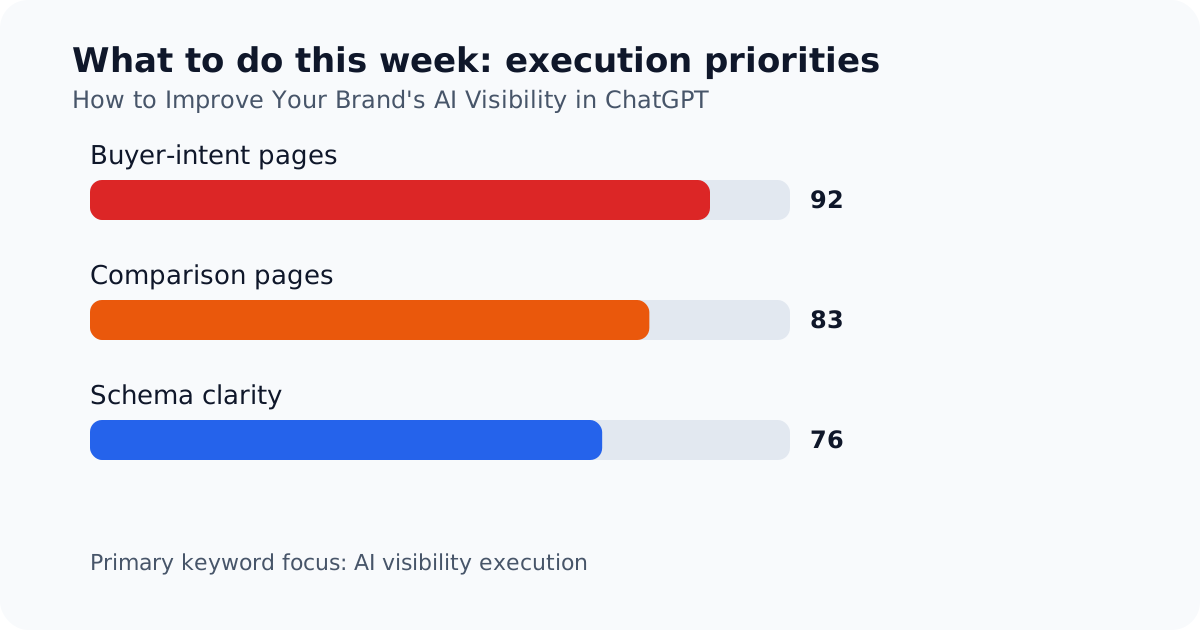 You do not need to implement the entire framework at once. Here are three high-impact tasks you can complete in the next five business days:
Task 1: Run your AI visibility audit. Spend 60 minutes running the audit prompts described in Step 1 across ChatGPT (and, if relevant to your audience, Google Gemini and Microsoft Copilot). Document what you find. This baseline will inform everything else you do. Use TryReadable's analyzer to make this faster and more systematic →
Task 2: Audit and update your review platform profiles. Log into your G2, Capterra, and Trustpilot profiles. Ensure your description matches your core positioning statement exactly. Add recent customer quotes if available. This is low-effort, high-impact work that can influence AI visibility within weeks.
Task 3: Identify three editorial targets. Make a list of three industry publications or "best of" articles in your category where your brand is not currently mentioned. Draft a short outreach email to the author or editor. Getting mentioned in even one high-authority article can meaningfully move your AI visibility over the following months.
FAQ
Does SEO still matter if I'm focused on AI visibility?
Yes—and the two disciplines are more complementary than they are in conflict. High-quality content that ranks well in search is also likely to be indexed and weighted by LLMs. The main difference is that AI visibility optimization places more emphasis on third-party mentions, entity clarity, and structured content, and less emphasis on keyword density and backlink volume for its own sake.
How often is ChatGPT's training data updated?
OpenAI does not publish a precise retraining schedule, but GPT-4 and subsequent models have training data cutoffs that are updated periodically. OpenAI's model documentation provides the most current information on knowledge cutoffs. This means that content you publish today may not influence ChatGPT's outputs for several months to over a year, depending on when the next training run occurs.
Can I directly submit content to OpenAI to influence ChatGPT?
No. OpenAI does not offer a mechanism for brands to directly submit content for inclusion in training data. The only way to influence AI visibility is to ensure your brand is well-represented in the publicly available content that LLMs are trained on.
What if ChatGPT is saying something inaccurate about my brand?
First, identify the source of the inaccuracy—it is likely originating from a specific piece of third-party content. Work to correct that content at the source. Second, publish authoritative, accurate content on your own channels that clearly states the correct information. Third, if the inaccuracy is significant, consider reaching out to OpenAI through their feedback mechanisms. Results are not guaranteed, but flagging clear factual errors is worthwhile.
Is AI visibility the same as "generative engine optimization" (GEO)?
The terms are used interchangeably by most practitioners. Researchers at Princeton and Georgia Tech published one of the first academic papers on GEO in 2023, defining it as "the process of optimizing content to increase its visibility in AI-generated responses." You can read the paper here. TryReadable uses "AI visibility" as a broader term that encompasses both the measurement and optimization of brand presence across AI systems.
How do I know if my AI visibility is improving?
The most reliable method is systematic, repeated auditing—running the same set of prompts over time and tracking changes in mention rate, positioning accuracy, and sentiment. TryReadable's platform automates this process and gives you a dashboard view of your AI visibility trends over time.
Does this apply to other AI tools beyond ChatGPT?
Yes. The same principles apply to Google Gemini, Microsoft Copilot, Perplexity, Claude, and other LLM-powered tools. The specific training data and weighting may differ, but the core signals—authoritative third-party content, consistent positioning, structured on-site content—are relevant across all major AI systems.
Sources
- Similarweb: ChatGPT Traffic Analysis
- SparkToro: Zero-Click Search Research
- Gartner: What Is Generative AI?
- OpenAI: ChatGPT Overview
- OpenAI: Model Documentation and Knowledge Cutoffs
- OpenAI: Usage Policies and Feedback
- arXiv: Generative Engine Optimization (GEO) Research Paper
- arXiv: How LLMs Encode Factual Associations
- G2: The Importance of B2B Software Reviews
- Wikipedia: Notability Guidelines
Start Measuring Your AI Visibility Today
AI visibility is not a future concern—it is a present competitive advantage. The brands that invest in it now will be the ones that appear in AI-generated recommendations when your buyers are making decisions. The brands that wait will find themselves invisible in a channel they cannot even see.
The first step is measurement. You cannot improve what you cannot see.
Ready to find out where your brand stands?
Analyze your AI visibility now →
Or, if you want a guided walkthrough of how TryReadable can help your team build a systematic AI visibility program: Book a demo →
This article is part of TryReadable's ongoing series on AI visibility for B2B brands. Browse all guides → | See the latest AI visibility reports →
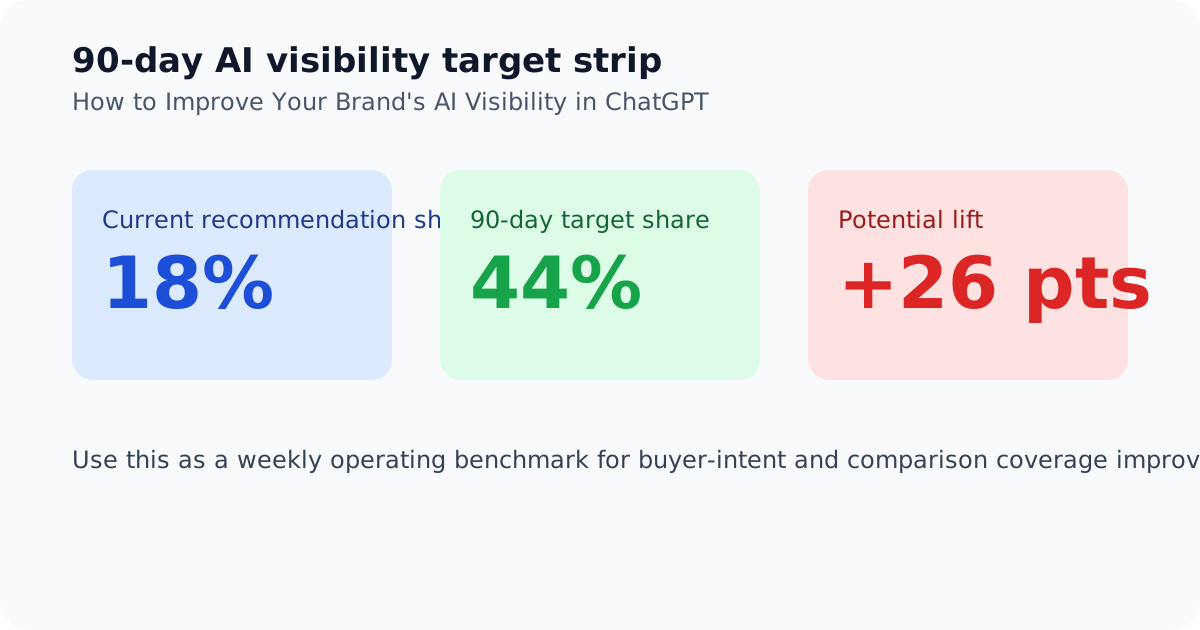
AI visibility trend snapshot
The chart below frames the opportunity cost of inaction over a 90-day operating window.
| Period | Indexed buyer queries covered | Estimated AI recommendation share |
|---|---|---|
| Current baseline | 3/9 | 18% |
| 30 days after fixes | 4/9 | 27% |
| 60 days after fixes | 5/9 | 35% |
| 90 days after fixes | 6/9 | 44% |
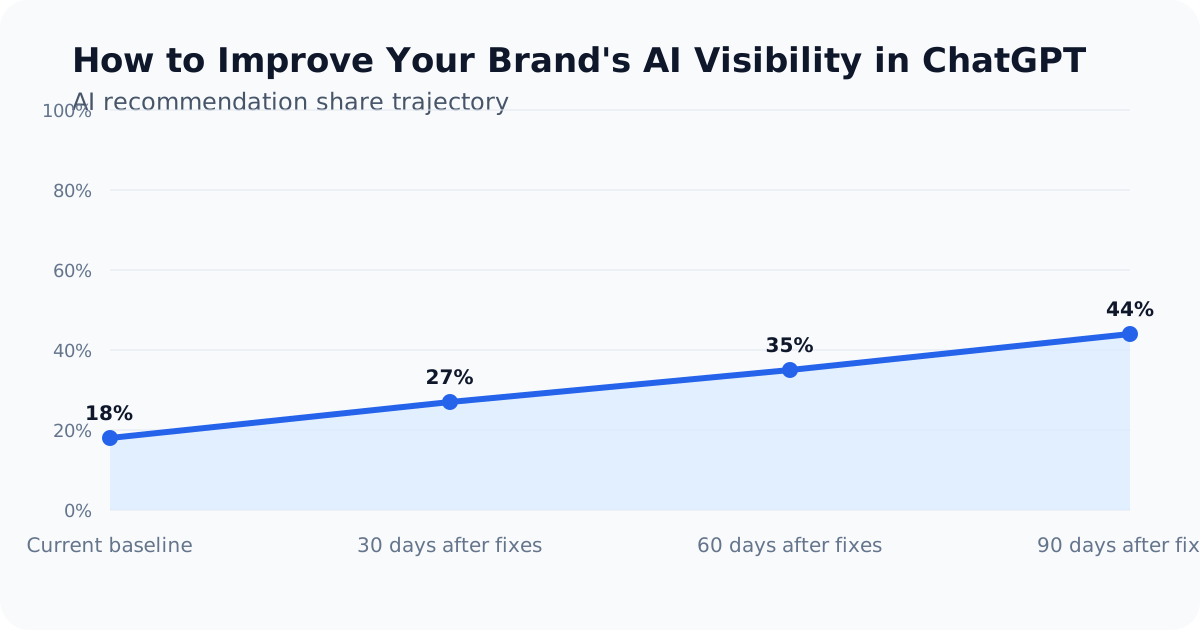
These values are an illustrative framework model to support planning and prioritization conversations.
Do you know why ChatGPT recommends competitors instead?
If your team wants to improve AI visibility, talk to us about the queries you miss, the competitors that show up, and the content that can close the gap.