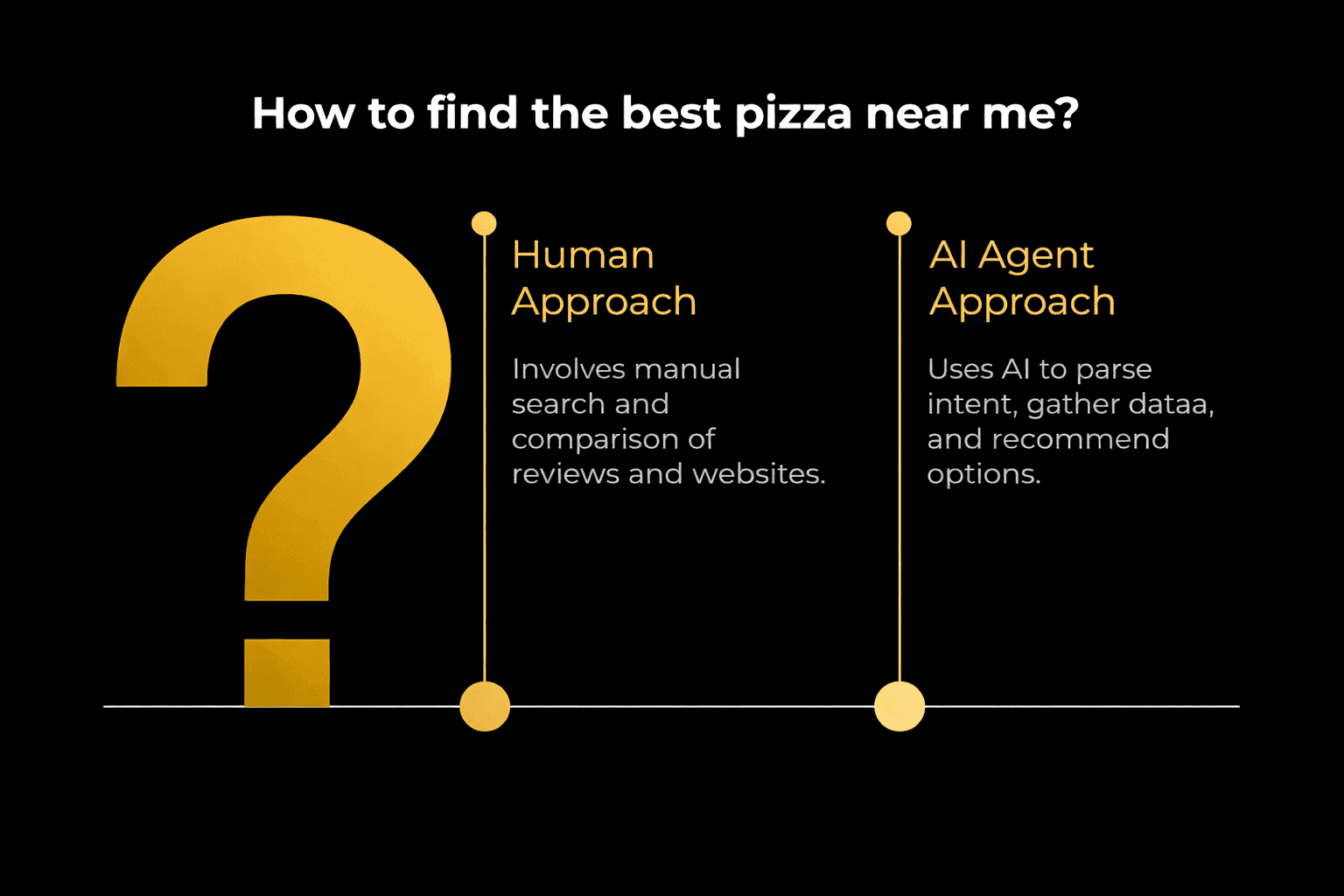
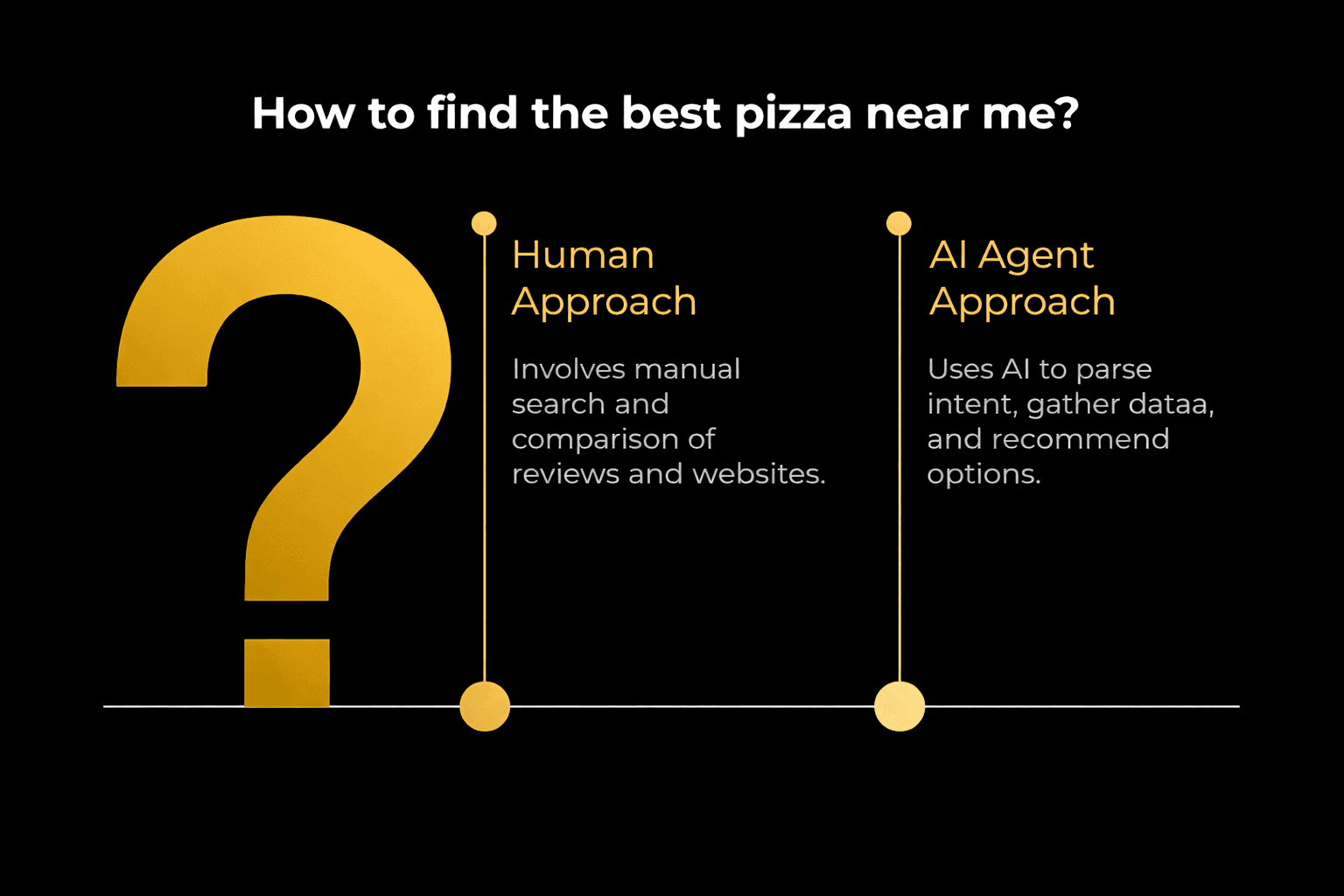
The traditional sales funnel — awareness, consideration, conversion — assumes humans actively navigate discovery, comparison, and purchase.
AI agents change that assumption.
In agent-mediated commerce, the buyer is an autonomous system. It interprets intent, selects products, and may even complete transactions on behalf of the user. This new model renders classic sales funnel metrics like pageviews, sessions, and conversion rate insufficient. The decision logic happens upstream of any human interaction.
This guide explains how AI agents interact with the sales funnel, what changes for businesses, and what leaders must do to remain visible and relevant in this new era.
How AI Agents Reshape the Sales Funnel
AI agents operate very differently from human shoppers. They do not:
- Browse category pages
- Interpret visual design
- Click CTAs or scroll carousels
- Fill forms manually
Instead, agents:
- Translate intent into structured constraints
- Retrieve data from validated sources
- Evaluate and filter options
- Execute actions programmatically
This reshapes the funnel into a set of logic stages rather than navigational steps.
Stage 1 — Intent Interpretation
Everything begins with a user expressing intent in natural language.
Examples include:
- “Find a business laptop with 32GB RAM under $2,000.”
- “Book a boutique hotel in Barcelona with free cancellation.”
The agent translates this intent into a structured plan with constraints. Successful interpretation is now the top priority metric, replacing surface metrics like session duration.
Stage 2 — Source Retrieval
Instead of crawling pages, agents rely on:
- Structured APIs
- Schema-exposed product data
- Trusted data platforms
- Verified metadata feeds
If your product truth is buried behind JavaScript, lacks structured schema, or is inconsistent, the agent may never retrieve it. This is a fundamental visibility risk that never shows up in traditional analytics.
Visibility now begins at the data layer.
Stage 3 — Evaluation and Ranking
Once data is collected, agents evaluate options using logic, not emotion.
They optimize for:
-
Constraint satisfaction
-
Real-time availability
-
Pricing clarity
-
Policy alignment
-
Fulfillment reliability
There is no subjective “stickiness” from branding or creative when the agent is ranking options. Data completeness and correctness determine inclusion and preference.
Stage 4 — Transaction Execution
When an agent commits to a purchase, it does not navigate checkout pages.
Instead, it triggers action through:
- API-driven add-to-cart flows
- Programmatic payment authorization
- Secure tokenized transactions
- Third-party execution protocols
Conversion is no longer a human action. It is a programmatic event triggered when constraints are met and systems are trusted.
Stage 5 — Post-Purchase Lifecycle
Agents may also manage:
- Order tracking
- Returns or exchanges
- Reorders or subscriptions
This extends the funnel into a continuous engagement loop that bypasses traditional customer journeys.
What Changes for Businesses
1. Upstream Visibility Becomes Paramount
If agents cannot retrieve your product truth, you never enter the funnel.
Structural clarity beats ranking signals.
2. Conversion Is Operational, Not Persuasive
No amount of design finesse matters if your APIs and transactional endpoints are brittle.
This shifts focus from UX to operational readiness.
3. Metrics Must Evolve
Traditional funnel metrics such as bounce rate or conversion rate collapse when there’s no UI.
Relevant metrics include:
- Retrieval success rate
- Constraint satisfaction scores
- Agent execution latency
- API reliability
- Selection frequency
These tell you whether agents can find, evaluate, and act on your commerce data.
Recommended Actions to Compete
Optimize Product Truth
Expose clean, structured, and complete data with consistent API schemas and schema markup.
Enable Agent-Ready Endpoints
Programmatic navigation, transaction initiation, and fulfillment confirmation must be callable with minimal friction.
Build Signal Reliability
Agents distrust inconsistent data. Ensure inventory, pricing, availability, policies, and delivery timelines are accurate and synchronized.
Establish Agent Telemetry
Without human sessions, you need visibility into:
- Inclusion in agent decision sets
- Match quality for each constraint
- Execution success or failures
- Response latency impacts
These become your new growth KPIs.
Strategic Implications
This shift affects how organizations measure and optimize demand:
- Marketing becomes data modeling
- Analytics becomes agent interaction analysis
- Product taxonomy becomes business logic
- Engineering becomes the frontline of conversion optimization
If you treat AI agents as a side channel, you’ll lose demand without noticing it.
Where Readable Fits
Readable gives teams real operational insight into how AI agents interact with their commerce ecosystem. Instead of guessing agent behavior, you see actual retrieval, matching, and execution results in live environments.
That gives you a real edge when the funnel is no longer visible through clicks and sessions.
The Bottom Line
AI agents rewrite the sales funnel. The buyer is no longer a person browsing a page. The decision process is a structured logic pathway driven by constraints, not curiosity.
To win in this era, businesses must optimize for machines first, then humans.
Do you know how AI agents are changing your funnel?
If buyers are delegating discovery and comparison, talk to us about the questions, pages, and proof points that decide whether your brand makes the shortlist.