Table of contents
- Search Is a Performance Channel. AI Is a Brand Channel.
- How SEO Content Is Written vs How AEO Content Must Be Written
- What AI Tools Actually Look for When They Talk About Your Brand
- The AEO Content Strategy Playbook for Founders and Marketers
- Why Comparison Content Performs Well in AEO
- How to Choose AEO Content Software: Diagnostic Depth vs Recommendation Quality
- Building a Business Case for AEO Investment
- How TryReadable Helps You Build Content AI Tools Actually Understand
- FAQ: AEO vs SEO Content Strategy
AEO Content vs SEO Content Strategies: Why the Rules Have Changed
There is a quiet shift happening in how people discover and evaluate products. A growing number of buyers are skipping Google entirely and going straight to ChatGPT, Gemini, or Perplexity with questions like "what is the best tool for managing customer onboarding" or "which platforms help SaaS companies reduce churn." They get an answer. They form an opinion. They may never visit your website.
If your content strategy is still built entirely around Google rankings, you are optimizing for a channel that is no longer the only one that matters. And more importantly, you may be completely invisible on the channels that are shaping brand perception right now.
This article is for founders and marketers who want to understand the real difference between AEO (Answer Engine Optimization) content and SEO content, why those differences matter, and what a practical AEO content strategy actually looks like in 2025.
Search Is a Performance Channel. AI Is a Brand Channel.
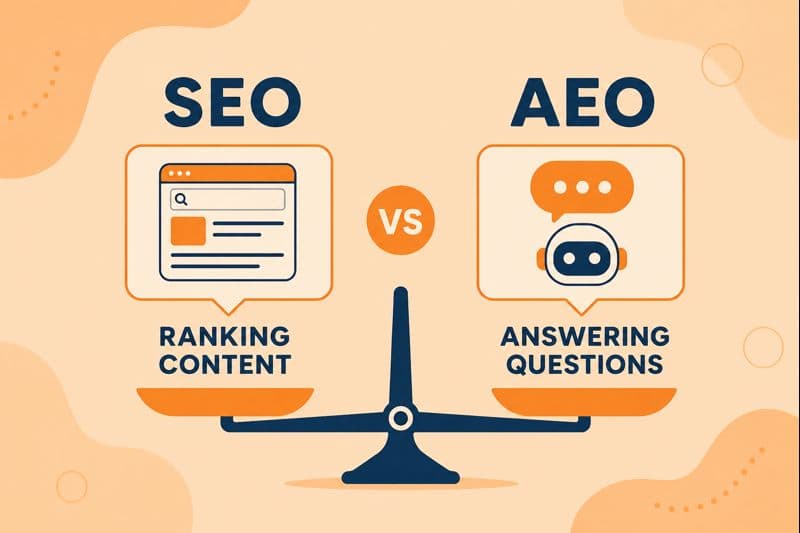
To understand why AEO content requires a fundamentally different approach, you first need to internalize one distinction: Google Search is a performance channel. AI tools are a brand channel.
These are not just different platforms. They operate on completely different logic, reward completely different behaviors, and serve completely different purposes in your marketing stack.
Google Search: The Performance Channel
Google Search is built around intent and conversion. When someone types a query into Google, they are signaling a specific need, and Google's job is to surface the most relevant results. Your job, as a marketer, is to earn the click.
This is why SEO content is engineered the way it is. Titles are written to generate curiosity. Meta descriptions are crafted to promise value and compel action. Rankings are conversion levers. The entire system is optimized around getting a human to choose your result over the nine others on the page.
Google's own documentation on how Search works makes this clear: the system evaluates relevance, quality, and usability, but the ultimate measure of success for a publisher is whether users click through and find what they were looking for.
In performance marketing terms, SEO is a funnel. You optimize for impressions, then clicks, then conversions. Every metric is trackable. Every improvement is measurable.
AI Tools: The Brand Channel
AI tools like ChatGPT, Gemini, and Perplexity operate on entirely different logic. When someone asks Gemini "what is the best tool for X," Gemini does not show them ten blue links and let them choose. It synthesizes an answer. It describes products, compares options, and makes recommendations, all in natural language, all without the user ever clicking anywhere.
This is a zero-click environment. The user forms an opinion about your brand based entirely on how the AI describes you. There is no title to optimize for curiosity. There is no meta description to entice a click. There is only the AI's understanding of what your product does, who it serves, and why it matters.
Think about what this means for brand perception. If someone asks ChatGPT about tools in your category and the AI describes your competitor clearly and accurately but describes your product vaguely or incorrectly, you have lost a brand impression without ever knowing it happened.
This is why AI tools are brand channels, not performance channels. They function more like PR, word-of-mouth, or analyst coverage than like paid search or organic rankings. You are not optimizing for traffic. You are optimizing for how you are understood.
Perplexity's approach to answer generation and the broader shift toward AI-generated answers has been well documented. A 2024 analysis from SparkToro found that a significant portion of searches already end without a click, and that number is growing as AI-generated overviews become more common in Google itself.
The implication is straightforward: brand perception is increasingly being formed in environments where you have no click-through data, no conversion tracking, and no direct feedback loop. The only lever you have is the quality and clarity of the content AI tools use to understand your brand.
How SEO Content Is Written vs How AEO Content Must Be Written
The tactical differences between SEO content and AEO content are significant. Let's make them concrete.
SEO Content: Written to Win Clicks
Consider a typical SEO title: "10 Best Project Management Tools in 2025 (Ranked and Reviewed)."
This title is engineered for performance. The number creates a list expectation. The year signals freshness. The parenthetical adds credibility. Every element is designed to make a human scanning a search results page choose this result over the others.
The meta description for this article might read: "Struggling to find the right project management tool? We tested 10 top options so you don't have to. See which one made the top spot."
Again, every word is doing conversion work. The question creates identification. The promise of saved effort reduces friction. The teaser creates curiosity.
This is excellent SEO content. It will earn clicks. It will drive traffic. It serves its purpose on a performance channel perfectly.
AEO Content: Written to Be Understood
Now consider what happens when someone asks ChatGPT: "What are the best project management tools for remote teams?"
ChatGPT does not care about your title. It does not read your meta description. It is looking at the substance of your content and asking: can I accurately summarize what this product does, who it is for, and why someone would choose it?
If your website says "we help teams work better together" and your blog posts are full of curiosity-gap headlines and vague value propositions, the AI has very little to work with. It may mention you briefly, describe you inaccurately, or skip you entirely in favor of a competitor whose content is clearer.
AEO content for the same product would look very different. Instead of "10 Best Project Management Tools," the content would clearly state: "Asana is a project management platform designed for teams of 10 to 500 people who need to coordinate work across multiple departments. It is particularly well suited for marketing and operations teams that run recurring workflows and need visibility across projects without requiring everyone to be in the same tool."
That is not a great SEO title. But it is exactly what an AI model needs to accurately represent that product in a conversational answer.
The Specific Patterns That Hurt AEO
Several common SEO content patterns actively damage AEO performance:
Clickbait headlines. Titles designed to create curiosity gaps ("You Won't Believe What This Tool Can Do") give AI models nothing useful to work with. They are optimized for human psychology, not machine comprehension.
Keyword stuffing. Repeating your primary keyword fifteen times in an article may still help with some SEO signals, but AI models prioritize coherence and factual density. Content that reads unnaturally because of keyword repetition is harder for AI to summarize accurately.
Vague value propositions. "We help businesses grow" is useless for AEO. It tells an AI model nothing specific about what you do, who you serve, or how you are different. Research on how large language models process and summarize content consistently shows that specificity and declarative clarity improve the accuracy of AI-generated summaries.
Thin content. A 300-word blog post optimized for a long-tail keyword may rank on Google, but it gives AI models almost nothing to synthesize. AEO rewards depth and factual richness.
The core principle is this: SEO content is written to make humans click. AEO content is written to make AI models understand. These are different cognitive tasks, and they require different writing strategies.
What AI Tools Actually Look for When They Talk About Your Brand
Understanding what AI tools look for when they synthesize brand information is essential for building an effective AEO content strategy. The mechanics are different from Google's ranking algorithm, but they are not mysterious.
Where AI Models Get Their Information
AI tools like ChatGPT, Gemini, and Perplexity pull from publicly available content. This includes your website, your documentation, your help center, reviews on third-party platforms like G2 and Capterra, press coverage, case studies, and any other content that is publicly indexed.
OpenAI has described how its models are trained on large corpora of web content, and tools like Perplexity explicitly retrieve and cite web sources in real time. This means the totality of your public content footprint shapes how AI tools understand and describe your brand.
This is fundamentally different from SEO, where you can focus your optimization efforts on a specific set of pages and keywords. For AEO, every piece of public content is a signal. Your homepage, your about page, your blog posts, your case studies, your G2 reviews, your press releases, your LinkedIn posts, your documentation, all of it contributes to the AI's understanding of your brand.
What Signals AI Models Prioritize
Based on how large language models process and summarize content, several patterns consistently improve AEO performance:
Structured, declarative sentences. AI models are much better at extracting and summarizing information that is written in clear, direct statements. "TryReadable is an AI knowledge base platform that helps SaaS founders control how AI tools describe their product" is far more useful to an AI than "We are passionate about helping innovative companies tell their story in the age of AI."
Specific, verifiable claims. Vague positioning gets ignored. Precise statements get remembered. "We help SaaS founders reduce churn by improving onboarding clarity" gives an AI model something specific to work with. "We help businesses grow" does not.
Consistent narrative across sources. If your homepage says you are a project management tool, your G2 profile says you are a collaboration platform, and your press coverage describes you as a productivity app, AI models encounter conflicting signals. This dilutes your brand representation and can result in inaccurate or inconsistent descriptions across different AI tools.
Depth and factual richness. AI models synthesize information, which means they need enough substance to work with. A single, well-structured page that thoroughly explains your product, its use cases, its differentiators, and its target audience gives AI models far more to work with than ten thin blog posts.
Third-party validation. Reviews, case studies, and earned media coverage carry significant weight because they represent independent confirmation of your brand claims. G2's research on buyer behavior consistently shows that third-party reviews influence purchase decisions, and the same logic applies to AI model training: independent sources that describe your product accurately reinforce your brand signal.
The Consistency Problem
One of the most common AEO mistakes is inconsistent brand messaging across public content. This happens for understandable reasons: your website was written two years ago, your help docs were written by a different team, your press releases use slightly different language, and your G2 profile was set up by someone who has since left the company.
For SEO, this inconsistency is annoying but manageable. For AEO, it is a serious problem. AI models that encounter conflicting descriptions of your product will either average them into something vague or default to whichever description appears most frequently and authoritatively.
The solution is to treat your brand narrative as a single, consistent asset that needs to be maintained across all public-facing content. This is one of the core problems that TryReadable's AI knowledge base is designed to solve.
The AEO Content Strategy Playbook for Founders and Marketers
Building an AEO content strategy from scratch requires a different mindset from traditional SEO planning. Here is a practical playbook for founders and marketers who want to start influencing how AI tools represent their brand.
Step 1: Write Your AEO Anchor Statement
Before you create any AEO content, you need a single, clear, jargon-free brand definition that answers three questions:
- What do you do?
- Who do you serve?
- What makes you different?
This is not your marketing tagline. It is not your elevator pitch. It is a precise, declarative statement that an AI model could use to accurately describe your product in a conversational answer.
A weak AEO anchor statement: "We help teams collaborate more effectively with AI-powered tools."
A strong AEO anchor statement: "TryReadable is an AI knowledge base platform that helps SaaS founders and marketers control how AI tools like ChatGPT and Perplexity describe their product, by giving them a structured, accurate source of brand information that AI models can reliably reference."
The strong version is specific about the product category, the target audience, the problem being solved, and the mechanism. An AI model can work with that. It cannot work with the weak version.
Once you have your AEO anchor statement, it should appear verbatim or near-verbatim on your homepage, your about page, your help documentation, and any other high-authority public content you control.
Step 2: Map the Questions Your Audience Asks AI Tools
The next step is to identify the specific questions your target audience is asking AI tools in your category. These are not keyword research queries in the traditional sense. They are conversational questions that someone would type into ChatGPT or Perplexity.
Examples for a SaaS onboarding tool:
- "What is the best tool for improving SaaS onboarding?"
- "How do I reduce churn in my SaaS product?"
- "What tools help with user activation in B2B SaaS?"
For each of these questions, you want to create content that answers the question clearly and positions your product accurately within the answer. The content should be written the way an AI would want to summarize it: structured, specific, and factually dense.
This is different from SEO keyword research, where you are looking for search volume and competition metrics. For AEO, you are looking for the questions that shape brand perception in your category.
Step 3: Prioritize Depth Over Volume
One of the most counterintuitive aspects of AEO content strategy is that volume matters much less than depth. For SEO, publishing frequently can help you capture more long-tail keywords and build topical authority. For AEO, a single well-structured, factually rich page is worth more than ten thin blog posts.
This is because AI models are synthesizing information, not indexing keywords. They need enough substance to form an accurate understanding of your product. A comprehensive guide to your product's use cases, written in clear declarative language with specific examples, gives AI models far more to work with than a collection of short posts optimized for individual keywords.
Research on how AI models handle long-form content suggests that structured, well-organized documents with clear headings and logical flow are easier for models to process and summarize accurately. This aligns with good content design principles generally, but it is especially important for AEO.
Step 4: Build an AI-Readable Knowledge Base
The most powerful thing you can do for your AEO content strategy is to consolidate your product information, use cases, differentiators, and brand narrative into a single, structured, publicly accessible knowledge base.
Think of this as the AEO equivalent of a well-optimized website architecture for SEO. Just as you would organize your site structure to help Google crawl and index your content efficiently, you want to organize your brand information to help AI models find and synthesize it accurately.
This knowledge base should include:
- A clear product definition (your AEO anchor statement)
- Detailed use case descriptions for each customer segment
- Specific differentiators with evidence or examples
- Common questions and clear answers
- Case studies with specific, verifiable outcomes
- Consistent terminology used across all sections
This is exactly what TryReadable's AI knowledge base is designed to help you build. Instead of hoping that AI tools scrape the right page from your website, you give them a single, well-organized source of truth about your brand.
Step 5: Distribute Your Brand Narrative Consistently
The final step is to ensure that your AEO anchor statement and core brand narrative appear consistently across all your public-facing content. This includes:
- Your website (homepage, about page, product pages)
- Your help documentation and knowledge base
- Your G2, Capterra, and other review platform profiles
- Your press releases and earned media coverage
- Your case studies and customer stories
- Your LinkedIn company page and executive profiles
Consistency is the multiplier. Every additional source that accurately describes your product reinforces the signal that AI models use to represent your brand. Every inconsistency dilutes it.
If you want to see how AI tools are currently describing your brand, the simplest approach is to query ChatGPT, Gemini, and Perplexity directly with the questions your customers would ask. The answers will tell you exactly where your AEO content strategy needs work. You can also use TryReadable's analysis tools to get a structured view of how your brand is being represented across AI channels.
Why Comparison Content Performs Well in AEO
One of the clearest patterns in how AI tools answer questions is that they frequently synthesize comparisons. When a user asks "what is the best tool for X," the AI rarely names a single winner. It describes several options, explains the differences, and helps the user decide based on their situation.
This means comparison content is disproportionately useful for AEO, for two reasons.
First, AI models are actively looking for structured comparison information when they construct these answers. A page that clearly explains how your product differs from a named competitor, written in specific declarative language, gives the AI exactly the material it needs to include you accurately in a comparison answer.
Second, comparison queries tend to come from buyers who are close to a decision. Someone asking "how does tool A compare to tool B" has already narrowed their consideration set. Being accurately represented in that answer matters more than being mentioned vaguely in a broad category overview.
What Makes Comparison Content Work for AEO
Effective AEO comparison content has several characteristics that differ from typical SEO comparison posts:
It names the comparison explicitly. Rather than burying the comparison in a listicle, the content directly addresses the specific pairing: "How TryReadable differs from [competitor]" or "TryReadable vs [competitor]: which is better for AEO content optimization."
It uses structured, parallel language. AI models extract comparison information more reliably when the two options are described using consistent attributes. If you describe your product by use case, pricing model, and target team size, describe the competitor the same way.
It makes specific, defensible claims. "TryReadable focuses on AI brand representation while [competitor] focuses on SEO keyword tracking" is a specific claim an AI can use. "TryReadable is better" is not.
It acknowledges genuine trade-offs. AI models are trained on a wide range of sources and tend to produce more balanced answers than pure marketing copy. Comparison content that acknowledges where a competitor is stronger in certain scenarios is more credible and more likely to be used accurately by AI tools.
It is written for the question, not the keyword. The question "which is better for AEO content optimization" is different from the keyword "AEO content tool comparison." Write the content to answer the question a buyer would actually ask an AI, not to rank for a keyword variant.
Comparison Content as a Content Marketing Strategy for Both SEO and AEO
Comparison content is one of the few content types that serves both channels well. For SEO, comparison queries have clear commercial intent and often carry meaningful search volume. For AEO, comparison content gives AI models the structured, specific information they need to represent your product accurately in head-to-head answers.
If you are building a content marketing strategy that needs to work for both SEO and AEO, comparison content is one of the highest-leverage investments you can make. A well-structured comparison page that clearly explains your positioning relative to two or three named competitors will earn organic traffic from Google and improve your representation in AI-generated answers simultaneously.
How to Choose AEO Content Software: Diagnostic Depth vs Recommendation Quality
As AEO has become a recognized discipline, a growing number of tools claim to help with it. The two most important dimensions to evaluate when choosing between AEO platforms are diagnostic depth and content recommendation quality. These are not the same thing, and prioritizing the wrong one for your situation will lead to wasted investment.
What Diagnostic Depth Means
Diagnostic depth refers to how thoroughly a platform can tell you what is currently happening with your brand in AI channels. A platform with strong diagnostic depth can answer questions like:
- How is my brand currently described by ChatGPT, Gemini, and Perplexity?
- Where are the inaccuracies or gaps in how AI tools represent my product?
- Which competitors are being mentioned more frequently or more accurately than my brand?
- Which of my content assets are being referenced by AI tools, and which are being ignored?
Diagnostic depth is most valuable when you are starting an AEO program and need to understand your baseline, or when you suspect your brand is being misrepresented but cannot pinpoint where the problem is. It is also valuable for ongoing monitoring, so you can detect changes in how AI tools describe your brand before they affect pipeline.
What Content Recommendation Quality Means
Content recommendation quality refers to how actionable and specific a platform's guidance is for improving your AEO performance. A platform with strong content recommendation quality can answer questions like:
- What specific changes should I make to my homepage to improve how AI tools describe my product?
- What new content should I create to fill gaps in my AEO coverage?
- How should I structure a comparison page to maximize its usefulness to AI models?
- Which existing content assets should I prioritize for AEO optimization?
Content recommendation quality is most valuable when you already have a reasonable understanding of your AEO baseline and need to know what to do next. It is also more valuable for teams that have limited content resources and need to prioritize high-impact changes over broad audits.
Which Should You Prioritize?
The honest answer is that the right priority depends on where you are in your AEO program.
If you are early in building an AEO strategy and do not yet have a clear picture of how AI tools currently represent your brand, prioritize diagnostic depth first. You cannot make good content decisions without understanding your baseline.
If you already have diagnostic visibility and the bottleneck is knowing what to change and how, prioritize content recommendation quality. Detailed, specific guidance on what to write and how to structure it is more valuable than additional diagnostic data you already have.
For most teams, the ideal platform provides both, but the depth of each capability varies significantly between tools. When evaluating options, ask vendors to show you a specific example of a diagnostic output and a specific example of a content recommendation for the same brand. The specificity and actionability of those examples will tell you more than any feature list.
A Note on Comparing Specific AEO Platforms
Several platforms have emerged in the AEO space, including tools focused on AI brand monitoring, AI citation tracking, and AEO-specific content optimization. Because this category is evolving quickly and platform capabilities change frequently, any specific comparison of named tools risks being outdated within months of publication.
The most reliable approach is to evaluate platforms against the two dimensions above, using your own brand as the test case. Ask each platform to analyze your current AEO performance and provide a sample recommendation. The quality of that output is the most reliable signal of whether the platform will deliver value for your specific situation.
Building a Business Case for AEO Investment
For SEO directors and content leaders who need to justify AEO investment to a CMO or executive team, the challenge is that AEO lacks the established measurement frameworks that make SEO easy to quantify. There is no AEO equivalent of organic traffic, keyword rankings, or domain authority that you can point to in a dashboard.
This does not mean the business case is weak. It means you need to frame it differently.
Frame AEO as Brand Channel Investment, Not Traffic Investment
The most effective framing for an AEO business case is to position it alongside other brand channel investments: PR, analyst relations, review platform management, and thought leadership. These are all investments in how your brand is perceived and described in channels where you do not control the output directly.
AEO fits this category precisely. You are investing in ensuring that AI tools, which are increasingly influential in B2B buyer research, describe your product accurately and favorably. The return is not measured in clicks. It is measured in brand representation quality and share of consideration in AI-generated answers.
If your organization already invests in PR or analyst relations, the logic for AEO investment is identical. The channel is different, but the mechanism is the same: you are shaping how influential third parties describe your brand to potential buyers.
Quantify the Channel's Reach
One concrete element you can include in an AEO business case is an estimate of how frequently AI tools are being used in your buyers' research process. You can gather this data through customer interviews, win/loss analysis, or by asking prospects directly whether they used AI tools to research vendors before engaging with your sales team.
If even a fraction of your pipeline is influenced by AI-generated brand descriptions, the investment in ensuring those descriptions are accurate and favorable has a clear return. The cost of being misrepresented or absent in AI answers is a lost brand impression at a high-intent moment in the buyer journey.
Position AEO as a Complement to SEO, Not a Replacement
A common objection to AEO investment is that it competes with existing SEO budget. The most effective response is to show that AEO and SEO address different channels and different moments in the buyer journey, and that the content investments required for AEO often strengthen SEO performance as well.
Specifically, the structured, factually rich content that performs well for AEO also tends to perform well under Google's helpful content guidelines. Investing in a well-organized knowledge base, clear product definitions, and specific comparison content creates assets that serve both channels simultaneously.
The incremental investment required for AEO, beyond what you are already spending on SEO, is primarily in content structure and brand narrative consistency, not in creating entirely new content from scratch.
Identify a Measurable Pilot
Rather than asking for a large budget commitment upfront, propose a defined pilot with measurable outcomes. A reasonable AEO pilot might involve:
- Auditing how your brand is currently described by three major AI tools (ChatGPT, Gemini, Perplexity)
- Identifying the top three inaccuracies or gaps in those descriptions
- Creating or updating specific content assets to address those gaps
- Re-auditing after 90 days to measure improvement in description accuracy
This gives you a concrete before-and-after comparison that demonstrates the value of AEO investment without requiring a large upfront commitment. It also builds internal familiarity with AEO measurement approaches, which makes future budget conversations easier.
How TryReadable Helps You Build Content AI Tools Actually Understand
Understanding the difference between AEO and SEO content strategy is one thing. Executing it is another. This is where TryReadable comes in.
The Core Problem TryReadable Solves
Most brands have their product information scattered across dozens of pages, written in different styles, by different people, at different times. Their homepage says one thing. Their help docs say another. Their blog posts use different terminology. Their G2 profile was last updated eighteen months ago.
When AI tools try to synthesize information about these brands, they encounter a fragmented, inconsistent picture. The result is brand descriptions that are vague, inaccurate, or incomplete. And because the brand has no visibility into what AI tools are saying about them, they have no way to know this is happening or to fix it.
TryReadable solves this by giving founders and marketers a structured way to build and maintain an AI knowledge base: a single, well-organized source of brand truth that AI tools can reliably reference when answering questions about your product.
What TryReadable's AI Knowledge Base Does
Think of TryReadable's AI knowledge base as the AEO equivalent of optimizing your meta tags for Google. When you optimize your meta tags, you are giving Google's crawlers clear, accurate signals about what each page is about. When you build an AI knowledge base with TryReadable, you are giving AI tools clear, accurate signals about what your brand is about.
Specifically, TryReadable helps you:
Structure your brand narrative. Instead of leaving AI tools to piece together your brand story from scattered pages, TryReadable gives you a structured format for defining what you do, who you serve, and what makes you different, in the clear, declarative language that AI models process most effectively.
Consolidate your product information. Use cases, differentiators, pricing context, customer segments, and competitive positioning can all be organized in a single, accessible knowledge base that AI tools can reference consistently.
Maintain narrative consistency. TryReadable helps you ensure that the same core brand narrative appears consistently across all your public-facing content, eliminating the conflicting signals that dilute your AEO performance.
Monitor how AI tools describe your brand. TryReadable gives founders visibility into how AI tools are currently representing their product, so they can identify gaps and inaccuracies before they affect brand perception at scale.
The Practical Impact for Founders
For a founder, the practical impact of TryReadable is straightforward: when someone asks ChatGPT or Perplexity about tools in your category, your product is described the way you intend it to be described.
This is not a small thing. Brand perception formed in AI channels is increasingly influencing purchase decisions, especially in B2B SaaS where buyers are sophisticated and do extensive research before engaging with a vendor. If AI tools are describing your product inaccurately or not mentioning it at all, you are losing brand impressions in a channel you cannot see.
TryReadable gives you control over that channel. Not by gaming AI systems or trying to manipulate outputs, but by ensuring that the public content AI tools use to understand your brand is clear, accurate, consistent, and comprehensive.
If you want to see how your brand is currently being represented in AI channels and understand what an AI knowledge base could do for your AEO strategy, book a demo with TryReadable or explore how other brands are using it.
You can also start by analyzing your current content to see where your AEO gaps are and what specific improvements would have the most impact on how AI tools describe your product.
FAQ: AEO vs SEO Content Strategy
What are the key differences between AEO and SEO content strategy?
The core difference is the audience for the content. SEO content is written to persuade a human to click. AEO content is written to help an AI model understand and accurately represent your brand.
In practice, this means SEO content prioritizes compelling titles, meta descriptions, and click-through signals, while AEO content prioritizes declarative clarity, factual specificity, and consistent brand narrative across all public sources. SEO success is measured in traffic and rankings. AEO success is measured in how accurately and favorably AI tools describe your brand when answering questions in your category.
The two strategies are not mutually exclusive. Well-structured, factually rich content tends to perform reasonably well in both channels. But the strategic intent and specific tactics differ enough that treating them as identical will result in content that does neither job well.
Do I need to choose between AEO and SEO, or can I do both?
You need both, but they require separate strategies and, in many cases, separate content assets. SEO content is optimized for human click behavior on Google. AEO content is optimized for AI comprehension and accurate brand representation. These goals are not always in conflict, but they are not the same, and treating them as identical will result in content that does neither job well.
The good news is that well-structured, factually rich content tends to perform reasonably well in both channels. Clear writing, logical organization, and specific claims help both Google's quality assessments and AI model comprehension. But the strategic intent, the specific tactics, and the success metrics are different for each channel, and you need to plan for both explicitly.
For most founders and marketers, the practical approach is to maintain your existing SEO content strategy while building a parallel AEO content layer: an AI knowledge base, consistently updated brand narrative, and AEO-optimized content assets that are specifically designed to influence how AI tools represent your brand.
Does AEO content hurt my SEO rankings?
No. Clear, well-structured, factually rich content tends to perform well in both channels. Google's quality guidelines, particularly the helpful content guidelines introduced in recent algorithm updates, reward exactly the kind of content that also performs well for AEO: specific, accurate, well-organized, and genuinely useful to the reader.
What you want to avoid is creating content that is so stripped of personality and narrative that it reads like a machine-generated fact sheet. Good AEO content is clear and specific, but it can still be engaging and well-written. The goal is not to write for machines at the expense of humans. It is to ensure that the substance of your content is clear enough for both humans and AI models to understand accurately.
What software shows the difference between SEO and AEO for content strategy?
The most direct way to see the difference in practice is to compare two outputs side by side: a Google Search results page for a query in your category, and a ChatGPT or Perplexity answer to the same query phrased conversationally.
The Google results page will show you which content is winning clicks based on title and meta description quality. The AI answer will show you which brands are being described accurately and favorably based on the clarity and consistency of their public content.
For a more structured analysis, tools like TryReadable are specifically designed to show you how AI tools currently represent your brand and where your AEO content gaps are. This gives you a concrete starting point for understanding what changes to your content strategy would improve your AEO performance without disrupting your existing SEO work.
When evaluating any AEO platform, the two most important dimensions are diagnostic depth (how clearly it shows you your current AI brand representation) and content recommendation quality (how specific and actionable its guidance is for improvement). See the section above on choosing between AEO platforms for a more detailed breakdown.
How do I know if AI tools are already talking about my brand?
The simplest approach is to query ChatGPT, Gemini, and Perplexity directly with the questions your customers would ask. Try queries like:
- "What is [your product name]?"
- "What are the best tools for [your category]?"
- "How does [your product] compare to [competitor]?"
- "Who should use [your product]?"
Pay attention to how accurately each tool describes your product, whether it mentions you at all in category queries, and whether the descriptions are consistent across tools. Inconsistencies between tools often indicate conflicting signals in your public content.
You can also use TryReadable's analysis tools to get a more structured view of how your brand is being represented across AI channels and identify specific gaps in your AEO content strategy.
How long does it take for AEO content to influence AI outputs?
This depends on several factors, including how quickly AI models index and update their training data, how authoritative your content sources are, and how consistently your brand narrative appears across public content.
For tools like Perplexity that retrieve content in real time, improvements to your public content can influence outputs relatively quickly, sometimes within days or weeks of publication. For models like ChatGPT that rely on training data with periodic updates, the timeline is longer and less predictable.
The most important thing to understand is that AEO is not a one-time optimization. It is an ongoing content practice, similar to how SEO requires continuous effort to maintain and improve rankings. Building a consistent, accurate, and comprehensive public content footprint is a long-term investment in how AI tools understand and represent your brand.
Research on how AI models update their knowledge suggests that consistent, high-quality content from authoritative sources builds signal over time, even when the exact timing of model updates is unpredictable. The brands that start building their AEO content strategy now will have a significant advantage as AI tools become an increasingly important channel for brand discovery and evaluation.
Why does comparison content perform well in AEO specifically?
AI tools are frequently asked to compare options, and they construct those answers by synthesizing comparison information from public content. A page that clearly explains how your product differs from a named competitor, written in specific declarative language, gives the AI exactly the material it needs to include you accurately in a comparison answer.
Comparison content also tends to come from buyers who are close to a decision, which makes accurate representation in those answers particularly valuable. If an AI tool describes your product inaccurately in a head-to-head comparison, you lose consideration at a high-intent moment in the buyer journey.
The structural characteristics that make comparison content effective for AEO are: explicit naming of the comparison, parallel language for both options, specific and defensible claims, acknowledgment of genuine trade-offs, and content written to answer the question a buyer would ask rather than to rank for a keyword. See the dedicated section above for a full breakdown.
Is AEO only relevant for B2B brands?
AEO is relevant for any brand that wants to control how AI tools describe them, but it is particularly urgent for B2B SaaS companies. B2B buyers are sophisticated researchers who increasingly use AI tools to shortlist vendors before ever engaging with a sales team. If AI tools are describing your product inaccurately or not mentioning it in category queries, you are losing consideration at the top of the funnel in a channel you cannot see.
That said, B2C brands, professional services firms, and even individual creators and consultants can benefit from AEO content strategy. Any brand that wants to be accurately represented in AI-generated answers needs to think about how AI tools understand them, not just how Google ranks them.
The shift from search-first to AI-first discovery is not coming. It is already here. Founders and marketers who recognize that AI tools are brand channels, not performance channels, and who build content strategies accordingly, will have a significant advantage in the years ahead.
The rules have changed. The content strategy needs to change with them.
If you are ready to start building an AEO content strategy for your brand, explore TryReadable's guides or book a demo to see how the AI knowledge base works in practice.
Sources
Is your content strategy invisible to AI answer engines?
Most B2B content is still optimized for Google clicks, not for how AI tools actually understand and describe your brand to buyers who never visit your site.