What you'll learn
- A practical framework to execute win AI buyer intent queries without waiting on large replatforming projects.
- How to prioritize high-impact fixes that improve AI discoverability first.
- Which signals AI assistants rely on when recommending vendors in buyer journeys.
- How to turn visibility insights into weekly execution tasks for marketing and growth teams.
- The metrics leadership should review to track progress and defend budget decisions.
- Common traps that create activity without improving recommendation outcomes.
How to Win AI Buyer-Intent Queries Against Competitors
There is a new front in B2B marketing, and most companies are losing it without even knowing the battle has started.
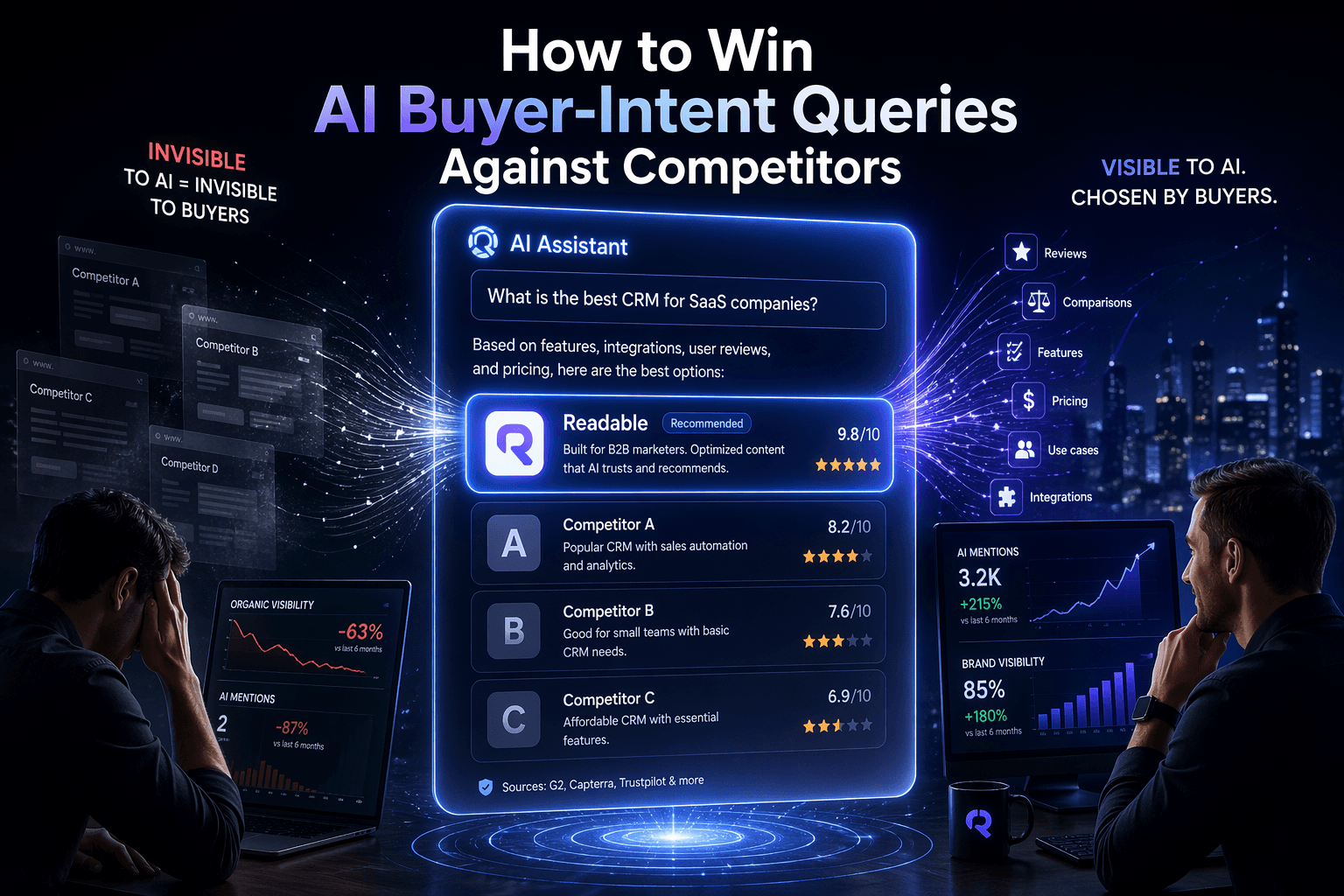
When a potential buyer opens ChatGPT, Perplexity, Google Gemini, or Claude and types something like "what is the best project management software for remote teams" or "which CRM should a 50-person SaaS company use," an AI assistant generates a confident, structured answer. That answer names specific products. It recommends specific vendors. It shapes the buyer's shortlist before they ever visit a website, read a review, or talk to a sales rep.
If your brand is not in that answer, you are invisible at the most critical moment in the buying journey.
This is the challenge of AI buyer-intent queries, and it is fundamentally different from traditional SEO. You are not competing for a blue link on a results page. You are competing to be cited, recommended, or described by a language model that has synthesized thousands of sources into a single, authoritative-sounding response.
The good news is that this is a winnable game. The companies that understand how AI systems select and surface information can engineer their content, their authority signals, and their digital presence to consistently appear in AI-generated buying recommendations. This article gives you the complete framework to do exactly that.
What You Will Learn
- Why AI buyer-intent queries are different from traditional search and why they matter more for B2B revenue
- How large language models and AI search tools decide which brands to recommend
- A step-by-step framework for auditing your current AI visibility and closing the gaps
- The specific content formats, structures, and signals that increase your chances of being cited
- Common mistakes that cause brands to disappear from AI recommendations even when they rank well in traditional search
- Three concrete actions you can take this week to start winning more AI buyer-intent queries
Table of Contents
- Why AI Buyer-Intent Queries Are a New Revenue Channel
- How AI Systems Decide What to Recommend
- Step-by-Step Framework to Win AI Buyer-Intent Queries
- Step 1: Audit Your Current AI Visibility
- Step 2: Map the Buyer-Intent Query Landscape
- Step 3: Build Authoritative, Citable Content
- Step 4: Optimize for Readability and Structure
- Step 5: Earn Third-Party Mentions and Citations
- Step 6: Monitor, Measure, and Iterate
- Common Mistakes That Kill AI Visibility
- What to Do This Week
- FAQ
- Sources
- Start Winning AI Queries Today
Why AI Buyer-Intent Queries Are a New Revenue Channel
The shift in how buyers research purchases is not subtle. According to Gartner's research on the future of sales, B2B buyers now spend only 17% of their total buying journey actually talking to potential suppliers. The rest of the time they are doing independent research, and an increasing share of that research is happening through AI assistants.
Perplexity AI reported crossing 10 million daily active users in 2024. ChatGPT regularly handles hundreds of millions of queries per week. Google's AI Overviews now appear at the top of search results for a significant portion of commercial queries. These are not niche tools used by early adopters. They are mainstream research instruments used by the exact buyers you are trying to reach.
The implications for B2B marketing are significant. When a VP of Operations asks an AI assistant "what tools should I use to manage vendor contracts," the AI does not return ten blue links and let the buyer decide. It synthesizes an answer. It names tools. It explains tradeoffs. It may even make a direct recommendation. The buyer forms an opinion before they ever visit a website.
This creates a new category of competitive advantage: AI share of voice. The brands that appear consistently in AI-generated answers to buyer-intent queries are building pipeline in a channel that most of their competitors have not yet figured out how to influence.
The brands that are absent from those answers are losing deals they never knew they were in.
How AI Systems Decide What to Recommend
To win AI buyer-intent queries, you need to understand the mechanics of how AI systems select information. This is not identical to how Google's PageRank algorithm works, though there is meaningful overlap.
Training Data and Pre-Training Knowledge
Large language models like GPT-4, Claude, and Gemini are trained on massive corpora of text from the internet, books, and other sources. During this training, the model develops associations between concepts, brands, and quality signals. A brand that appears frequently in high-quality, authoritative contexts during the training period is more likely to be surfaced in responses.
This means that your historical content footprint matters. Brands that have been publishing substantive, well-cited content for years have an advantage in base model knowledge. But this is not the only factor, and it is not the one you can most directly influence today.
Retrieval-Augmented Generation (RAG)
Many AI search tools, including Perplexity, Bing Copilot, and Google's AI Overviews, use a technique called retrieval-augmented generation. Rather than relying solely on training data, these systems retrieve current web content at query time and use it to generate their responses. They are essentially doing a search, reading the top results, and synthesizing an answer.
This is where traditional SEO signals still matter. If your content ranks well in organic search, it is more likely to be retrieved and used as a source by RAG-based AI systems. Ahrefs has documented that pages ranking in the top positions for a query are significantly more likely to be cited in AI Overviews.
Structured Data and Semantic Clarity
AI systems are better at extracting and using information when it is clearly structured. Content that uses headers, lists, tables, and explicit definitions is easier for AI to parse and cite accurately. Content that buries key claims in dense paragraphs is harder to extract and less likely to be used.
Authority and Citation Signals
AI systems, particularly those with web access, weight sources that are themselves frequently cited and linked to. This is analogous to domain authority in traditional SEO, but it extends to brand mentions, press coverage, analyst reports, and third-party reviews. A brand that is discussed in G2 reviews, mentioned in industry publications, and cited in analyst reports has a stronger authority signal than a brand that only publishes content on its own website.
Readability and Comprehension
This is a factor that is often overlooked. AI systems are more likely to accurately represent and cite content that is clearly written and easy to understand. Content that is dense with jargon, poorly organized, or written at a reading level that requires significant effort to parse is less likely to be accurately extracted and cited.
This is one of the core reasons that readability optimization is not just a user experience concern. It is a direct input into AI visibility. You can analyze your content's readability score to see how your current pages perform on this dimension.
Step-by-Step Framework to Win AI Buyer-Intent Queries
Step 1: Audit Your Current AI Visibility
Before you can improve your AI visibility, you need to understand where you currently stand. This means systematically testing how AI systems respond to the buyer-intent queries most relevant to your category.
How to run an AI visibility audit:
Start by identifying 20 to 30 buyer-intent queries that represent how your target customers would ask an AI assistant for help with the problem your product solves. These should be phrased as a buyer would phrase them, not as a marketer would phrase them.
Examples of buyer-intent query formats:
- "What is the best [category] for [use case]?"
- "Which [category] tools should a [company type] use?"
- "How do I choose between [your brand] and [competitor]?"
- "What should I look for in a [category] solution?"
- "Is [your brand] worth it for [specific use case]?"
Run each of these queries through ChatGPT, Perplexity, Claude, and Google's AI Overviews. Document the results in a spreadsheet. Track:
- Whether your brand is mentioned at all
- Whether your brand is recommended or just mentioned
- Which competitors are mentioned
- What specific claims are made about your brand
- What sources are cited
This audit gives you a baseline. You can also use tools like TryReadable's AI visibility reports to track how your brand appears across AI platforms over time.
What you are looking for:
The goal is to identify patterns. Are there specific query types where you consistently appear? Are there query types where competitors appear but you do not? Are there inaccurate claims being made about your product? Are there gaps in how AI systems describe your capabilities?
Each of these patterns points to a specific action you can take.
Step 2: Map the Buyer-Intent Query Landscape
Once you have your baseline, you need to build a comprehensive map of the buyer-intent query landscape in your category. This goes beyond the initial 20 to 30 queries you used for your audit.
Identify query clusters:
Buyer-intent queries tend to cluster around a few core themes:
- Category discovery ("what tools exist for X")
- Comparison and evaluation ("X vs Y", "best X for Y")
- Validation and social proof ("is X good", "X reviews")
- Use-case fit ("does X work for Y scenario")
- Pricing and value ("how much does X cost", "is X worth it")
You want to be visible across all of these clusters, not just the ones where you already appear.
Use competitor analysis:
Run the same queries for your top three to five competitors. Identify the queries where they appear and you do not. These are your highest-priority gaps. A competitor appearing in an AI recommendation for a query you are not present in represents a direct pipeline loss.
Prioritize by commercial intent:
Not all buyer-intent queries are equal. Queries that indicate a buyer is close to a purchase decision are worth more than queries that indicate early-stage research. Prioritize queries that include signals like "best for [specific use case]," "pricing," "alternatives to [competitor]," and "should I use [category]."
Step 3: Build Authoritative, Citable Content
This is the core of the framework. To appear in AI-generated answers to buyer-intent queries, you need content that AI systems can find, understand, and cite with confidence.
Create dedicated comparison and evaluation pages:
AI systems frequently surface comparison content when answering buyer-intent queries. Pages that directly address "[Your Brand] vs [Competitor]" or "[Your Brand] alternatives" are highly citable for evaluation-stage queries. These pages should be factual, balanced, and specific. Avoid pure marketing language. Include concrete feature comparisons, pricing information, and use-case guidance.
Build comprehensive use-case content:
For each major use case your product addresses, create a dedicated piece of content that explains the problem, describes the solution approach, and explains specifically how your product addresses it. This content should be detailed enough to be genuinely useful to a buyer researching the problem, not just a thin marketing page.
Develop category-level educational content:
AI systems are more likely to cite brands that demonstrate genuine expertise in a category, not just expertise in their own product. Create content that educates buyers about the category as a whole. Explain how to evaluate solutions, what questions to ask vendors, what common mistakes buyers make, and what the landscape looks like. This positions your brand as an authoritative voice in the category, which increases the likelihood that AI systems will surface you when answering category-level questions.
Use explicit, extractable claims:
When you make claims about your product, make them explicit and specific. Instead of "our platform is easy to use," write "our platform has a median time-to-first-value of under 30 minutes for new users." Instead of "we serve enterprise customers," write "we work with companies between 200 and 5,000 employees in the financial services and healthcare sectors."
Specific, concrete claims are far more likely to be accurately extracted and cited by AI systems than vague marketing language.
You can find more detailed guidance on structuring content for AI visibility in our content optimization guides.
Step 4: Optimize for Readability and Structure
The structure and readability of your content directly affects how AI systems process and cite it. This is not a minor consideration. It is one of the most actionable levers you have.
Use clear heading hierarchies:
Every piece of content should have a clear H1, followed by logical H2 and H3 sections. AI systems use heading structure to understand the organization of content and to extract specific sections in response to specific queries. A page with a clear heading hierarchy is significantly easier for AI to parse than a page with dense, unbroken prose.
Lead with the answer:
For any question your content is addressing, answer it directly in the first paragraph of the relevant section. Do not build to the answer. State it first, then provide supporting detail. This structure, sometimes called the inverted pyramid, makes it much easier for AI systems to extract accurate answers from your content.
Use lists and tables for comparisons:
When comparing features, listing options, or presenting structured information, use HTML lists or tables rather than prose. AI systems are much better at extracting structured data from lists and tables than from sentences that describe the same information.
Target a reading level appropriate for your audience:
This is a nuanced point. You want your content to be clear and accessible, but not dumbed down. For B2B content targeting business buyers, a reading level around grade 10 to 12 is typically appropriate. Content that is significantly more complex than this is harder for AI systems to accurately parse and summarize.
Research from the Nielsen Norman Group consistently shows that even expert readers prefer content written at a lower complexity level than their expertise would suggest. This applies to AI systems as well as human readers.
You can check how your content scores on readability metrics by using the TryReadable analyzer. Pages that score poorly on readability are likely underperforming in AI visibility as well.
Step 5: Earn Third-Party Mentions and Citations
Your own content is necessary but not sufficient. AI systems weight third-party mentions and citations heavily, particularly for buyer-intent queries where the AI is trying to provide an objective recommendation.
Prioritize review platform presence:
Platforms like G2, Capterra, and TrustRadius are frequently crawled and cited by AI systems. Having a strong, well-reviewed presence on these platforms is one of the most direct ways to increase your AI visibility for buyer-intent queries. AI systems treat review platform data as a form of social proof and frequently cite it when making recommendations.
Actively solicit reviews from satisfied customers. Respond to reviews, both positive and negative. Keep your profile information current and detailed.
Pursue industry publication coverage:
Articles in industry publications that mention your brand in the context of solving specific problems are highly valuable for AI visibility. These mentions signal to AI systems that your brand is recognized by authoritative third parties as a solution in your category.
Develop a PR strategy that targets publications your buyers read. Pitch stories that are genuinely newsworthy or educational, not just promotional. The goal is to generate coverage that a buyer researching your category would find credible and useful.
Engage with analyst communities:
Analyst firms like Forrester, IDC, and Gartner are among the most authoritative sources that AI systems draw on. Being included in analyst reports, even in a minor capacity, significantly increases your authority signal. Engage with relevant analysts, provide briefings, and participate in research processes.
For smaller companies, there are also independent analysts and consultants who publish research in specific niches. These can be valuable sources of third-party validation that AI systems will cite.
Build a strong backlink profile:
Traditional link building still matters for AI visibility, particularly for RAG-based systems that retrieve current web content. Links from authoritative, relevant domains signal to both traditional search engines and AI systems that your content is trustworthy and worth surfacing.
Focus on earning links from sources that your buyers would consider credible: industry publications, professional associations, complementary software vendors, and educational institutions.
Step 6: Monitor, Measure, and Iterate
AI visibility is not a one-time project. It is an ongoing discipline that requires regular monitoring and adjustment.
Set up a regular query testing cadence:
At least monthly, run your priority buyer-intent queries through the major AI platforms and document the results. Track changes in whether and how your brand is mentioned. Note when competitors gain or lose visibility. Look for new query patterns that are emerging in your category.
Track citation sources:
When AI systems do cite your brand, note which specific pages or third-party sources they are drawing on. This tells you which content is working and which is not. Double down on the content types and formats that are generating citations.
Monitor for inaccurate claims:
AI systems sometimes make inaccurate claims about products, particularly when their training data is outdated or when they are synthesizing conflicting sources. Regularly check whether AI systems are making accurate claims about your product. When you find inaccuracies, create clear, authoritative content that corrects the record. Over time, this content will be retrieved and used to update the AI's understanding.
Use competitive intelligence:
Track not just your own visibility but your competitors'. When a competitor gains visibility for a query where you are absent, analyze what content or signals might be driving that. This competitive intelligence is one of the most valuable inputs for prioritizing your content and PR efforts.
You can access structured competitive AI visibility data through TryReadable's visibility reports.
Common Mistakes That Kill AI Visibility
Even companies that are actively trying to improve their AI visibility often make mistakes that undermine their efforts. Here are the most common ones.
Optimizing for Keywords Instead of Questions
Traditional SEO optimization focuses heavily on keyword density and placement. AI systems do not work this way. They are trying to answer questions, not match keywords. Content that is optimized for keyword density but does not clearly and directly answer the questions buyers are asking will underperform in AI visibility even if it ranks well in traditional search.
Reframe your content strategy around questions. For every piece of content, ask: what specific question is this answering, and does it answer that question clearly and directly?
Writing for Impressiveness Instead of Clarity
B2B marketing content has a long tradition of using complex language, industry jargon, and elaborate sentence structures to signal sophistication and expertise. This approach actively hurts AI visibility. AI systems extract and cite content that is clear and easy to parse. Dense, jargon-heavy content is harder to accurately summarize and less likely to be cited.
This does not mean dumbing down your content. It means being precise and clear rather than elaborate and impressive. The goal is to communicate expertise through the quality of your insights, not the complexity of your language.
Ignoring Third-Party Signals
Many companies focus all of their AI visibility efforts on their own website content and ignore the third-party signals that AI systems weight heavily. A company with mediocre website content but strong review platform presence, good press coverage, and analyst recognition will often outperform a company with excellent website content but weak third-party signals.
Both matter. Do not neglect either.
Failing to Update Outdated Content
AI systems, particularly those using RAG, retrieve current content. Pages that have not been updated in years may contain outdated information that AI systems will either ignore or cite inaccurately. Regularly audit your most important pages and update them with current information, current pricing, and current feature descriptions.
Treating AI Visibility as a One-Time Project
Some companies run an AI visibility audit, make a round of content updates, and then move on. AI visibility is a dynamic, ongoing competition. Your competitors are also working to improve their visibility. The AI platforms themselves are constantly evolving. Treating this as a one-time project rather than an ongoing discipline means you will quickly fall behind.
Neglecting Structured Data Markup
Schema.org structured data markup helps AI systems understand the content and context of your pages. Product pages, FAQ pages, and review pages that include appropriate schema markup are easier for AI systems to parse and more likely to be accurately cited. This is a technical SEO practice that has direct implications for AI visibility.
What to Do This Week
Given everything in this article, here are the three highest-leverage actions you can take in the next five business days.
Task 1: Run a 20-query AI visibility audit.
Identify the 20 buyer-intent queries most relevant to your category and run them through ChatGPT, Perplexity, and Google AI Overviews. Document which competitors appear and which do not. This gives you the baseline data you need to prioritize everything else. Budget two to three hours for this task.
Task 2: Identify your three highest-priority content gaps.
Based on your audit, identify the three query types where competitors appear and you do not. For each one, determine whether the gap is a content gap (you do not have a page that addresses this query), a readability gap (you have content but it is not clearly structured), or an authority gap (you lack third-party signals for this topic). Prioritize the content gaps first, as these are the fastest to address.
Task 3: Analyze and improve one high-priority page.
Take the single most important page for your AI visibility goals, whether that is a category page, a comparison page, or a use-case page, and run it through the TryReadable analyzer. Implement the top three readability and structure recommendations. Then manually check whether the page directly and clearly answers the buyer-intent queries it is targeting. If it does not, rewrite the opening sections to lead with clear, direct answers.
These three tasks will not solve your AI visibility challenges overnight, but they will give you a clear picture of where you stand and start moving the needle on the factors that matter most.
FAQ
How long does it take to see results from AI visibility optimization?
The timeline varies depending on the AI platform and the type of optimization. For RAG-based systems like Perplexity and Google AI Overviews, improvements to your content and traditional SEO signals can show results within weeks, as these systems retrieve current content. For base model knowledge in systems like ChatGPT, changes take longer because they depend on model retraining cycles, which happen on a schedule that is not publicly disclosed. Focus first on the RAG-based systems where you can see faster results, while building the long-term authority signals that will improve your base model visibility over time.
Does traditional SEO still matter for AI visibility?
Yes, significantly. For RAG-based AI systems, traditional SEO signals like domain authority, backlinks, and page ranking are direct inputs into which content gets retrieved and used. A page that ranks well in organic search is more likely to be retrieved by AI systems when answering related queries. Traditional SEO and AI visibility optimization are complementary, not competing, disciplines.
How do I handle AI systems making inaccurate claims about my product?
Create clear, authoritative content that directly addresses the inaccuracy. For example, if an AI system is incorrectly describing your pricing model, create a dedicated pricing page that clearly and explicitly explains how your pricing works. Over time, as AI systems retrieve and use this content, the inaccurate claims should be corrected. You can also reach out to AI platform providers directly, though the effectiveness of this approach varies by platform.
Should I create separate content specifically for AI, or optimize my existing content?
You should optimize your existing content first. Creating entirely separate content for AI systems is not necessary and can create maintenance overhead. The principles that make content more visible to AI systems, including clear structure, direct answers, specific claims, and good readability, also make content more useful for human readers. Optimizing your existing content for these principles improves both human and AI readability simultaneously.
How important is it to be on review platforms like G2 and Capterra?
Very important, particularly for B2B software. These platforms are frequently cited by AI systems when answering buyer-intent queries because they provide structured, third-party validation data. If you are not actively managing your presence on the major review platforms in your category, you are missing one of the most direct levers for improving AI visibility. Prioritize getting reviews, keeping your profile current, and responding to feedback.
Can I influence what AI systems say about my brand?
You can influence it indirectly through the content and signals you create and earn. You cannot directly edit what AI systems say, but you can shape the information environment that AI systems draw on. The more authoritative, clear, and accurate your content and third-party signals are, the more accurately and favorably AI systems will represent your brand.
What is the relationship between readability and AI visibility?
Readability is a direct input into AI visibility. AI systems extract and cite content more accurately when it is clearly written and well-structured. Content that is dense, jargon-heavy, or poorly organized is harder for AI systems to parse and less likely to be accurately cited. Improving your content's readability score is one of the most actionable steps you can take to improve AI visibility. You can measure this with the TryReadable analyzer.
Sources
- Gartner: The B2B Buying Journey - Research on how B2B buyers allocate time during the purchase process
- Ahrefs: Google AI Overviews Study - Analysis of which pages are cited in Google's AI-generated responses
- Nielsen Norman Group: Legibility, Readability, and Comprehension - Research on how reading complexity affects comprehension
- Perplexity AI - AI search platform using retrieval-augmented generation
- G2 Software Reviews - B2B software review platform frequently cited by AI systems
- Capterra - Software review and discovery platform
- TrustRadius - B2B technology review platform
- Schema.org - Structured data vocabulary for helping AI and search systems understand web content
Start Winning AI Queries Today
The window to build a meaningful AI visibility advantage is open right now. Most of your competitors have not yet built a systematic approach to winning buyer-intent queries in AI platforms. The companies that move first will establish authority signals, content depth, and third-party credibility that will be difficult for later movers to overcome.
The framework in this article gives you everything you need to start. The audit tells you where you stand. The content and readability optimization steps tell you what to build. The third-party signal work tells you how to earn the external authority that AI systems weight heavily.
The first step is understanding your current position.
Analyze your content's readability and AI visibility score to see exactly where your pages stand and what changes will have the biggest impact.
If you want a more comprehensive look at how your brand is performing across AI platforms relative to your competitors, book a demo and we will walk you through your current AI share of voice and the specific opportunities available in your category.
The buyers you want to reach are already asking AI assistants for recommendations. The question is whether your brand is in the answer.
Are your competitors showing up in AI buyer recommendations while you're invisible?
Most B2B brands don't realize they're losing deals at the moment buyers query AI assistants. Let's audit your AI visibility and build a winning strategy.