
Programmatic Guide
How to Optimize Your Website for AI Agent Traffic
What you'll learn
- Introduction
- What You'll Learn
- Table of Contents
- Why AI Agent Traffic Is a New Growth Channel
---
title: How to Optimize Your Website for AI Agent Traffic description: >- How to optimize your website for AI agent traffic guide for founders and marketers: optimize website AI agent traffic, practical execution steps, benchmarks, and actio... date: '2026-04-02' author: TryReadable Editorial Team slug: how-to-optimize-your-website-for-ai-agent-traffic image: >- https://okb3ee0ypogvikpa.public.blob.vercel-storage.com/blog-images/how-to-optimize-your-website-for-ai-agent-traffic/supplemental-1
How to Optimize Your Website for AI Agent Traffic
Introduction
Something quietly shifted in how people find information online. A growing share of your potential customers are no longer typing queries into Google and clicking through ten blue links. They are asking an AI agent , ChatGPT, Perplexity, Claude, Gemini, or a custom enterprise copilot , and receiving a synthesized answer that may or may not include your brand.
If your website is not structured in a way that AI agents can read, parse, and trust, you are invisible to this new channel. And unlike traditional SEO, where you can watch rankings move over weeks, AI visibility is harder to measure and easier to lose without noticing.
This guide is written for founders and marketers who want to act now, before the channel matures and competition intensifies. You will learn exactly what makes a website legible to AI agents, how to audit your current state, and what to change first.
Want to see how readable your site is to AI agents right now? Run a free analysis at TryReadable before you read on , it takes under two minutes.
What You'll Learn
- Why AI agent traffic is different from traditional search traffic and why it matters for B2B growth
- The technical and content signals AI agents use to evaluate and cite a source
- A seven-step framework to optimize your website for AI agent discovery
- The most common mistakes marketers make when trying to appear in AI-generated answers
- Three concrete tasks you can complete this week to start improving your AI visibility
Table of Contents
- Why AI Agent Traffic Is a New Growth Channel
- How AI Agents Evaluate and Cite Sources
- The Seven-Step Optimization Framework
- Step 1: Audit Your Content Readability
- Step 2: Structure Your Pages for Machine Parsing
- Step 3: Build Topical Authority Through Depth
- Step 4: Earn and Display Trust Signals
- Step 5: Optimize Your Technical Foundation
- Step 6: Create Citable, Quotable Content Assets
- Step 7: Monitor AI Visibility Over Time
- Common Mistakes to Avoid
- What to Do This Week
- FAQ
- Sources
Why AI Agent Traffic Is a New Growth Channel
The numbers are hard to ignore. Perplexity AI reported over 100 million weekly active users by late 2024. ChatGPT crossed 300 million weekly active users in early 2025. Enterprise tools like Microsoft Copilot are embedded directly into the workflows of millions of knowledge workers. These are not niche products , they are becoming the default interface for research, vendor evaluation, and decision-making.
When a procurement manager asks their AI assistant "What are the best tools for improving website content clarity?", the AI does not return a list of links. It returns a synthesized recommendation. If your brand is mentioned, you get a warm, pre-qualified lead. If you are not mentioned, you do not exist in that moment.
This is what researchers at Gartner have called "zero-click discovery" , the user gets an answer without ever visiting a website. For brands, this creates a new imperative: you need to be the answer, not just a result.
The good news is that the signals AI agents use to evaluate sources overlap significantly with good content and technical SEO practice. The bad news is that most websites , even well-optimized ones , have structural and content gaps that make them difficult for AI agents to parse and trust.
The Difference Between Traditional SEO and AI Optimization
Traditional SEO is about ranking in a list. AI optimization is about being cited in a synthesis. The table below illustrates the key differences:
| Dimension | Traditional SEO | AI Agent Optimization |
|---|---|---|
| Goal | Rank in search results | Be cited in AI-generated answers |
| Primary signal | Backlinks + keyword relevance | Content clarity + topical authority |
| User behavior | Click through to your site | Receive synthesized answer |
| Measurement | Rankings, organic traffic | Brand mentions in AI outputs |
| Content format | Keyword-optimized pages | Clear, structured, citable prose |
| Trust signals | Domain authority, backlinks | Author credentials, citations, freshness |
| Update cycle | Weeks to months | Continuous |
How AI Agents Evaluate and Cite Sources
To optimize for AI agents, you need to understand how they work at a high level. Large language models like GPT-4 and Claude are trained on vast corpora of web content. When they generate an answer, they draw on patterns learned during training , but retrieval-augmented systems like Perplexity and Bing Copilot also fetch live web content at query time.
Both modes reward the same underlying qualities:
1. Clarity and readability. AI agents parse text. Dense, jargon-heavy, or poorly structured prose is harder to extract signal from. Content written at an appropriate reading level, with clear topic sentences and logical flow, is more likely to be understood and cited correctly.
2. Structured information. Headers, lists, tables, and definition-style formatting help AI agents identify discrete facts and claims. A page that buries its key insight in the fifth paragraph of a wall of text is less citable than one that leads with a clear, quotable statement.
3. Topical depth and authority. AI agents favor sources that demonstrate comprehensive knowledge of a topic. A single blog post is less authoritative than a cluster of interlinked content that covers a topic from multiple angles.
4. Trust and credibility signals. Author bylines with credentials, publication dates, citations to primary sources, and institutional trust signals (press mentions, case studies, customer logos) all contribute to how an AI agent weights a source.
5. Technical accessibility. If your content is locked behind JavaScript rendering, paywalls, or bot-blocking rules, AI crawlers cannot access it. Clean HTML, fast load times, and permissive crawl policies are prerequisites.
Researchers at Princeton and Georgia Tech have studied how LLMs select sources for citation and found that surface-level signals like formatting and sentence structure significantly influence which content gets incorporated into generated answers , even when the underlying factual quality is similar.
The Seven-Step Optimization Framework

Step 1: Audit Your Content Readability
The first step is understanding where you stand. AI agents process text the same way a human reader does , they struggle with the same things: long sentences, passive voice, unexplained jargon, and unclear structure.
Run your key pages through a readability audit. Focus on:
- Flesch-Kincaid reading level: Most B2B content should target a grade 8–10 reading level. Higher than that and you risk losing both human readers and AI parsers.
- Sentence length: Aim for an average of 15–20 words per sentence. Sentences over 30 words are hard to parse.
- Paragraph length: Keep paragraphs to 3–5 sentences. Long blocks of text are harder to extract discrete claims from.
- Passive voice: Aim for less than 10% passive voice. Active constructions are clearer and more citable.
- Jargon density: Every unexplained acronym or industry term is a parsing risk.
The Hemingway Editor is a free tool that highlights readability issues in real time. Readable.com provides more detailed scoring. TryReadable's analyze tool is purpose-built for this use case and benchmarks your content against AI agent readability standards specifically.
Start with your homepage, your top three landing pages, and your most-visited blog posts. These are the pages most likely to be crawled and cited by AI agents.
Step 2: Structure Your Pages for Machine Parsing
Structure is the single highest-leverage change most websites can make. AI agents are essentially very sophisticated text parsers. They use your HTML structure to understand the hierarchy and relationships between ideas.
Use semantic HTML correctly. Your <h1> should contain the primary topic of the page. <h2> tags should represent major subtopics. <h3> tags should represent supporting points within those subtopics. Never skip heading levels for visual reasons.
Add FAQ schema markup. FAQ schema (a type of structured data from Schema.org) tells AI agents explicitly that a section of your page contains question-and-answer pairs. This is one of the most direct ways to get your content surfaced in AI-generated answers.
Use definition lists for key terms. If you are explaining a concept, use a clear "X is Y" sentence structure. "Topical authority is the degree to which a website is recognized as a comprehensive, trustworthy source on a specific subject." That sentence is far more citable than a paragraph that dances around the definition.
Add a table of contents. A linked table of contents at the top of long-form content helps AI agents understand the structure of the page before parsing the full text.
Implement breadcrumb schema. Breadcrumbs help AI agents understand where a page sits within your site's information architecture, which contributes to topical authority signals.
Step 3: Build Topical Authority Through Depth
A single well-written page is not enough. AI agents favor sources that demonstrate comprehensive coverage of a topic. This is the same principle behind Google's Helpful Content system , depth and breadth of coverage signal expertise.
Build content clusters around your core topics:
- Identify your three to five core topics. These should map directly to the problems your product solves.
- Create a pillar page for each topic. A pillar page is a comprehensive, long-form resource (2,000+ words) that covers the topic at a high level and links to supporting content.
- Create supporting content. Each pillar page should link to five to ten supporting articles that go deep on specific subtopics.
- Interlink aggressively. Every supporting article should link back to the pillar page and to other relevant supporting articles.
This cluster structure signals to AI agents that your site is a comprehensive resource on a topic, not just a collection of loosely related pages.
For TryReadable customers, our guides section provides a model for how to structure a content cluster around a core topic.
Step 4: Earn and Display Trust Signals
AI agents are trained to be skeptical of low-quality sources. Trust signals help your content pass the credibility threshold.
Author credentials. Every piece of content should have a named author with a brief bio that establishes their expertise. "Written by a marketing team" is not a trust signal. "Written by Jane Smith, former Head of Content at [Company], with 10 years of experience in B2B SaaS marketing" is.
Publication and update dates. AI agents weight recency. A page with a clear publication date and a "last updated" date is more trustworthy than an undated page. Update your most important pages at least quarterly.
Citations and external links. Citing primary sources , research papers, official documentation, reputable news outlets , signals that your content is grounded in evidence. This is one of the most underused trust signals in B2B content.
Social proof. Customer logos, case studies, testimonials, and press mentions all contribute to the overall trust profile of your domain. These signals are not just for human visitors , they are part of the context AI agents use to evaluate source quality.
E-E-A-T signals. Google's E-E-A-T framework (Experience, Expertise, Authoritativeness, Trustworthiness) was designed for human quality raters, but the underlying signals are exactly what AI agents look for too.
Step 5: Optimize Your Technical Foundation
Even the best content is invisible if AI crawlers cannot access it. Run through this technical checklist:
Robots.txt and crawl permissions. Check your robots.txt file. Some AI crawlers use specific user agents (GPTBot for OpenAI, ClaudeBot for Anthropic, PerplexityBot for Perplexity). If you are blocking these user agents, you are opting out of AI visibility. OpenAI publishes documentation on GPTBot that explains how to allow or disallow their crawler.
Page speed. Slow pages are crawled less frequently and less completely. Use Google PageSpeed Insights to identify and fix performance issues. Aim for a Largest Contentful Paint (LCP) under 2.5 seconds.
Mobile responsiveness. AI crawlers often use mobile user agents. Ensure your content renders correctly on mobile.
JavaScript rendering. If your content is rendered client-side via JavaScript, some crawlers may not see it. Where possible, serve key content as server-rendered HTML.
XML sitemap. A clean, up-to-date XML sitemap helps crawlers discover all your content. Submit it to Google Search Console and keep it current.
Canonical tags. Duplicate content confuses crawlers. Use canonical tags to tell crawlers which version of a page is authoritative.
Step 6: Create Citable, Quotable Content Assets
The most powerful thing you can do for AI visibility is create content that is inherently quotable. AI agents are looking for clear, authoritative statements they can incorporate into a synthesized answer.
Original data and research. If you publish original survey data, benchmark reports, or case study statistics, you become a primary source. Primary sources are cited far more frequently than secondary sources. Even a small survey of 50 customers can generate citable data points.
Clear definitions. Define the key terms in your industry clearly and authoritatively. "What is [X]?" pages that provide crisp, accurate definitions are highly citable.
Comparison content. "X vs. Y" content that provides clear, structured comparisons is extremely useful to AI agents synthesizing answers to evaluation questions.
How-to guides. Step-by-step guides with numbered lists are easy for AI agents to parse and cite. This article is itself an example of this format.
Statistics and benchmarks. Concrete numbers are more citable than vague claims. "Companies that improve content readability see a 23% increase in time on page" is more citable than "improving readability helps engagement."
Check out our recent AI visibility reports for examples of the kind of data-driven content that earns citations from AI agents.
Step 7: Monitor AI Visibility Over Time
You cannot optimize what you cannot measure. AI visibility monitoring is still an emerging practice, but there are practical approaches available today.
Manual spot-checking. Regularly query AI agents with the questions your customers ask. Note which sources are cited. Track whether your brand appears and in what context.
Brand mention tracking. Tools like Mention and Brand24 can track when your brand name appears in online content, including AI-generated content that gets published.
Search Console and analytics. Monitor your organic traffic for changes in referral patterns. As AI agents become more prevalent, you may see shifts in how traffic arrives at your site.
Structured testing. Create a set of 20–30 queries that represent your target customers' questions. Test these queries monthly across ChatGPT, Perplexity, and Claude. Track your citation rate over time.
TryReadable's AI visibility reports provide benchmarking data that helps you understand how your content compares to competitors in AI agent outputs.
Common Mistakes to Avoid
 Even well-intentioned optimization efforts can go wrong. Here are the most common mistakes we see founders and marketers make:
Mistake 1: Optimizing for keywords instead of questions. Traditional SEO trains you to think in keywords. AI optimization requires thinking in questions. Your customers ask AI agents full questions: "What is the best way to improve my website's content quality?" not "website content quality improvement." Structure your content around complete questions and clear answers.
Mistake 2: Blocking AI crawlers. Some security-conscious teams block all non-Google bots. This is understandable but counterproductive for AI visibility. Review your bot-blocking rules and explicitly allow the major AI crawlers.
Mistake 3: Prioritizing design over structure. Beautiful websites with heavy use of CSS, JavaScript animations, and non-semantic HTML are often invisible to AI agents. The visual experience matters for human visitors, but the underlying HTML structure matters for machines. You can have both , but structure must come first.
Mistake 4: Publishing thin content at scale. Some teams respond to the content volume demands of SEO by publishing large numbers of short, thin articles. This is counterproductive for AI visibility. A single comprehensive 2,000-word guide is worth more than ten 300-word posts on related topics.
Mistake 5: Ignoring content freshness. AI agents weight recency. A page that was last updated in 2021 is less likely to be cited than one updated in 2025, even if the content is similar. Build a regular content refresh cadence into your editorial calendar.
Mistake 6: Writing for search engines instead of humans. The irony of AI optimization is that the best strategy is to write genuinely useful, clear, well-structured content for human readers. AI agents are trained on human-generated content and have learned to recognize quality the same way humans do. Keyword stuffing, unnatural phrasing, and padding for length all hurt AI visibility.
Mistake 7: Treating AI optimization as a one-time project. AI agents are updated continuously. The signals they use to evaluate sources evolve. AI optimization is an ongoing practice, not a one-time audit. Build it into your regular content and technical workflows.
What to Do This Week
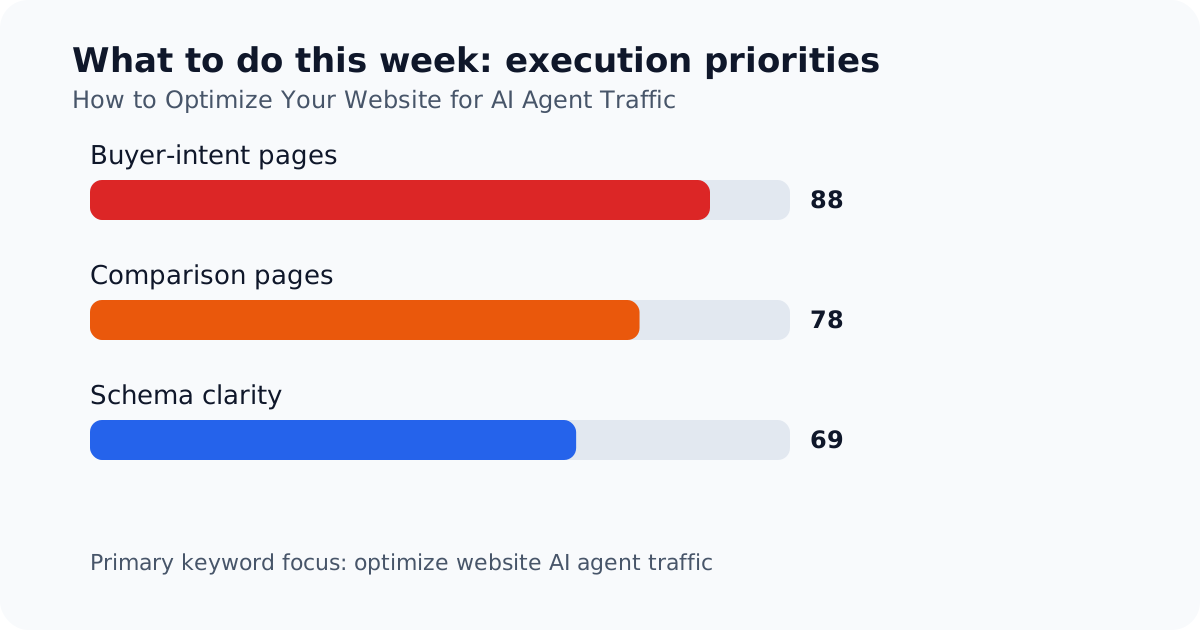 You do not need to implement everything in this guide at once. Here are three high-impact tasks you can complete in the next five business days:
Task 1: Run a readability audit on your top five pages. Use TryReadable's analyze tool to score your homepage, your top landing page, and your three most-visited blog posts. Note which pages score below grade 10 on the Flesch-Kincaid scale and flag them for revision. This takes 30 minutes and gives you a clear prioritized list.
Task 2: Add FAQ schema to your three most important pages. Identify the three questions your customers most commonly ask about your product or category. Add a clearly formatted FAQ section to your homepage or key landing page, and implement FAQ schema markup. This is a direct signal to AI agents that your page contains question-and-answer content. A developer can implement the schema in under an hour.
Task 3: Check your robots.txt for AI crawler blocks.
Open your robots.txt file (yourwebsite.com/robots.txt) and check whether GPTBot, ClaudeBot, or PerplexityBot are blocked. If they are, work with your developer to allow them. This is a five-minute fix that immediately opens your content to AI crawlers.
FAQ
What is AI agent traffic? AI agent traffic refers to visits and citations generated when AI tools like ChatGPT, Perplexity, Claude, or enterprise AI assistants discover, crawl, or cite your website content in their responses. Unlike traditional search traffic, AI agent traffic often results in brand mentions or recommendations rather than direct clicks.
How is optimizing for AI agents different from traditional SEO? Traditional SEO focuses on ranking in a list of search results. AI optimization focuses on being cited in a synthesized answer. The signals overlap , both reward quality, authority, and technical accessibility , but AI optimization places greater emphasis on content clarity, structured formatting, and topical depth.
Can I measure how often AI agents cite my website? Direct measurement is still limited, but you can use manual spot-checking (querying AI agents with your target questions), brand mention monitoring tools, and traffic analysis to track trends. TryReadable's AI visibility reports provide benchmarking data to help contextualize your performance.
Should I block AI crawlers to protect my content? This is a legitimate concern, but blocking AI crawlers means opting out of AI visibility entirely. Most businesses benefit more from being cited by AI agents than from restricting access. If you have specific content you want to protect, you can use more targeted blocking rules rather than blocking all AI crawlers.
How long does it take to see results from AI optimization? AI agents that use retrieval-augmented generation (like Perplexity) can reflect changes within days of recrawling your site. For LLMs that rely on training data, changes may take months to appear in outputs. Focus first on retrieval-augmented systems for faster feedback.
What reading level should my content target? For most B2B audiences, a Flesch-Kincaid grade level of 8–10 is appropriate. This is clear and professional without being condescending. Technical documentation may need to be higher, but marketing and educational content should aim for accessibility.
Do I need to create separate content for AI agents? No. The best approach is to create genuinely useful, well-structured content for human readers. AI agents are trained to recognize quality the same way humans do. Separate "AI-optimized" content that is not useful to humans is not a sustainable strategy.
How important is page speed for AI visibility? Page speed affects how frequently and completely AI crawlers index your content. Faster pages are crawled more thoroughly. Aim for an LCP under 2.5 seconds as a baseline.
Sources
- Perplexity AI Blog , Product Updates and Usage Statistics
- OpenAI Blog , ChatGPT Usage and Product Announcements
- Gartner , What Is Generative AI?
- Princeton / Georgia Tech Research on LLM Citation Behavior (arXiv)
- Google , Helpful Content System Documentation
- Google , E-E-A-T and Quality Rater Guidelines
- OpenAI , GPTBot Documentation
- Schema.org , FAQPage Structured Data
- Google PageSpeed Insights
- Hemingway Editor , Readability Tool
Ready to See How Your Website Scores?
AI agent traffic is not a future trend , it is happening now, and the brands that optimize early will have a significant advantage as the channel matures.
The fastest way to understand your current position is to run a readability and structure audit on your most important pages. TryReadable's analysis tool benchmarks your content against the signals AI agents use to evaluate and cite sources, and gives you a prioritized list of improvements.
If you want a deeper walkthrough of how TryReadable can help your team build a systematic AI visibility practice, book a demo with our team. We work with B2B founders and marketing teams to build content strategies that perform across both traditional search and AI agent channels.
Last updated: January 2025. This article is reviewed and updated quarterly to reflect changes in AI agent behavior and best practices.
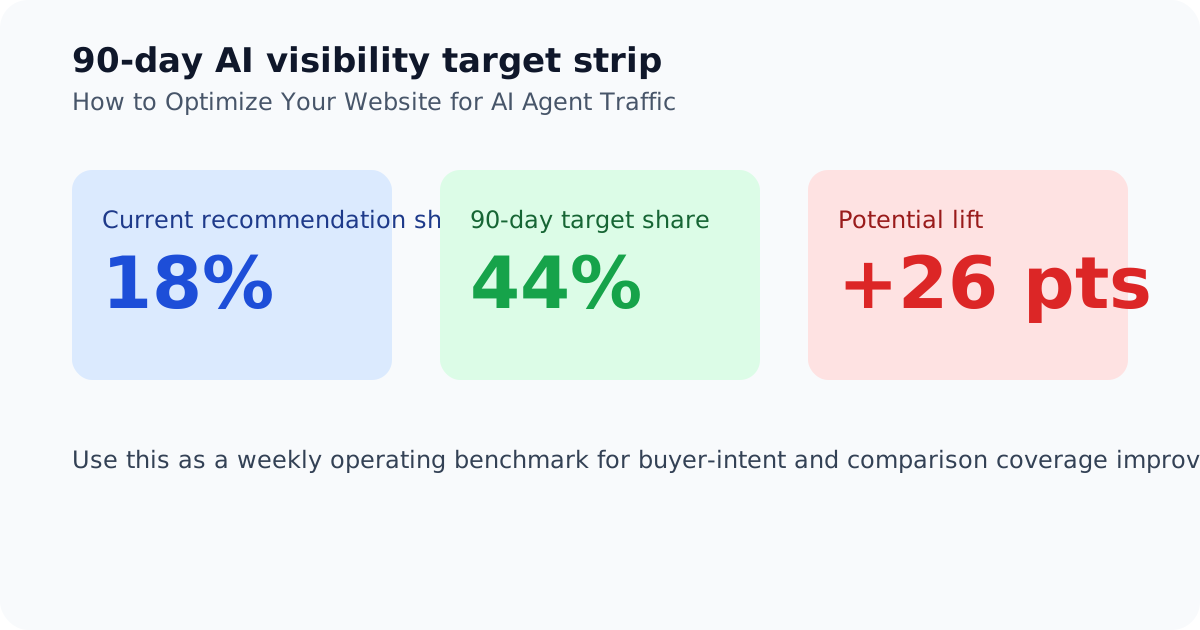
AI visibility trend snapshot
The chart below frames the opportunity cost of inaction over a 90-day operating window.
| Period | Indexed buyer queries covered | Estimated AI recommendation share |
|---|---|---|
| Current baseline | 3/9 | 18% |
| 30 days after fixes | 4/9 | 27% |
| 60 days after fixes | 5/9 | 35% |
| 90 days after fixes | 6/9 | 44% |
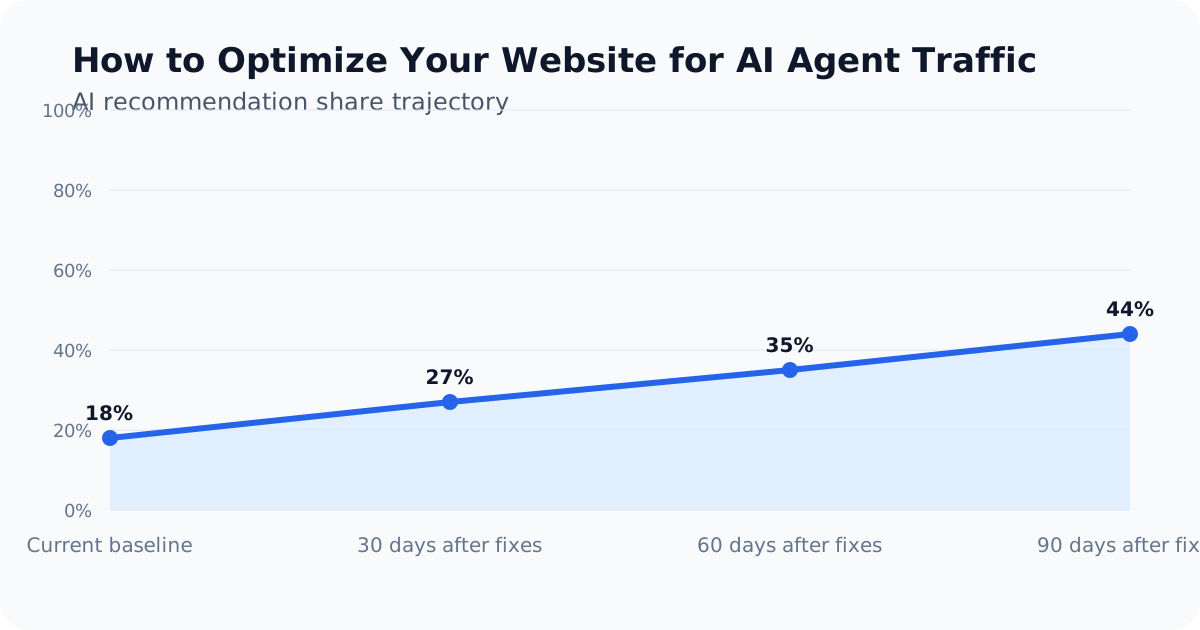
These values are an illustrative framework model to support planning and prioritization conversations.
Analyze My Website
Get a walkthrough of where your brand stands in AI answers and agent-driven discovery.
Ready to operationalize AI Influence and Domination?
Book a live walkthrough tailored to your growth and analytics team.