
Programmatic Guide
How to Create Agentic Pages That AI Systems Cite
What you'll learn
- What you'll learn
- Introduction
- What You Will Learn
- Table of Contents
---
title: How to Create Agentic Pages That AI Systems Cite description: >- A practical, step-by-step guide for founders and marketers who want their content to be discovered, understood, and cited by AI agents, LLMs, and answer engines. date: '2026-04-19' author: TryReadable Editorial Team slug: how-to-create-agentic-pages-that-ai-systems-cite image: "https://okb3ee0ypogvikpa.public.blob.vercel-storage.com/blog-images/manual/how-to-create-agentic-pages-that-ai-systems-cite/1776616054862-how-to-create-agentic-pages-that-ai-systesms-cite.png"
What you'll learn
- A practical framework to execute how to create agentic pages AI citations without waiting on large replatforming projects.
- How to prioritize high-impact fixes that improve AI discoverability first.
- Which signals AI assistants rely on when recommending vendors in buyer journeys.
- How to turn visibility insights into weekly execution tasks for marketing and growth teams.
- The metrics leadership should review to track progress and defend budget decisions.
- Common traps that create activity without improving recommendation outcomes.
How to Create Agentic Pages That AI Systems Cite
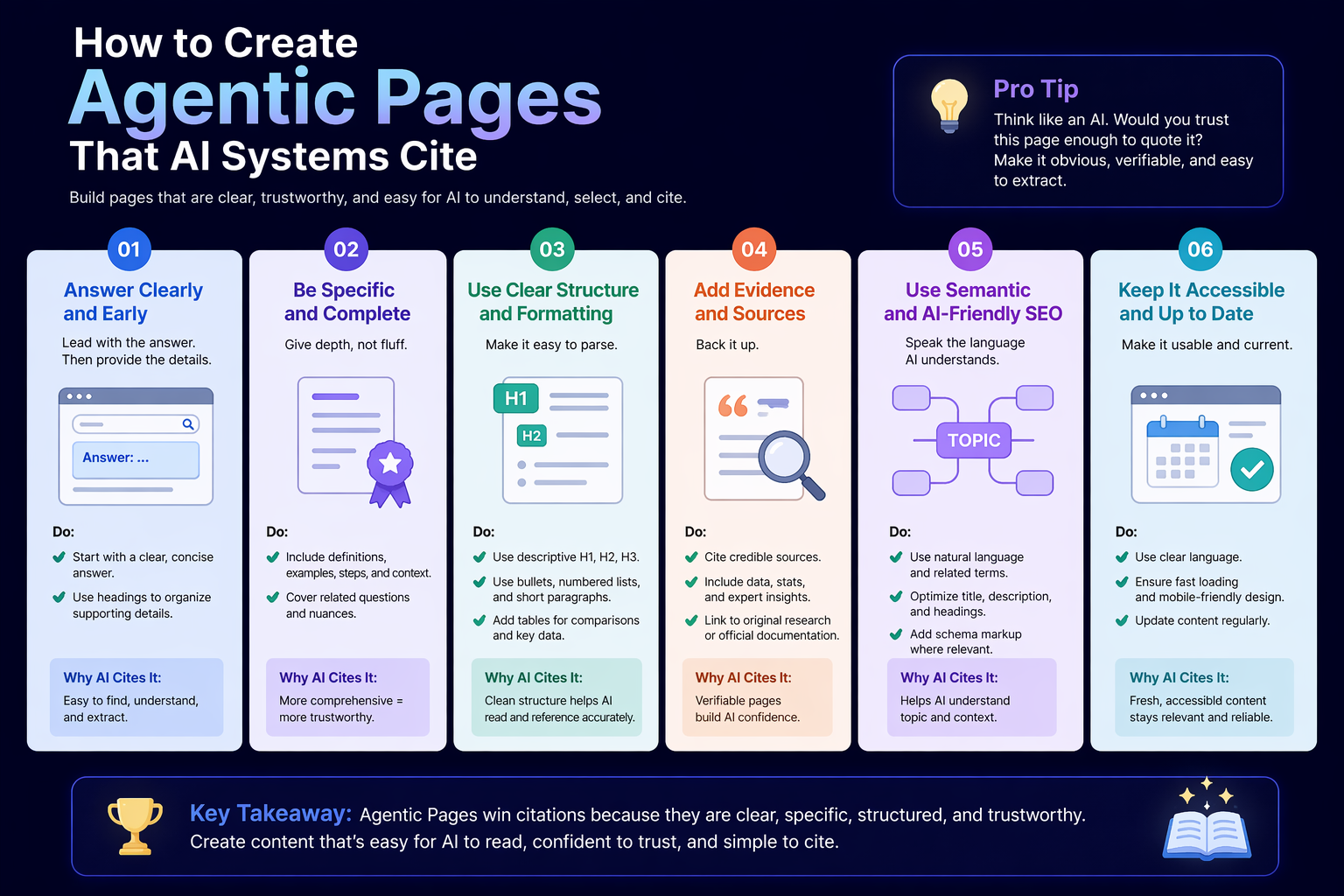
Introduction
Something has quietly shifted in how people find information online. A growing share of research journeys no longer end on a search results page. They end inside a chat window, a voice assistant, or an AI-powered workflow tool that synthesizes answers from dozens of sources and presents a single, confident response.
For founders and marketers, this creates a new and urgent question: when an AI agent assembles an answer about your category, your product, or your competitors, does your content make the cut?
The answer depends less on traditional SEO signals than most teams assume. Domain authority still matters, but it is no longer the primary filter. What AI systems actually reward is something older and more fundamental: clarity, structure, and the kind of authoritative specificity that lets a machine extract a clean, citable fact or explanation without ambiguity.
This article gives you a concrete framework for building what we call "agentic pages" -- content designed from the ground up to be understood, trusted, and cited by AI systems including large language models (LLMs), retrieval-augmented generation (RAG) pipelines, and AI-powered search engines like Perplexity, Google's AI Overviews, and Bing Copilot.
You do not need to abandon your existing content strategy. You need to layer a new set of structural and semantic decisions on top of it.
What You Will Learn
- Why AI citation patterns differ from traditional search ranking signals
- The anatomy of a page that AI systems prefer to cite
- A seven-step framework for building agentic pages from scratch or retrofitting existing ones
- The most common mistakes that cause good content to be ignored by AI agents
- Three concrete tasks you can complete this week to improve your AI visibility
- Answers to the questions founders and marketers ask most often about this topic
Table of Contents
- Why AI Citation Patterns Are Different
- What Makes a Page "Agentic"
- The Seven-Step Framework
- Common Mistakes
- What to Do This Week
- FAQ
- Sources
Why AI Citation Patterns Are Different
Traditional search engines rank pages. AI systems cite passages.
That distinction sounds subtle, but it changes almost everything about how you should write and structure content.
When Google ranks a page, it evaluates hundreds of signals at the domain and page level: backlinks, Core Web Vitals, E-E-A-T signals, keyword relevance, and more. The user then clicks through and reads the page themselves. The search engine is a pointer.
When an AI agent answers a question, it is doing something fundamentally different. It is reading your content on behalf of the user, extracting the most relevant passage or claim, and weaving it into a synthesized response. The AI is a reader and an editor simultaneously.
This means the unit of value has shifted from the page to the passage. A single well-constructed paragraph that directly answers a specific question is more valuable for AI citation purposes than a 3,000-word article that buries the answer in the middle of the fifth section.
Research from Perplexity's own documentation on how it selects sources confirms that the system prioritizes sources that provide direct, factual answers to the query. Similarly, Google's guidance on AI Overviews emphasizes that content needs to be helpful, accurate, and clearly structured to be considered for inclusion.
The implication is clear: you need to write for extraction, not just for reading.
What Makes a Page "Agentic"
An agentic page is one that is optimized for the full lifecycle of AI interaction: discovery, parsing, extraction, and citation.
Most content is optimized for only one of these stages. Blog posts are often written for human reading but are structurally opaque to automated parsing. Landing pages are optimized for conversion but contain almost no citable factual content. Technical documentation is precise but often lacks the contextual framing that helps AI systems understand where a claim fits in the broader knowledge landscape.
An agentic page does all four things well:
Discovery: The page is indexed, crawlable, and semantically connected to the topic cluster it belongs to. It signals relevance through title tags, meta descriptions, heading structure, and internal links.
Parsing: The page uses clean HTML structure, logical heading hierarchies, and short paragraphs that allow automated systems to segment content into discrete units of meaning.
Extraction: Individual sections contain self-contained claims that can be lifted and cited without losing meaning. Each claim is supported by evidence, attribution, or a logical explanation.
Citation: The page provides enough context for an AI system to attribute the claim correctly -- including the author, organization, date, and source type.
Anthropic's research on retrieval-augmented generation and OpenAI's documentation on how ChatGPT uses browsing both point toward the same underlying principle: AI systems favor content that is dense with verifiable, well-attributed information and light on filler.
You can check how well your current pages perform on these dimensions using TryReadable's content analyzer, which scores your content for readability, structure, and AI-visibility signals.
The Seven-Step Framework
Step 1: Define the Atomic Claim
Every agentic page should be built around a single, specific, defensible claim. Not a topic. Not a theme. A claim.
A topic is "content marketing." A claim is "B2B companies that publish at least two long-form articles per week generate 67% more leads than those that publish monthly, according to HubSpot's 2023 State of Marketing report."
The difference matters because AI systems are answering questions, not browsing topics. When a user asks "how often should a B2B company publish content," the AI is looking for a page that contains a direct, citable answer. A page organized around a topic gives the AI too much to sort through. A page organized around a claim gives it exactly what it needs.
Before you write a single word, complete this sentence: "After reading this page, an AI agent should be able to cite the fact that ___________."
If you cannot complete that sentence, you do not yet have a clear enough focus for the page.
This approach aligns with what Wil Reynolds and the Seer Interactive team have described as "answer-first architecture" -- a structural philosophy that prioritizes the direct answer over the narrative buildup.
Step 2: Structure for Extraction
Once you have your atomic claim, you need to build a page structure that makes it easy for AI systems to find and extract that claim, along with the supporting evidence.
The most reliable structure for agentic pages follows this pattern:
-
Lead with the answer. State your core claim in the first 100 words of the article. Do not make the reader or the AI agent wade through context before getting to the point.
-
Use descriptive H2 and H3 headings. Headings are one of the primary signals AI systems use to segment content. A heading like "Why This Matters" tells an AI nothing. A heading like "Why Readability Scores Predict AI Citation Rates" tells it exactly what the following section contains.
-
Write in short paragraphs. Paragraphs of three to five sentences are easier for automated systems to parse as discrete units of meaning. Long, dense paragraphs create ambiguity about where one idea ends and another begins.
-
Use numbered lists and bullet points for multi-part claims. When you are making a claim that has several components, a list is more extractable than a paragraph. AI systems can cite "the three reasons X happens" more cleanly from a list than from prose.
-
Include a summary or key takeaway section. Many AI systems specifically look for summary content near the top or bottom of a page. A "Key Takeaways" box or a "TL;DR" section dramatically increases the likelihood that your core claim will be extracted correctly.
Google's Search Central documentation on structured data provides additional technical guidance on how markup signals help automated systems understand content hierarchy.
Step 3: Write at the Right Reading Level
This is the step that most content teams skip, and it is one of the most consequential.
AI systems are not penalized for reading complex prose the way human readers are. But they are penalized for it in a different way: complex, jargon-heavy writing increases the likelihood that the AI will misinterpret a claim, extract it out of context, or skip it in favor of a clearer source.
The research on this is consistent. The Flesch-Kincaid readability framework, originally developed for military training manuals, has become a standard benchmark for content clarity. Pages that score between 50 and 70 on the Flesch Reading Ease scale -- roughly equivalent to a 7th to 9th grade reading level -- tend to perform better in AI citation contexts because they balance precision with accessibility.
This does not mean dumbing down your content. It means choosing the clearer word when two words mean the same thing, breaking complex sentences into two simpler ones, and defining technical terms when you introduce them rather than assuming shared context.
You can measure your current content's readability score instantly using TryReadable's free analyzer. The tool flags sentences that are too long, words that are unnecessarily complex, and structural patterns that reduce extractability.
For a deeper dive into readability best practices, see our content optimization guides.
Step 4: Add Verifiable Evidence
AI systems are trained to prefer content that is grounded in verifiable evidence. This is not just a quality signal -- it is a trust signal. When an AI agent cites a claim, it is implicitly vouching for that claim to the user. Systems are increasingly calibrated to avoid citing content that makes assertions without supporting evidence.
Verifiable evidence comes in several forms:
Statistics with attribution. "According to [source], X% of Y do Z" is highly citable. "Many companies struggle with X" is not.
Named studies or reports. Citing a specific study by name, institution, and year gives AI systems a chain of attribution they can follow. Vague references to "research" do not.
Expert quotes with full attribution. A quote from a named expert at a named organization, with a date, is far more citable than a paraphrase.
Case studies with specifics. "Company X increased conversion by 34% after implementing Y" is citable. "Many companies have seen results" is not.
Primary data. If you have conducted original research, surveys, or analysis, this is among the most citable content you can produce. AI systems actively seek out primary sources.
Moz's research on E-E-A-T signals and how they apply to AI-era content provides a useful framework for thinking about evidence standards. The core principle is the same whether you are optimizing for human trust or machine trust: show your work.
Step 5: Use Semantic Markup
Semantic markup is the technical layer that helps AI systems understand not just what your content says, but what type of content it is and how it relates to other content.
The most important markup types for agentic pages are:
Schema.org structured data. Adding JSON-LD markup to your pages tells AI systems and search engines the type of content (Article, FAQPage, HowTo, etc.), the author, the publication date, and the organization. This dramatically improves the accuracy of AI attribution.
FAQPage schema. If your page includes a FAQ section (and it should), marking it up with FAQPage schema makes each question-answer pair directly extractable as a discrete unit. This is one of the highest-leverage technical changes you can make.
HowTo schema. For step-by-step content like this article, HowTo schema signals to AI systems that the content is procedural and that the steps are sequential. This improves the accuracy of extraction for instructional content.
Article schema with dateModified. Freshness is a significant signal for AI citation. Including a dateModified field in your Article schema tells AI systems when the content was last updated, which affects whether it is considered current enough to cite.
Google's structured data documentation provides implementation examples for all of these schema types. If you are on a modern CMS like Next.js or Contentful, adding JSON-LD is typically a one-time template change that applies across all your content.
Step 6: Build Topical Authority Through Internal Linking
AI systems do not evaluate pages in isolation. They evaluate them in the context of the broader site and content ecosystem they belong to. A single well-written page on a topic you have never covered before is less likely to be cited than a page that sits within a dense cluster of related, interlinked content.
This is the principle of topical authority, and it applies to AI citation just as it applies to traditional SEO.
Building topical authority for AI citation purposes requires:
A clear content cluster structure. Each major topic you want to be cited on should have a pillar page (comprehensive overview) and a set of cluster pages (specific subtopics). The pillar page links to all cluster pages, and each cluster page links back to the pillar.
Consistent terminology. AI systems build semantic maps of your content. If you use different terms for the same concept across different pages, you fragment your topical signal. Choose your terminology deliberately and use it consistently.
Internal links with descriptive anchor text. "Click here" tells an AI nothing. "See our guide to AI content optimization" tells it exactly what the linked page covers and how it relates to the current page.
For example, if you are reading this article and want to understand how your current content performs against these criteria, our AI visibility reports show how content in your category is being cited across major AI platforms.
Cross-linking between related claims. When you make a claim on one page that is supported or extended by content on another page, link between them. This creates a web of evidence that AI systems can follow and that strengthens the credibility of each individual claim.
Step 7: Maintain Freshness Signals
AI systems are increasingly sensitive to content freshness, particularly for topics where information changes rapidly. A page that was accurate in 2022 may be actively misleading in 2025, and AI systems are trained to deprioritize content that may be outdated.
Freshness signals include:
The datePublished and dateModified fields in your schema markup. These are the most direct signals of freshness.
In-text date references. Phrases like "as of Q1 2025" or "in the most recent edition of [report]" signal to AI systems that the content has been reviewed recently.
Regular content audits. Set a calendar reminder to review your most important agentic pages every six months. Update statistics, replace outdated references, and add new evidence as it becomes available.
Version history or changelog sections. For technical content, a brief "Last updated" note with a summary of what changed is both a trust signal for human readers and a freshness signal for AI systems.
Search Engine Journal's analysis of freshness as a ranking factor provides useful context on how freshness signals have evolved and why they matter increasingly in the AI era.
Common Mistakes
Even teams that understand the principles of agentic page design make predictable mistakes. Here are the ones we see most often.
Writing for the scroll, not the extract. Many content teams are trained to write for engagement metrics: time on page, scroll depth, social shares. These metrics reward narrative tension, cliffhangers, and delayed payoffs. AI citation rewards the opposite: immediate clarity, front-loaded answers, and dense information. If your content is structured to keep readers reading, it may be poorly structured for AI extraction.
Burying the claim in qualifications. Academic writing often buries the main claim under layers of context and qualification. This is appropriate for peer-reviewed research but counterproductive for agentic pages. State your claim clearly, then provide the qualifications and nuance. Not the other way around.
Using vague, unattributed statistics. "Studies show that 80% of buyers..." is worse than useless for AI citation purposes. It signals low credibility and gives the AI no chain of attribution to follow. Either cite the specific study or remove the statistic.
Ignoring technical crawlability. A beautifully written, perfectly structured page that is blocked by a robots.txt rule or hidden behind a login wall will never be cited. Audit your crawlability regularly. Use Google Search Console to verify that your most important pages are indexed and accessible.
Treating AI optimization as a one-time project. The landscape of AI citation is changing rapidly. What works today may be less effective in six months. Teams that build ongoing processes for monitoring their AI visibility and updating their content accordingly will consistently outperform teams that treat this as a one-time optimization.
Neglecting the FAQ section. FAQ sections are among the highest-value components of an agentic page because they directly mirror the question-answer format that AI systems use. A page without a FAQ section is missing one of the most reliable mechanisms for AI citation.
Over-optimizing for keywords at the expense of clarity. Keyword stuffing has always been a bad practice, but it is particularly damaging for AI citation. AI systems are sophisticated enough to recognize when content is written for keyword density rather than genuine helpfulness, and they deprioritize it accordingly.
If you want a diagnostic view of how your existing pages score on these dimensions, book a demo with our team and we will walk through your content together.
What to Do This Week
You do not need to rebuild your entire content library to start improving your AI citation rate. Here are three high-leverage tasks you can complete in the next five business days.
Task 1: Audit your three most important pages for atomic claim clarity. Pick the three pages that are most important to your business -- your homepage, your primary product page, and your highest-traffic blog post. For each one, ask: what is the single most important claim this page makes? Is that claim stated clearly in the first 100 words? Is it supported by verifiable evidence with attribution? If not, rewrite the opening section to lead with the claim and add at least one cited statistic or study.
Task 2: Add FAQPage schema to your top content. If you do not already have FAQ sections on your key pages, add them. Write five to eight questions that your target audience actually asks about your topic, and answer each one in two to four sentences. Then add FAQPage schema markup to make each question-answer pair directly extractable. This is a high-leverage change that can improve AI citation rates within weeks of implementation.
Task 3: Run a readability audit on your pillar content. Use TryReadable's analyzer to score your most important pages for readability. Focus on pages that score below 50 on the Flesch Reading Ease scale. For each flagged page, identify the three to five most complex sentences and rewrite them for clarity. This single change often produces measurable improvements in AI citation rates within one to two content refresh cycles.
FAQ
What is an agentic page? An agentic page is a piece of web content that is specifically designed to be discovered, parsed, extracted, and cited by AI systems including large language models, retrieval-augmented generation pipelines, and AI-powered search engines. It differs from a standard SEO-optimized page in that it prioritizes passage-level extractability over page-level ranking signals.
How is AI citation different from traditional SEO ranking? Traditional SEO ranking evaluates pages as a whole and determines their position in a list of results. AI citation evaluates individual passages within pages and determines whether they are accurate, clear, and well-attributed enough to be included in a synthesized answer. The unit of value has shifted from the page to the passage.
Does domain authority still matter for AI citation? Yes, but it is less dominant than in traditional SEO. AI systems use domain authority as one signal among many, but a highly authoritative domain with poorly structured, vague content will often be outperformed by a lower-authority domain with clear, well-evidenced, well-structured content.
How long should an agentic page be? Length should be determined by the complexity of the claim you are making, not by a target word count. A simple factual claim may be best served by a 500-word page. A complex procedural topic like this one may require 3,000 words or more. The key is that every word should be earning its place by adding evidence, context, or clarity to the core claim.
How quickly can I expect to see results after optimizing for AI citation? This varies significantly depending on the AI system, your domain's existing authority, and the competitiveness of your topic. Some teams see measurable improvements in AI visibility within four to six weeks of implementing structural changes. Others see results over a longer horizon of three to six months. Consistent, ongoing optimization produces better results than one-time changes.
Should I create separate pages specifically for AI citation, or optimize my existing pages? Both approaches have merit. For most teams, the highest-leverage starting point is optimizing existing high-traffic pages, since they already have some authority and indexing history. Creating new pages specifically designed as agentic pages is a valuable complement to this, particularly for topics where you do not yet have strong existing content.
What role does readability play in AI citation? Readability is a significant factor. AI systems favor content that is clear and unambiguous because it reduces the risk of misinterpretation during extraction. Content written at a 7th to 9th grade reading level (Flesch Reading Ease score of 50 to 70) tends to perform well in AI citation contexts while remaining credible and substantive for human readers.
How do I track whether my content is being cited by AI systems? This is an evolving area. Some AI platforms like Perplexity provide source attribution that you can monitor manually. Google Search Console is beginning to surface some AI Overview data. Third-party tools including TryReadable's AI visibility reports track citation patterns across major AI platforms. Building a regular monitoring cadence is important because the landscape changes quickly.
Sources
-
Perplexity AI: How Perplexity Works -- Official documentation on source selection methodology.
-
Google Search Central: AI Overviews -- Google's guidance on content eligibility for AI Overviews.
-
Anthropic Research -- Published research on retrieval-augmented generation and language model behavior.
-
OpenAI Help Center: How ChatGPT Browses the Web -- Documentation on ChatGPT's web browsing and source selection.
-
Seer Interactive: AI SEO -- Analysis of answer-first architecture and AI search optimization.
-
Readable.com: Flesch Reading Ease and Flesch-Kincaid Grade Level -- Explanation of readability scoring frameworks.
-
Google Search Central: Structured Data Introduction -- Technical documentation on structured data markup.
-
Moz: Google E-E-A-T -- Analysis of Experience, Expertise, Authoritativeness, and Trustworthiness signals.
-
Google Search Central: Article Structured Data -- Implementation guide for Article schema markup.
-
Search Engine Journal: Google Freshness Algorithm -- Analysis of freshness as a ranking and citation signal.
-
Google Search Console -- Tool for monitoring indexing status and search performance.
Start Building Pages That AI Systems Actually Cite
The shift toward AI-mediated information discovery is not a future trend. It is happening now, and the gap between teams that understand how to create agentic pages and teams that do not is widening every month.
The good news is that the principles are not complicated. Write clear, specific, well-evidenced content. Structure it for extraction. Mark it up semantically. Build topical authority through consistent internal linking. Maintain freshness. Repeat.
The teams that will win in the AI citation era are not necessarily the ones with the biggest content budgets or the highest domain authority. They are the ones that understand the new unit of value -- the passage, not the page -- and build their content strategy around it.
If you want to see exactly where your current content stands, run a free analysis on TryReadable. You will get a readability score, a structural assessment, and specific recommendations for improving your AI visibility within minutes.
If you want a more comprehensive review of your content strategy and how it maps to AI citation opportunities in your category, book a demo with our team. We work with founders and marketing teams to build content systems that perform in both traditional search and AI-mediated discovery.
The window to build a durable advantage in AI citation is open right now. The teams that move first will be the ones that AI systems learn to trust and return to consistently.
Analyze My Website
Get a walkthrough of where your brand stands in AI answers and agent-driven discovery.
Ready to operationalize AI Influence and Domination?
Book a live walkthrough tailored to your growth and analytics team.